
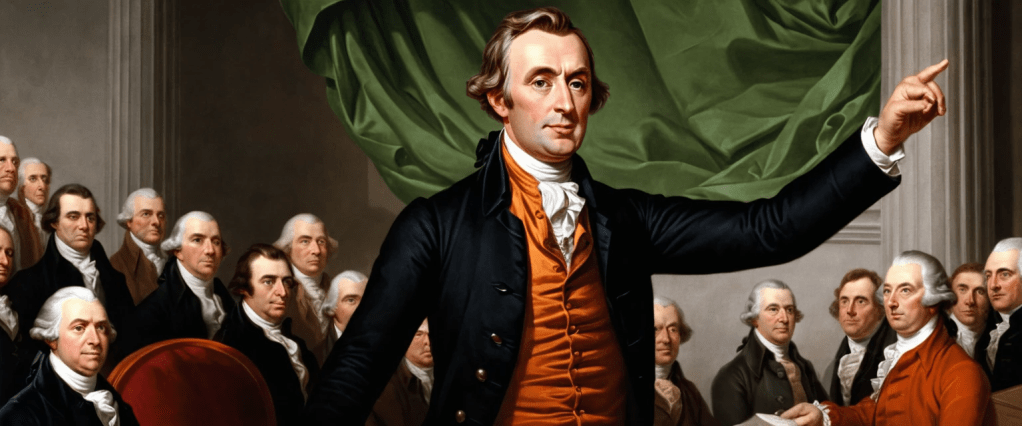
March 23, 1775
Give me liberty, or give me death!
On March 23, 1775, Patrick Henry, an American attorney, orator, and politician, delivered one of the most powerful speeches in American history at the Second Virginia Convention in Richmond. In his passionate address advocating for armed resistance against British rule, he famously declared:
“Give me liberty, or give me death!”
This iconic phrase not only became a defining slogan of the American Revolution but also left a lasting imprint on the English language, influencing political rhetoric, literature, and cultural discourse.
The Speech’s Impact on Political and Revolutionary Language
Patrick Henry’s speech was a masterpiece of rhetoric, employing persuasive techniques that have since become staples of political and activist language.
- The Language of Resistance and Liberty – Henry’s declaration introduced and reinforced key terms in the English lexicon, such as:
- Liberty – A word deeply embedded in English political discourse, symbolizing freedom, independence, and self-determination.
- Tyranny – A term widely used in political rhetoric to describe oppressive government or absolute rule.
- Patriotism – While the concept of patriotism predates Henry, his speech helped solidify its association with the fight for freedom and national identity.
- The Power of Antithesis – The contrast between “liberty” and “death” in his famous line exemplifies antithesis, a rhetorical device that became a hallmark of English political and activist speeches.
- Influence on Future Political Discourse – Henry’s fiery speech set a precedent for powerful, emotionally charged rhetoric, influencing later American leaders such as Abraham Lincoln, Franklin D. Roosevelt, John F. Kennedy, and Martin Luther King Jr.
Influence on Literature and Popular Culture
Patrick Henry’s words transcended the realm of politics and became immortalized in literature, poetry, and public discourse.
- Echoes in Revolutionary and War Literature – His speech influenced writers and poets who depicted themes of resistance, freedom, and sacrifice, including Thomas Paine (Common Sense), Nathaniel Hawthorne, and Walt Whitman.
- Inspiration for Future Protest Movements – Variations of “Give me liberty, or give me death!” have been adapted into slogans for civil rights, labor movements, and anti-colonial struggles worldwide.
- Appearances in Film, Music, and Media – Henry’s words have been referenced in movies, political dramas, and historical documentaries, reinforcing their status as a defining moment in English rhetoric.
The Speech’s Contribution to the Evolution of American English
The American Revolution played a significant role in shaping American English, and Henry’s speech contributed to the emerging distinctiveness of American political vocabulary.
- Revolutionary Phrases and Idioms – Expressions rooted in the fight for independence entered common speech, such as:
- “No taxation without representation” – Another phrase from the revolutionary period, reinforcing the themes of freedom and self-governance.
- “Live free or die” – A phrase that echoes Henry’s speech and later became the official motto of New Hampshire.
- American Identity and Language – Henry’s rhetoric helped establish a linguistic style in American political discourse that emphasized boldness, directness, and emotional appeal, setting it apart from British parliamentary tradition.
The Speech’s Global Influence on Revolutionary Rhetoric
Henry’s words did not just shape American English but also resonated in global struggles for independence. His speech became a template for defiance against oppression, influencing:
- The French Revolution (1789–1799) – Revolutionary leaders such as Maximilien Robespierre and Georges Danton used similar passionate rhetoric to rally support.
- Latin American Independence Movements – Figures like Simón Bolívar and José de San Martín employed similar language of resistance in their fight against Spanish rule.
- 20th-Century Civil Rights and Anti-Colonial Movements – Leaders such as Mahatma Gandhi, Nelson Mandela, and Malcolm X adopted rhetorical strategies that echoed Henry’s urgent call for freedom at any cost.
A Speech That Transformed Language and History
Patrick Henry’s speech on March 23, 1775, was more than a call to arms—it was a linguistic milestone that shaped political, literary, and cultural discourse. His famous phrase, “Give me liberty, or give me death!”, became:
A defining slogan of the American Revolution
A rhetorical model for political and activist speeches
A lasting contribution to the English language and global discourse on freedom
Through its eloquence, urgency, and moral conviction, Henry’s speech immortalized the language of liberty, ensuring that his words continue to inspire writers, orators, and freedom movements across the world.
One line. Endless revolutions. Patrick Henry’s words still set hearts ablaze!
Originally published on March 23, 2025, on The-English-Nook.com.
Visit my page to find out ‘What Happened on this Day?‘ and learn ‘The Word of the Day‘—you’ll find it here first and all in one place!
If you’re a language enthusiast, you’ll have access to a variety of resources, including short stories in English and Spanish, interesting readings, vocabulary, and much more—not just for English, but also for Spanish. Come check it out!
 What Happened on This Day?
Leave a comment