

April 10, 1778
A Life in Letters
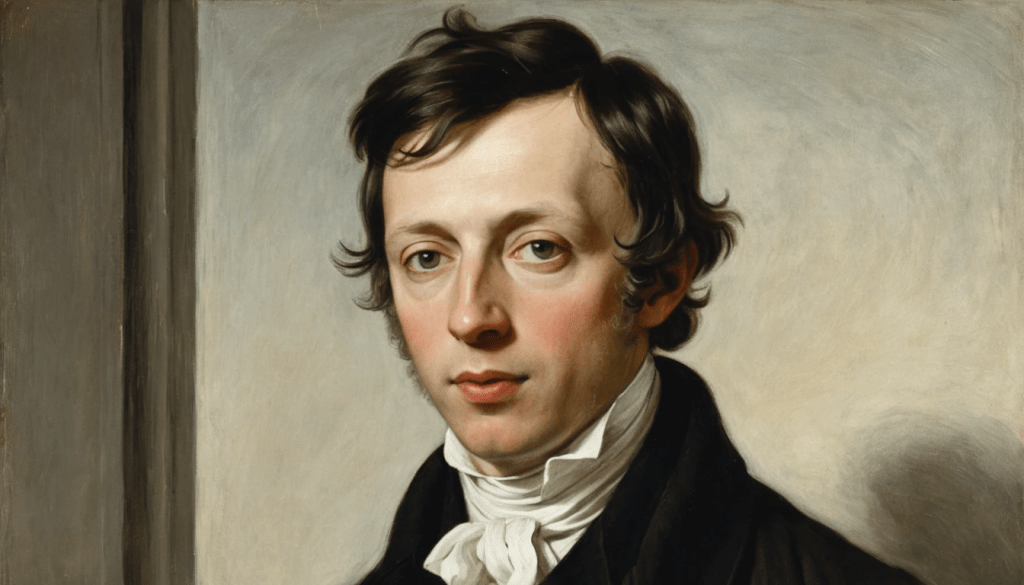
On April 10, 1778, William Hazlitt was born in Maidstone, Kent, England. The son of a Unitarian minister, Hazlitt grew up in an intellectually stimulating environment that fostered his early interest in philosophy, politics, and art. Over the course of his life, he would become one of the most brilliant essayists and critics of the English Romantic period, distinguished by a sharp intellect, an eloquent prose style, and a fiercely independent spirit.
Hazlitt’s essays bridged the personal and the political, the literary and the philosophical. His writing spanned diverse topics, from art and theatre to ethics and the nature of genius. Though often contentious in his lifetime, Hazlitt is now regarded as a towering figure of English letters—one whose work helped define the modern essay and shape critical vocabulary.
Champion of the Romantic Mind
Hazlitt stood alongside major Romantic thinkers and artists, offering both insight and critique. He was a close friend and interlocutor of figures such as Samuel Taylor Coleridge, William Wordsworth, Charles Lamb, and William Blake, and engaged with their ideas through his own distinct lens—skeptical, passionate, and often political.
- Essays that Endure – His essays, such as “On the Pleasure of Hating,” “On Gusto,” and “The Indian Jugglers,” explored human emotion, aesthetics, and the contradictions of society with unmatched nuance.
- Literary Criticism and Commentary – His Lectures on the English Poets (1818) and Characters of Shakespeare’s Plays (1817) were early attempts to systematize literary criticism in accessible, vivid language. Hazlitt’s approach combined intellectual rigor with emotional depth, helping shape the language we use today when analyzing literature.
Shaping the English Essay Form
Hazlitt’s work helped standardize the familiar essay, a style of writing that blends personal reflection with broader cultural or philosophical themes.
- First-person intimacy – Hazlitt’s use of personal anecdotes and introspection gave his prose a directness and authenticity that influenced generations of English essayists, from George Orwell to Joan Didion.
- Conversational cadence – His informal yet refined style exemplified how written English could be both intellectually serious and conversational in tone. This balance became a hallmark of English essay writing.
Contributions to Literary Vocabulary and Critique
Hazlitt’s writings introduced and reinforced terms that are now common in English literary discourse:
- “Gusto” – Used by Hazlitt to describe vividness and energy in artistic expression, the term gained traction in critical circles as a way to assess the visceral impact of an artwork or performance.
- “Character” as literary construct – Hazlitt’s deep readings of Shakespeare’s characters helped define how we understand psychological realism and character development in literature.
- “Genius” and “imagination” – Hazlitt helped frame these Romantic-era ideals not as divine gifts but as human faculties—powerful, flawed, and essential to art and thought.
- “Hate” as a philosophical category – In “On the Pleasure of Hating,” Hazlitt explored the paradoxes of resentment, envy, and opposition, treating them as serious psychological and moral phenomena. This essay expanded the English lexicon for discussing complex emotional states.
Hazlitt’s Legacy in English Literature
Though his reputation waned in the Victorian era, Hazlitt was rediscovered by 20th-century writers and scholars who saw in his work a precursor to modern literary criticism and personal essay writing.
- Influence on Modern Essayists – Writers such as Virginia Woolf, George Orwell, and Christopher Hitchens admired Hazlitt’s style and argumentative clarity. His essays became models for how personal voice and critical insight could be fused.
- Education and Anthologies – Hazlitt’s work is frequently included in university syllabi and essay anthologies, where it continues to introduce students to the form and function of the English essay.
A Lasting Voice in the Language of Literature
William Hazlitt’s birth on April 10, 1778, marked the arrival of one of English literature’s most incisive voices. His contributions extended far beyond his lifetime, not only enriching the essay form but shaping the vocabulary of literary and cultural criticism.
From the introduction of nuanced emotional terms to the development of a more personal, reflective prose style, Hazlitt helped evolve how the English language grapples with beauty, truth, and the human experience. His legacy lives on in every essay that seeks both clarity and complexity, personal voice and public thought.
He didn’t just write essays—he rewrote the rules of thought.
Originally published on April 10, 2025, on The-English-Nook.com.
Visit my page to find out ‘What Happened on this Day?‘ and learn ‘The Word of the Day‘—you’ll find it here first and all in one place!
If you’re a language enthusiast, you’ll have access to a variety of resources, including short stories in English and Spanish, interesting readings, vocabulary, and much more—not just for English, but also for Spanish. Come check it out!


 What Happened on This Day?
Leave a reply to juliansummerhayes Cancel reply