
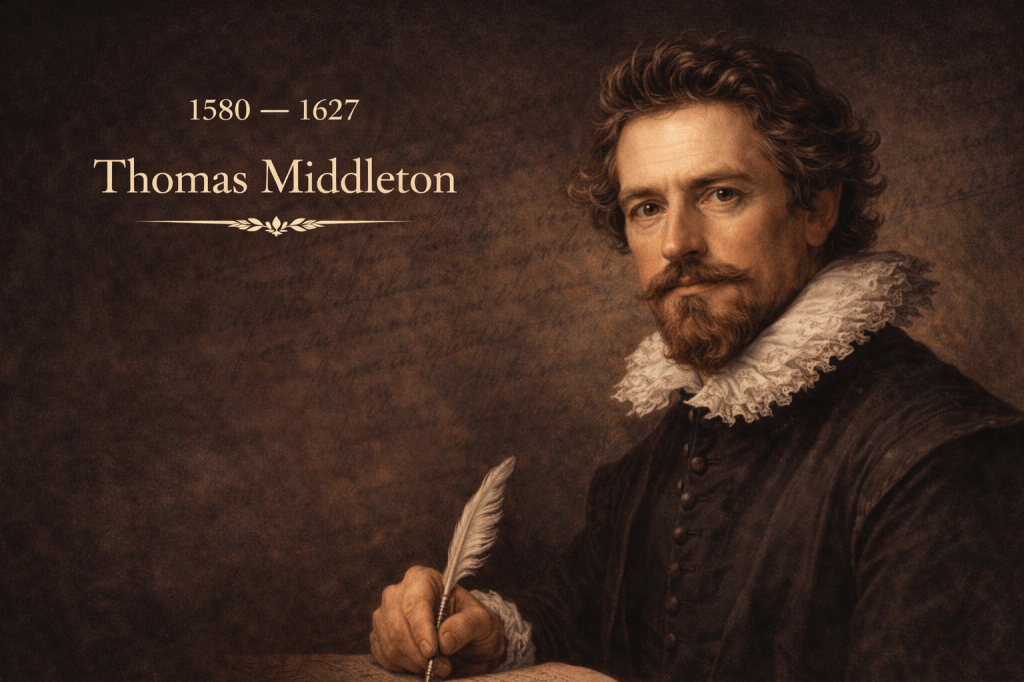
April 18, 1580
A Voice Enters the Stage
On April 18, 1580, Thomas Middleton was baptized in London, into a society undergoing profound transformation. The Elizabethan Golden Age was nearing its end, and a darker chapter in English culture—the Jacobean era—was about to begin.
In this transitional moment, a new voice quietly entered the world.
Not yet a playwright. Not yet a critic of society. But one who would come to reshape how English sounded on stage.
1. A Language Between Eras
Middleton’s life unfolded at a turning point in English drama.
The elaborate verse and elevated tone of early Renaissance theatre were beginning to give way to something sharper, more grounded, and more unsettling. Audiences were no longer satisfied with distant grandeur—they wanted to see themselves reflected in the language they heard.
Middleton answered that shift.
His writing moved away from purely stylized expression and toward something more immediate. Dialogue became more natural, more flexible, and closer to everyday speech.
English on stage began to feel less like performance—and more like life.
2. The Rise of a More Natural Voice
One of Middleton’s most important contributions was his use of idiomatic English.
Characters did not speak in idealized rhythms alone. They argued, manipulated, joked, and deceived using language that reflected real interaction. Slang, double meanings, and conversational structures entered the stage more freely.
This shift mattered.
It expanded what English could do in drama: not just elevate emotion, but reveal intention; not just present ideas, but expose character.
The result was a more flexible, expressive dramatic language—one capable of capturing both subtlety and tension.
3. Satire, Irony, and the Language of Critique
Middleton did not use language neutrally.
He used it to dissect society.
Through satire and irony, his works exposed hypocrisy, ambition, corruption, and moral contradiction. Words carried double meanings. Dialogue often revealed more than it appeared to say.
This introduced a sharper rhetorical edge into English drama.
Language became a tool of critique—capable of questioning authority, social norms, and human behavior without stating it directly.
In Middleton’s hands, English did not just describe the world.
It challenged it.
4. Expanding the Language of Character
Middleton’s characters were rarely simple.
His women, in particular, moved beyond fixed roles. They were not only virtuous or corrupt—they were conflicted, strategic, and aware of their circumstances. This required a different kind of language.
English adapted.
It became more capable of expressing inner conflict, moral ambiguity, and psychological tension. Dialogue began to carry layers—what was said, what was implied, and what was hidden.
This deepened the expressive range of English drama and influenced how characters would be written for generations.
5. Collaboration and Influence
Middleton was part of a collaborative theatrical world.
He worked alongside figures such as William Rowley, John Webster, and possibly even contributed to works associated with William Shakespeare. This exchange of ideas helped shape shared conventions in structure, tone, and language.
Through collaboration, elements of English drama became more standardized: narrative pacing, dialogue rhythm, and recurring themes such as revenge, disguise, and madness.
Language evolved collectively—not in isolation, but through constant interaction between writers.
6. A Lasting Shift in English Drama
Middleton’s influence did not always remain at the forefront of literary history.
Yet the changes he helped drive endured.
English drama became more flexible, realistic, psychologically aware, and socially critical. His work contributed to a broader transformation in how language functioned on stage—moving it closer to human experience, and further from purely stylized expression.
This is how language evolves—not through rules alone, but through use, pressure, and reinvention.
Key Shifts
- Stage dialogue became more natural and idiomatic
- English expanded to reflect real speech and interaction
- Satire and irony sharpened the language of critique
- Characters gained psychological and emotional depth
- Collaboration helped standardize dramatic conventions
- English drama moved toward realism and expressive flexibility
Why It Matters
The story of Thomas Middleton is not only about one playwright.
It is about a moment when English changed how it spoke on stage.
Language adapted to reflect people more truthfully—how they think, argue, deceive, and reveal themselves. That shift continues to shape drama, storytelling, and even modern dialogue today.
A baptism marked the beginning of a life.
But the language that followed reshaped how stories are told.
Middleton gave English drama its sharpest tongue and darkest mirror.

Also on this day!
If this moment still speaks, there is more to uncover.
 What Happened on This Day?
Leave a comment