
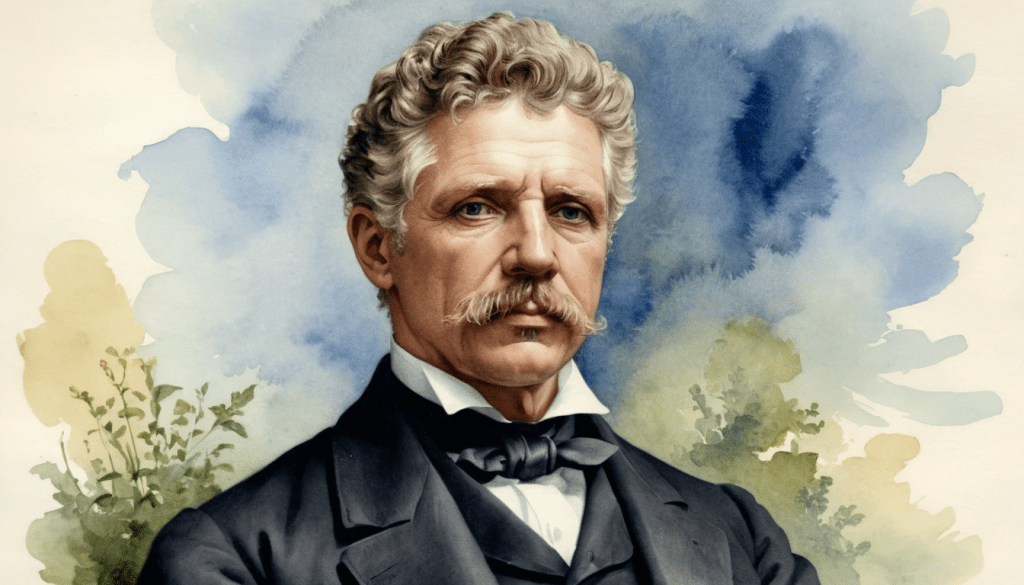
June 24, 1842
Birth of Ambrose Bierce (1842–1913?)
On June 24, 1842, Ambrose Bierce was born in Meigs County, Ohio—a man destined to become one of the sharpest and most enduring satirists in American literature. Though he would vanish mysteriously around 1913 during a trip to Mexico, Bierce’s literary legacy—especially his acerbic The Devil’s Dictionary—remains alive in the rhythms and tone of modern English.
Bierce did not just write in English; he carved it into a scalpel. With brutal clarity and wit, he helped shape a cynical, incisive American voice that still echoes in journalism, political critique, and literary satire.
The Devil’s Dictionary and the Birth of Cynical English
Bierce’s most famous work, The Devil’s Dictionary, began as a series of satirical definitions published in American newspapers. In its final form, it offered a subversive reimagining of English vocabulary, turning everyday words into barbed commentary on human nature and society. Examples include:
- “Politics, n. A strife of interests masquerading as a contest of principles.”
- “Love, n. A temporary insanity curable by marriage.”
- “Corporation, n. An ingenious device for obtaining individual profit without individual responsibility.”
This use of dictionary form as literary weapon was groundbreaking. It elevated the lexical structure of English into a platform for satire, turning definitions into tiny philosophical grenades.
Language of Precision and Irony
Beyond his satire, Bierce was a fierce defender of linguistic clarity and correctness. His essays on writing, grammar, and usage anticipated later stylists like Orwell and Strunk & White. He railed against bloated language, redundancy, and euphemism—insisting that good English was not only clear but unsparing.
- His style combined brevity, formality, and acerbic irony—a tone that would influence later journalists, essayists, and fiction writers.
- His prose suggested that moral seriousness and sarcastic wit could co-exist in the same sentence, and that English could be both a tool of expression and a mode of interrogation.
Influence on American English and Satirical Voice
Bierce’s legacy is not confined to literary circles. His linguistic influence permeates:
- Editorial voice – Satirical columnists from H.L. Mencken to contemporary opinion writers owe much to Bierce’s voice: dry, sharp, and unyielding.
- Political and media rhetoric – The caustic, ironic tone often used in critiques of institutions and ideologies echoes Bierce’s disdain for hypocrisy and cant.
- Modern idiom – While not all his definitions entered the lexicon, many of his cynical turns of phrase (and the style itself) became models for darkly humorous English.
The Fiction of Irony and the Irony of Fiction
In addition to satire, Bierce wrote chilling and innovative fiction. His short story An Occurrence at Owl Creek Bridge is still one of the most anthologized in American literature—a masterclass in psychological realism, temporal manipulation, and narrative shock. His Civil War stories, often based on his own battlefield experience, brought a new emotional vocabulary of trauma, disillusionment, and death into English prose.
A Vanishing Act and a Lingering Voice
Ambrose Bierce disappeared around 1913, likely killed during the Mexican Revolution. But his disappearance only added mystique to a legacy already brimming with darkness and wit. In many ways, his voice has only grown louder—heard in every ironic tweet, every skeptical essay, and every sharply worded editorial.
A Voice of Ironic English Is Born
Bierce’s contribution to English wasn’t just in what he wrote—it was in how he taught writers to think about words: with suspicion, discipline, and a ruthless sense of humor.
Ambrose Bierce didn’t just write English satire—he retooled the language to ask harder questions.
He turned the English dictionary into a mirror, one where civilization saw itself smirking back.
 What Happened on This Day?
Leave a comment