
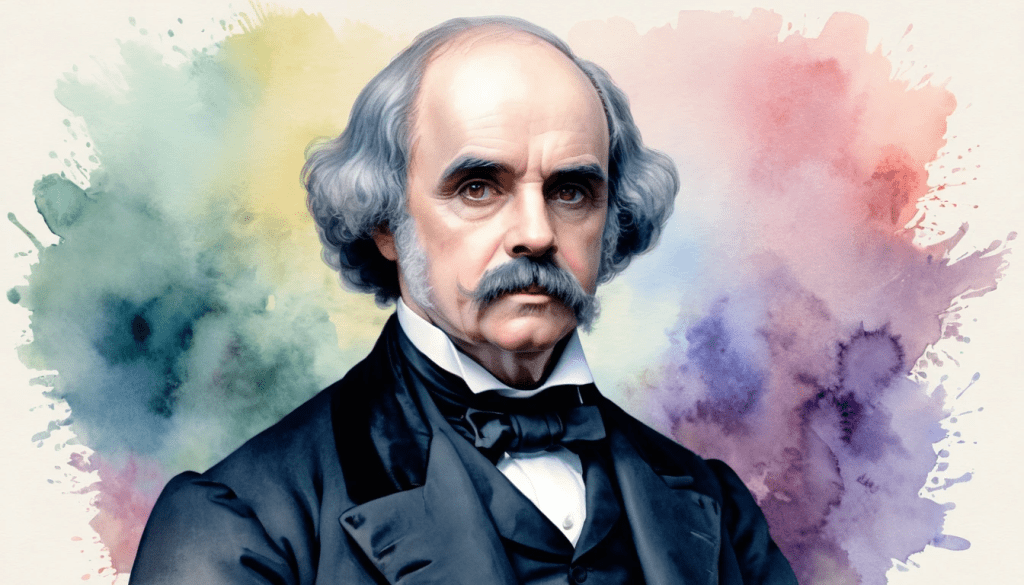
July 4, 1804
Birth of Nathaniel Hawthorne
On July 4, 1804, the same date as the young American republic’s founding anniversary, Nathaniel Hawthorne was born in Salem, Massachusetts—a coincidence that ties his literary legacy deeply to the moral and national consciousness of the United States. As the author of enduring English-language works like The Scarlet Letter and The House of the Seven Gables, Hawthorne shaped how American English articulates sin, guilt, shame, and identity, giving literary form to the Puritan legacy at the heart of American culture.
Language of Shame, Morality, and Isolation
Hawthorne’s prose introduced or reinforced English-language expressions and motifs that remain central in both literary and everyday contexts:
- “Scarlet letter” – now a common idiom in English, symbolizing public shame or stigma, originally drawn from his novel’s heroine Hester Prynne.
- His exploration of “original sin,” “hypocrisy,” “atonement,” and “redemption” infused these terms with new secular and psychological dimensions in American English.
- He helped codify the Gothic American lexicon, with phrases like “haunted past,” “ancestral guilt,” and “specter of history” becoming part of literary English.
Hawthorne and the Voice of a New National Literature
Hawthorne was part of a cohort (alongside Melville and Emerson) helping to define a distinctly American voice in English literature, one that could compete with European traditions. His richly symbolic, psychologically complex style marked a turning point:
- His dense, allegorical vocabulary and long, meditative sentences added gravitas and nuance to English prose.
- Themes like moral ambiguity, individual conscience, and communal judgment gave rise to a language of inner conflict that became central to American narrative tradition.
A Literary Birth on Independence Day
Hawthorne’s birth on July 4 became a powerful symbol in American literary history. His work consistently questioned the moral foundations of American freedom, especially through critique of the Puritanical roots of American society. This made him a figure whose language often mirrored the contradictions of the American experiment itself:
- The tension between individual liberty and communal morality,
- The linguistic contrast between public appearance and inner truth, and
- The persistent shadow of historical injustice—all themes woven into his English prose.
Enduring Influence on English Literature
Hawthorne’s language continues to resonate:
- Writers from Toni Morrison to Margaret Atwood have drawn on Hawthorne’s style and themes.
- Terms like “Hawthornian ambiguity” and “Puritan burden” have become staples in literary English criticism.
- His metaphors and moral dilemmas appear in political and cultural commentary—where the phrase “wearing a scarlet letter” is still used to describe ostracism or moral branding.
“No man, for any considerable period, can wear one face to himself, and another to the multitude, without finally getting bewildered as to which may be the true.”
— Nathaniel Hawthorne, The Scarlet Letter
 What Happened on This Day?
Leave a comment