
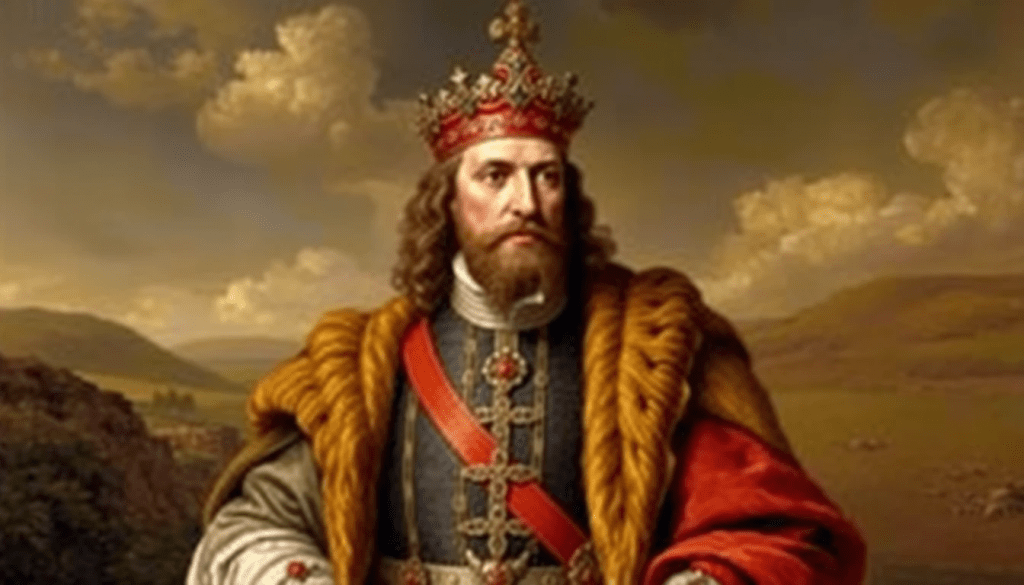
July 13, 1174
Fealty, Vassalage, and the Language of Medieval Power in English
On July 13, 1174, William I of Scotland—known as William the Lion—was captured at Alnwick during a failed military campaign into northern England. This event led to the Treaty of Falaise, in which William was forced to swear fealty to Henry II of England, acknowledging the English king as his overlord. Though this arrangement was later reversed in 1189, the language and political ideas it introduced left a lasting mark on English ceremonial, legal, and political vocabulary.
Fealty: Oaths and the Formalization of Loyalty
The concept of fealty—from the Latin fidelitas—was central to feudal society, and the Treaty of Falaise helped codify its usage in Anglo-Norman legal English. By submitting to Henry II, William enacted a ritualized swearing of loyalty, establishing a formulaic vocabulary of oaths that would persist in English legal documents, royal ceremonies, and political rhetoric.
- In English, “to swear fealty” remains a recognizable expression of solemn allegiance.
- The phrase became embedded in chivalric literature and, later, in parliamentary and military contexts.
- It evolved into symbolic expressions of state loyalty—such as oaths of allegiance to the Crown.
Vassalage: A Hierarchical Lexicon
William’s subjugation also reinforced the term “vassalage”—a condition of formal subordination to a higher authority. The idea of a king acting as a vassal to another monarch was politically controversial, and the rhetoric around this submission introduced and normalized English-language references to:
- “Subjugation”, “client kingship”, and “overlordship”, all of which appear in English chronicles and diplomatic histories.
- “Liege” and “liege lord”, which continue to appear in English literature and legal history, describing loyalty owed to a sovereign.
- “Homage” as both a legal and literary term—signaling ritual submission and now figuratively used (e.g., “paying homage to tradition”).
Even today, “vassal state” or “political vassalage” appears in English-language political commentary to describe unequal power relationships between nations or institutions.
Treaty Language: “On Terms” and Conditional Release
William’s eventual release from captivity was conditional—structured through legalistic language that emphasized the terms of submission and the possibility of reversal. From this, the English treaty-making vocabulary inherited several enduring expressions:
- “Release on terms” became a template for conditional agreements involving prisoners or political captives.
- Words like “concession,” “subjection,” and “recognition of sovereignty” entered official English discourse through such diplomatic negotiations.
- “Terms of surrender” and “binding agreement” gained currency in both medieval and modern English.
A Linguistic Legacy in English Ceremonial and Political Speech
The aftermath of the event also echoed in English monarchical and parliamentary rituals. The symbolic use of language to express:
- Allegiance,
- Loyal service,
- and conditional loyalty
was institutionalized in English through ceremonies like knighthood investitures, royal oaths, and court etiquette—where phrases such as “my liege,” “faithful subject,” and “I do hereby swear…” became standard. Many of these phrases trace their structure to the diplomatic and ceremonial formulas solidified in the 12th century.
Enduring Usage in Literature and Political Metaphor
The event’s linguistic residue continues to influence:
- Historical fiction and fantasy literature: where the language of fealty, vassalage, and oaths are core to world-building (e.g., Tolkien, Martin).
- Political metaphor: “vassalage” is still used figuratively in critiques of alliances or perceived subordination (e.g., “economic vassals of larger powers”).
- Legal and ceremonial English: modern oaths of office, courtly titles, and diplomatic protocols still reflect the structural remnants of feudal diction.
A Moment That Spoke Through Centuries
Though brief in political effect, the capture of William the Lion in 1174 left a long linguistic shadow. It helped shape a rhetorical and legal tradition in English that still resonates today—one built on the vocabulary of power, loyalty, hierarchy, and submission. The event helped anchor feudal language into English at a pivotal moment, enriching how the language could articulate allegiance, sovereignty, and interdependence—terms still vital in diplomacy, literature, and law.
When kings bowed, English rose—fealty, forged into every oath.
 What Happened on This Day?
Leave a comment