
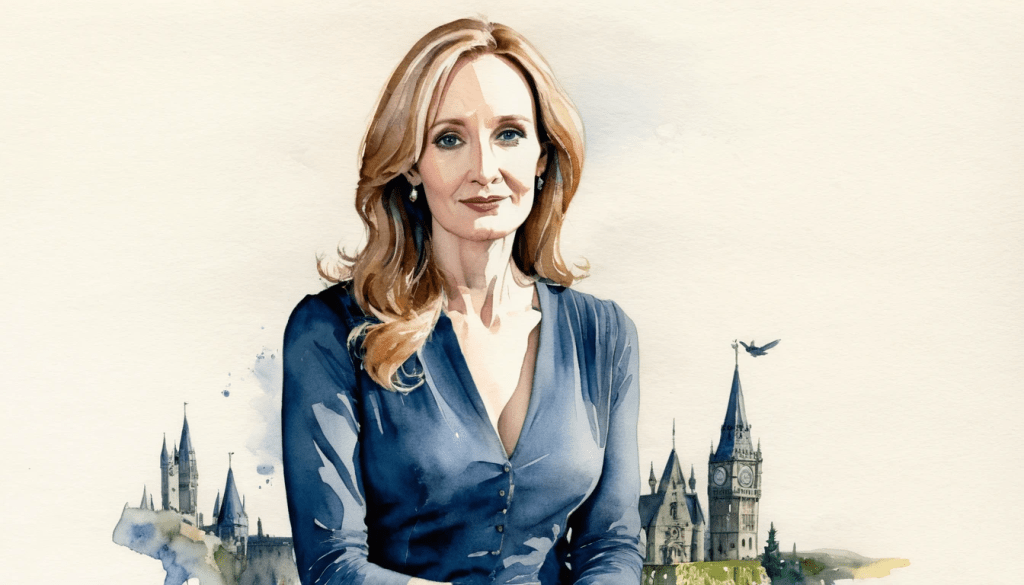
July 31, 1965
The Magic of Modern English Vocabulary
British author J.K. Rowling, born on July 31, 1965, transformed global English through her Harry Potter series—blending neologisms, invented traditions, and mythic vocabulary. Her imaginative contributions shaped a new subgenre of English literary and pop-cultural language, with terms like “Hogwarts,” “Muggle,” “Quidditch,” “Azkaban,” and “Dementor” now part of everyday global English.
Key Linguistic and Cultural Impacts
• Invented Words with Global Recognition
Rowling coined dozens of original terms that have escaped the boundaries of fiction to become recognizable components of informal and even academic English. Many of her terms serve as cultural shorthand across generations, nationalities, and contexts.
- “Muggle” – Perhaps the most widespread Rowlingism, “Muggle” (meaning a non-magical person) has entered colloquial English as a term for someone outside a specific group or lacking specialized knowledge. It’s now used in tech, gaming, and even professional contexts (e.g., “I’m a Muggle when it comes to coding”).
- “Hogwarts” – More than a fictional school, “Hogwarts” is now a symbol of magical coming-of-age, often used metaphorically in education and media. English speakers refer to “Hogwarts houses” and “Hogwarts vibes” to denote community, learning, or fantasy-driven identity.
- “Quidditch” – While originally a sport invented in the books, “Quidditch” has become a real-world athletic activity and a recognized term in sports journalism, metaphorically representing complex, whimsical, or fantastical team dynamics.
• Terms Adopted by Dictionaries
Major dictionaries, including the Oxford English Dictionary (OED) and Merriam-Webster, have officially added Rowling-coined words such as:
- “Muggle”
- “Hogwarts” (as an allusion)
- “Dementor” – Used metaphorically to describe emotionally draining or soul-crushing forces (e.g., “That manager is a real Dementor”).
Stylistic Impact on English Literary Language
Rowling’s work reanimated British school-story tropes, Arthurian myth, and Latin-infused magical terms, giving the English language a blend of:
- Elevated pseudo-archaic register (“Ministry of Magic,” “Order of the Phoenix”)
- Playful phonetics (“Hufflepuff,” “Gringotts,” “Slytherin”)
- Blended etymology (e.g., “Pensieve” = pensive + sieve)
This style has influenced a wave of YA literature, fantasy fiction, and even fanfiction lexicon, making her terminology a linguistic blueprint for worldbuilding authors.
Pop-Cultural English: A Global Lingua Franca
The popularity of the Harry Potter books and films has led to her invented terms being used by English learners worldwide, reinforcing the spread of pop-cultural English beyond native-speaking countries. For example:
- ESL teachers use Harry Potter references to teach figurative language, idioms, and context clues.
- Global social media references use “sorting hat,” “Voldemort,” or “Muggle problems” to convey nuanced feelings or archetypes.
Summary
J.K. Rowling’s birthday on July 31, which she shares with her fictional hero Harry Potter, marks not only the rise of a literary phenomenon but the permanent expansion of the English lexicon. Her inventive terms, iconic names, and cultural catchphrases are now fixtures in:
- Educational curricula
- Fan discourse
- Linguistic studies
- Pop-culture commentary
Rowling’s linguistic legacy is one of the most wide-reaching of any contemporary author, making her one of the few modern writers whose fiction has genuinely reshaped global English vocabulary.
She didn’t just write magic—she rewrote the dictionary.
 What Happened on This Day?
Leave a comment