
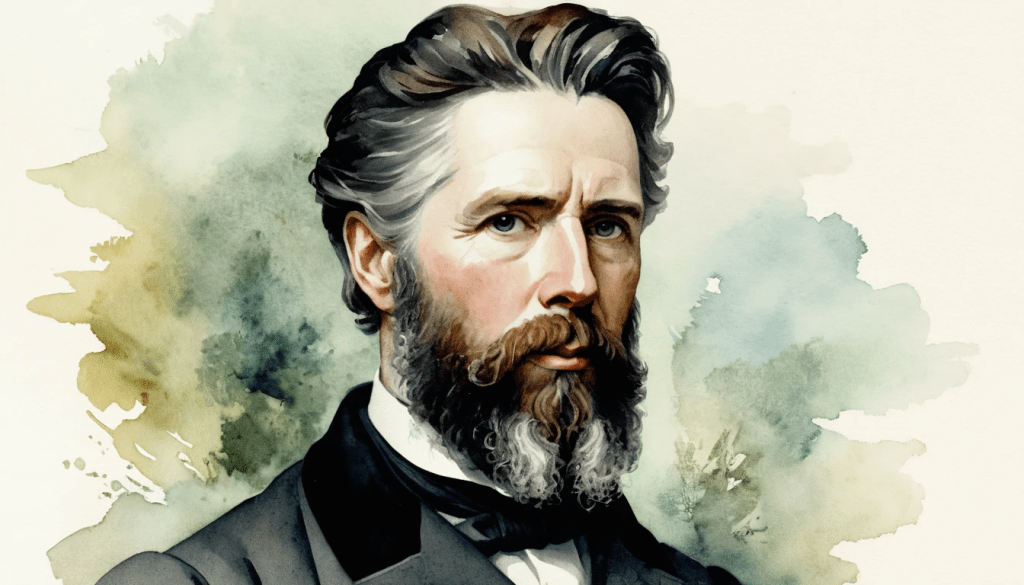
August 1, 1819
Melville’s Mark on English
Herman Melville (1819–1891), born in New York on August 1, is one of the most linguistically influential figures in American literature. Best known for his 1851 novel Moby-Dick, Melville profoundly shaped the English literary vocabulary, especially through his use of maritime language, symbolic expression, and philosophical depth. His contributions continue to echo through literary criticism, modern idiom, and even everyday speech.
Key Linguistic Contributions to English
1. Maritime Vocabulary as Literary Language
Melville, a former sailor, transformed the specialized terminology of seafaring into rich symbolic vocabulary used in English literature and metaphor:
- “Whale,” “harpoon,” “crow’s nest,” “bulkhead,” “try-works” – Once technical terms, these were elevated to metaphorical heights in Moby-Dick, giving English a way to speak poetically about depth, danger, and the unknown.
- “The white whale” – Now commonly used in English to mean a lifelong obsession or elusive goal, this metaphor stems directly from Captain Ahab’s pursuit of Moby Dick.
- “Captain Ahab” – His name became a metaphor in English for a person consumed by vengeance or a personal mission, used frequently in journalism and literary criticism.
2. Narrative Voice and Archetypal Naming
- “Call me Ishmael.” – The famous opening line of Moby-Dick has become one of the most recognized in English literature. The name Ishmael now serves as a symbol in English for alienation, wandering, or the disconnected narrator.
- Melville’s narrative strategy—blending first-person intimacy with epic omniscience—expanded English storytelling norms and helped diversify narrative voice in fiction.
3. Existential and Symbolic Language
Melville introduced or helped popularize phrases that are now standard in discussions of philosophy, literature, and psychology:
- “The inscrutable sea”, “monomaniacal pursuit”, “leviathan”, “man against nature”, and “ungraspable phantom of life”—such expressions allowed English to express a new kind of intellectual and emotional ambiguity.
- His writing contributed to a symbolist register in English, enabling authors to articulate abstract ideas through physical metaphor and Biblical or mythic allusion.
4. Stylistic Hybridization of English
Melville’s language blended Shakespearean drama, King James Bible rhythms, scientific diction, and American idiom—creating a voice that was at once:
- Elevated and colloquial
- Biblical and modern
- Formal yet wild in metaphor
This fusion of styles contributed to what would become hallmarks of modernist and postmodernist English fiction.
Enduring English Terms and Expressions
Melville’s writing has permanently added symbolic and idiomatic phrases to English, including:
- “White whale” – for an unattainable obsession.
- “Ahab-like” or “Ahabian” – for a destructive or obsessive personality.
- “Ishmael” – for a detached or reflective observer.
- “To be at sea” – metaphorically confused or lost, reinforced by Melville’s usage.
- “Queequeg’s coffin” – symbol of salvation emerging from apparent doom, now used metaphorically in analysis.
Cultural and Linguistic Legacy
- Critical studies of Melville’s language have given rise to entire fields of analysis in narrative theory, American Romanticism, and philosophical literature.
- His novels and short stories are referenced in academic English, literary journalism, and political rhetoric.
- Modern writers from William Faulkner to Don DeLillo, and even film and television, draw on Melvillean phrases and moods to explore themes of identity, madness, and the unknowable.
Summary
Herman Melville, born August 1, 1819, transformed the English literary lexicon by bringing together nautical terminology, philosophical metaphor, and rich stylistic layering. His influence extended beyond literature into popular idioms, scholarly vocabulary, and even journalistic expression. Moby-Dick, in particular, ensured that terms like “white whale”, “Ahab”, and “Call me Ishmael” would become lasting fixtures of the English language.
Melville didn’t just write about the sea—he made English deeper.
 What Happened on This Day?
Leave a comment