
August 9, 1854
Thoreau’s Influence on English Literary, Philosophical, and Environmental Vocabulary
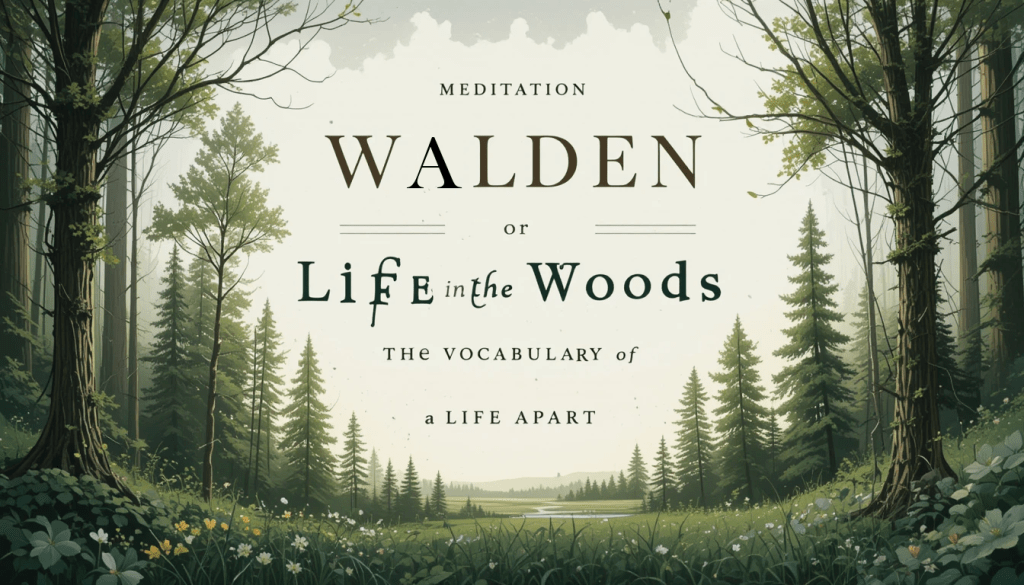
On August 9, 1854, American author, philosopher, and naturalist Henry David Thoreau published Walden; or, Life in the Woods. The work was more than just a memoir of his two-year experiment in simple living beside Walden Pond—it was a deliberate philosophical statement about self-reliance, minimalism, and humanity’s relationship with nature. In English literary and intellectual history, Walden became a lexical landmark, introducing or popularizing terms, idioms, and rhetorical styles that endure in modern English.
Key Vocabulary and Expressions Introduced or Reinforced
1. “Transcendentalism”
- Though the word existed before Walden, Thoreau’s book solidified it in English as the philosophical movement that privileges intuition, moral idealism, and harmony with nature over materialism.
- In literary criticism, “Transcendentalism” now serves as both a historical label and an interpretive lens, used for works advocating spiritual self-improvement and natural harmony.
2. “Waldenian simplicity”
- Not a direct phrase in Thoreau’s text, but coined by later critics to encapsulate his philosophy of deliberate living.
- Now a descriptive term in English environmental and lifestyle writing for the voluntary reduction of possessions, technological dependence, and societal obligations.
3. “Naturalist self-reliance”
- Thoreau fused Emerson’s idea of self-reliance with a distinctly ecological sensibility—building, growing, and sustaining oneself directly from the land.
- This hybrid term appears in English-language environmentalism, sustainability movements, and personal-development literature.
4. “Cabin in the woods”
- Thoreau’s modest one-room dwelling entered the English imagination as both a literal image and a metaphor for withdrawal from the noise of society.
- The phrase now appears in literature, marketing, and political rhetoric as shorthand for solitude, introspection, or radical independence.
5. “To live deliberately”
- A direct quotation from Walden, this phrase became an English idiom meaning to live with conscious intention and awareness rather than passively following societal routines.
- It has migrated into motivational literature, mindfulness discourse, and environmental activism.
6. “Quiet desperation”
- Thoreau’s assertion that “the mass of men lead lives of quiet desperation” entered common English as a critique of unfulfilled, conformist living.
- Now used both in literary contexts and everyday speech to describe hidden discontent in modern life.
Stylistic and Rhetorical Contributions to English
Poetic Naturalism in Prose
- Thoreau’s language elevated everyday objects—pond ice, wood smoke, animal tracks—into symbols, enriching English with metaphorical associations between nature and moral insight.
Lexical Layering
- Walden blends Anglo-Saxon plainness (“wood,” “pond,” “bread”) with Latinate abstraction (“resignation,” “serenity”), creating a rhythm and texture imitated by later environmental and philosophical writers.
Philosophical Imperative in Nonfiction
- His use of imperative verbs (“Simplify, simplify”) gave nonfiction a prescriptive tone without sacrificing lyrical quality—an enduring feature in English-language nature essays.
Long-Term Lexical Impact
- Environmental Discourse: Phrases and ideas from Walden reappear in 20th- and 21st-century debates about conservation, sustainability, and climate ethics.
- Political and Social Movements: Civil rights leaders and anti-war activists cited Thoreau’s call for principled independence, embedding his vocabulary into protest literature.
- Education and Culture: Terms like “Walden,” “Thoreauvian,” and “living deliberately” are now part of academic English in literature, philosophy, and environmental studies.
Conclusion
The publication of Walden on August 9, 1854 did more than capture one man’s life beside a Massachusetts pond—it permanently altered the English vocabulary of philosophy, literature, and environmental thought. Whether invoked in scholarly discourse, lifestyle journalism, or personal reflection, Thoreau’s words have become cultural shorthand for simplicity, integrity, and the conscious pursuit of meaning.
🌿 One pond, one cabin, one book — and the English language was never the same.
Curious about what happened today in history? Want to learn a new word every day?
You’ll find it all—first and in one place—at The-English-Nook.com!
If you love languages, this is your space.
Enjoy bilingual short stories, fun readings, useful vocabulary, and so much more in both English and Spanish.
Come explore!
 What Happened on This Day?
Leave a comment