
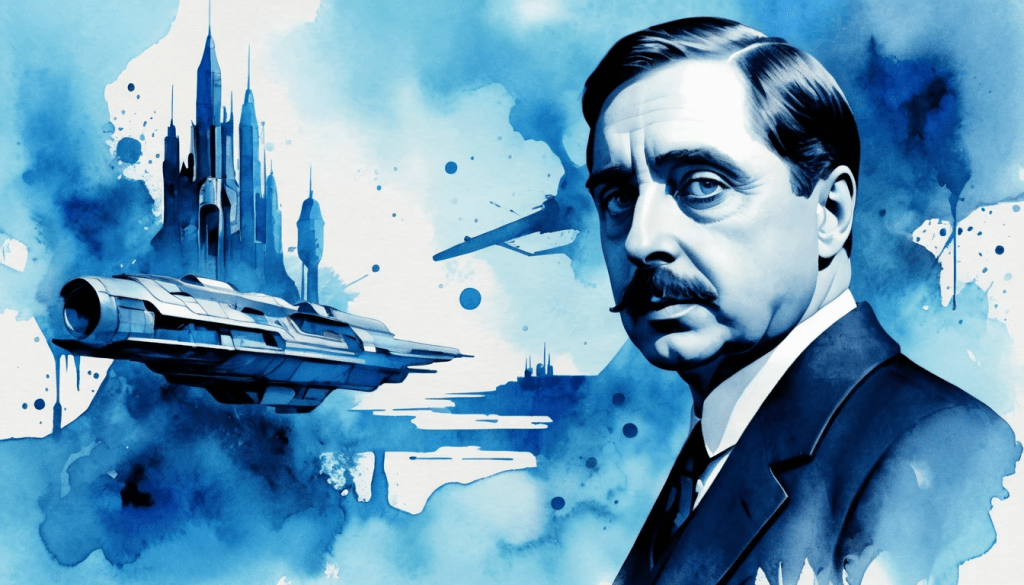
August 13, 1946
The Loss of a Literary Architect Who Rebuilt the English Language of the Future
On August 13, 1946, Herbert George Wells—the author, social commentator, and visionary—died in London, leaving behind a linguistic legacy that permanently altered the way English could speak about time, space, science, and the destiny of humanity. Known during his lifetime as the “father of science fiction” (a term later solidified by critics), Wells was not simply a novelist; he was a lexical innovator, coining and popularizing expressions that migrated from fiction into mainstream English usage.
1. Invention and Popularization of Scientific Vocabulary
Wells’ narratives were laboratories of language. His works turned speculative terms into household phrases:
- “Time Machine” — first introduced in his 1895 novella, the term became shorthand in English for any device or metaphorical vehicle enabling temporal travel.
- “Invisible Man” — an expression that now works equally in science fiction and in political or social contexts, describing people rendered unseen by circumstances.
- “Martian invasion” — from The War of the Worlds (1898), now a figurative expression for sudden, overwhelming threats.
By the time of his death, these terms were no longer just plot devices; they were functional components of English descriptive capacity.
2. Political and Utopian Lexicon
Beyond fiction, Wells’ political writings enriched English with an idealistic yet pragmatic vocabulary:
- “World State” — a phrase that entered diplomatic and academic discourse as a theoretical global political order.
- “Open Conspiracy” — his term for a coordinated, transparent plan for social progress, now used metaphorically in activism and criticism.
- “Modern Utopia” — blending classical utopian tradition with contemporary sociopolitical analysis, giving English a term for forward-looking, realistic reform models.
3. Title Phrases as Idioms and Metaphors
Wells’ titles became linguistic currency, frequently used by journalists, critics, and politicians:
- “War of the Worlds” — shorthand for epic conflict between radically different powers, whether literal or metaphorical.
- “Shape of Things to Come” — a predictive phrase still employed in speeches, essays, and headlines about the future.
- “The Food of the Gods” — a poetic idiom for transformative knowledge or dangerous innovation.
4. The Emergence of “Wellsian”
By the 1930s, critics were already using the adjective “Wellsian” to mean:
Combining imaginative speculation with scientific plausibility, often laced with social critique.
This term remains in English literary criticism, film reviews, and even design commentary. It signals a particular register of futurism—optimistic yet tinged with caution.
5. Influence on English Narrative Style
Wells’ clear, journalistic prose blended with visionary content helped shift English science fiction away from ornate Victorian styles toward crisp, modernist clarity. His approach expanded English narrative possibilities, allowing technical and scientific terminology to coexist naturally with emotional and philosophical reflection in popular literature.
Language Legacy of August 13
H. G. Wells’ death marked the passing of a man whose imaginative inventions became part of the working vocabulary of the modern world. The words, phrases, and stylistic patterns he left behind gave English new tools to describe:
- the distant past (prehistoric, Neanderthal popularization),
- the far future (utopia, apocalypse in modern senses),
- and the strange landscapes of human possibility.
For English speakers today, to use terms like time machine, Martian, World State, or Wellsian is to speak with the linguistic fingerprints of a man who imagined futures that became part of our present tongue.
He imagined tomorrow so vividly, we still speak in his words today.
Curious about what happened today in history? Want to learn a new word every day?
You’ll find it all—first and in one place—at The-English-Nook.com!
If you love languages, this is your space.
Enjoy bilingual short stories, fun readings, useful vocabulary, and so much more in both English and Spanish.
Come explore!

 What Happened on This Day?
Leave a reply to Death of H. G. Wells (1866–1946) – Giving English a Vision of Tomorrow – penwithlit Cancel reply