
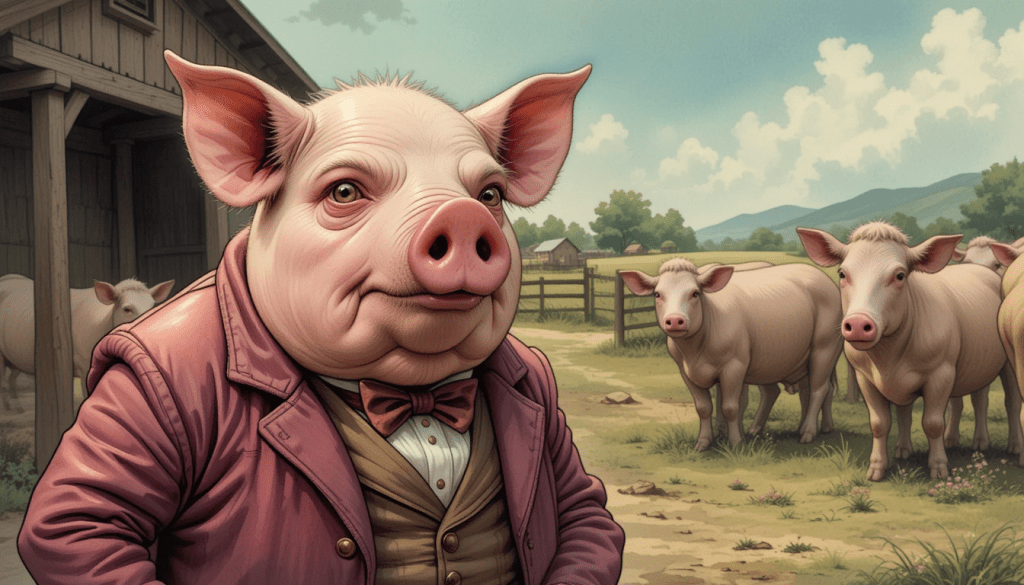
August 17, 1945
George Orwell’s Allegory and Its Transformation of English Political Vocabulary
On August 17, 1945, George Orwell’s novella Animal Farm was published in London by Secker & Warburg. Subtitled a “fairy story,” the book was immediately recognized as a political allegory of the Soviet Union under Stalin, though its resonance reached far beyond its immediate historical context. More than a literary achievement, Animal Farm reshaped the lexicon of English political and cultural discourse, supplying generations with new metaphors, slogans, and shorthand for describing corruption, betrayal, and authoritarianism.
1. “Animal Farm” as a Permanent English Metaphor
- The very title, “Animal Farm”, became embedded in English vocabulary as a metaphor for a state, system, or institution that claims to be egalitarian but devolves into oppression.
- In journalism and political commentary, phrases such as “a new Animal Farm” or “this feels like Animal Farm politics” are routinely deployed to describe revolutions gone wrong, bureaucratic hypocrisy, or authoritarian systems masked by populist rhetoric.
- This transformation of a fictional farm into a critical metaphor is one of the most striking examples of a literary phrase naturalizing itself into common English usage.
2. Orwell’s Slogans and Aphorisms in English
The novella introduced some of the most enduring phrases in modern English political language:
- “All animals are equal, but some animals are more equal than others” → has become a universal shorthand in English for exposing legal or social hypocrisy. It is often quoted in parliamentary debates, legal commentary, and journalistic headlines.
- “Four legs good, two legs bad” → a reductionist slogan, used in English to criticize oversimplified political rhetoric or propaganda.
- “Four legs good, two legs better” → Orwell’s later inversion, now a phrase for describing betrayal of original ideals or opportunistic ideological shifts.
These linguistic formulas—both satirical and memorable—are prime examples of how Animal Farm contributed quotable aphorisms to the English lexicon.
3. Political Archetypes in English
Through allegory, Orwell also gave English cultural discourse a vocabulary of character types:
- Napoleon → became a shorthand in English critical writing for a dictatorial leader cloaked in revolutionary legitimacy. Terms like “Napoleonic leadership” or “Napoleonic hypocrisy” are frequently applied beyond Orwell’s story.
- Snowball → came to symbolize the idealistic revolutionary who is scapegoated or exiled. English commentary sometimes refers to “a Snowball figure” in political movements.
- Squealer → now a recognized symbol in English political language for propagandists, spin-doctors, or state media mouthpieces.
4. Expanding English Terminology of Power and Control
While Animal Farm did not invent certain words, it recontextualized and popularized them in English:
- “Revolution betrayed” → a phrase tied directly to Orwell’s allegory, widely used in English to describe broken revolutionary promises.
- “Cult of personality” → though older, it entered English political commentary with sharper clarity after Orwell’s depictions of Napoleon.
- “Farmyard politics” → coined in later English criticism to describe childish, petty, or animalistic behavior in governance, clearly inspired by Orwell’s setting.
5. Influence on the “Orwellian” Vocabulary
Though Nineteen Eighty-Four (1949) would later crystallize terms like “Big Brother,” “doublethink,” and “thoughtcrime”, Animal Farm laid the groundwork for English describing political distortion:
- “Orwellian allegory” → a term applied to political satire written in English after Orwell.
- “Propaganda fable” → coined by critics to categorize Orwell’s style of political storytelling.
- “Allegorical dictatorship” → a phrase in English literary and political discourse emerging directly from this novella’s impact.
6. Institutional and Educational Vocabulary
Because Animal Farm became a core text in English-language education, it permanently embedded certain concepts into how English speakers talk about politics and literature:
- “Political allegory” → popularized as a widely understood label for literature through Orwell’s novella.
- “Satirical fable” → cemented in English literary criticism largely due to Animal Farm.
- “Dystopian animal parable” → a phrase coined by scholars in English critical writing to describe the work’s genre fusion.
7. Lasting Phrases and Terms in English from Animal Farm
- “Animal Farm” → metaphor for corrupted systems.
- “Some are more equal than others” → enduring critique of hypocrisy.
- “Four legs good, two legs bad” → symbol of reductive slogans.
- “Napoleonic rule” → shorthand for betrayal by leaders.
- “Squealer tactics” → propaganda through lies and spin.
- “Revolution betrayed” → failure of utopian promises.
Language Legacy
The publication of Orwell’s Animal Farm marks a decisive moment in the history of English vocabulary. The book demonstrated how literary allegory can coin, reshape, and stabilize political terminology. Its phrases are now so woven into English that even people who have never read the novella recognize them instantly. To this day, the English-speaking world uses Orwell’s animals, slogans, and metaphors as a shared critical shorthand for understanding corruption, authoritarianism, and the betrayal of ideals.
When Orwell’s animals spoke, English politics found a new language of truth disguised in satire.
Curious about what happened today in history? Want to learn a new word every day?
You’ll find it all—first and in one place—at The-English-Nook.com!
If you love languages, this is your space.
Enjoy bilingual short stories, fun readings, useful vocabulary, and so much more in both English and Spanish.
Come explore!
 What Happened on This Day?
Leave a comment