
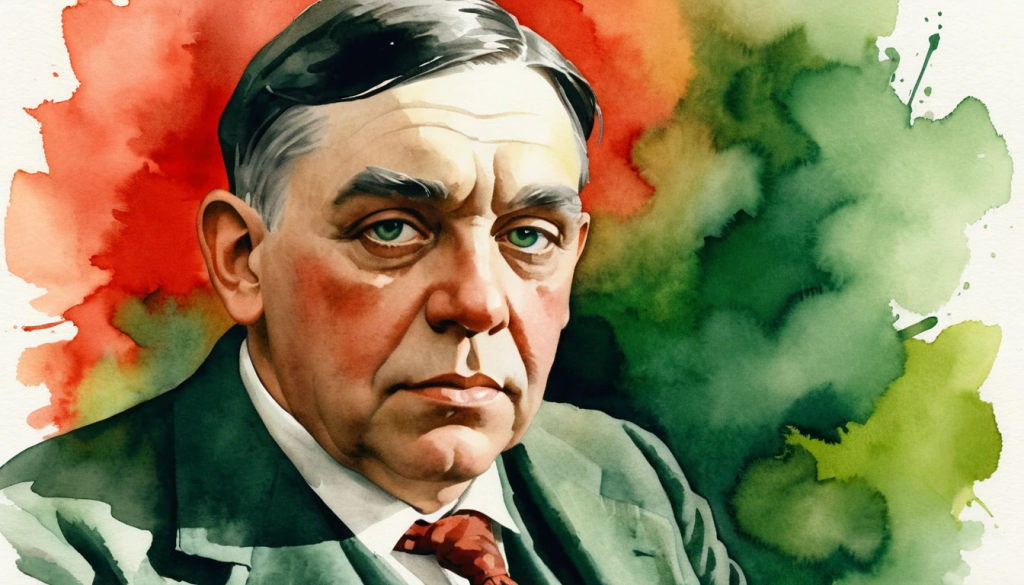
September 12, 1880
The Sage of Baltimore Who Made American English a Subject of Its Own
On September 12, 1880, Henry Louis Mencken was born in Baltimore, Maryland. Best remembered as a journalist, satirist, critic, and self-styled philologist, Mencken became one of the most influential voices in American letters during the first half of the 20th century. His biting essays and fearless critiques earned him the title “the Sage of Baltimore”, but his greatest linguistic legacy came with The American Language (1919), a monumental study that celebrated and defended the independence of American English.
Mencken insisted that American English was not merely a provincial offshoot of British usage but a dynamic, creative, and democratic idiom in its own right. By doing so, he introduced a vocabulary of linguistic pride and cultural self-awareness that has permanently shaped English-language discourse.
1. The Vocabulary of Linguistic Independence
Mencken’s writings on language brought new expressions and reinforced older ones in English discussions about national identity and style:
- “The American Language” — his book title became a shorthand in English for the recognition of American English as distinct and legitimate.
- “Americanisms” — a term Mencken helped popularize in critical discussion, meaning words, idioms, or usages unique to U.S. English.
- “Democratic speech” — his phrase for the way American English reflected the voices of common people rather than aristocratic elites.
- “Living language” — an idea Mencken championed, emphasizing English as a changing, evolving organism.
By coining, endorsing, and popularizing these terms, Mencken expanded the metalanguage English speakers use to describe their own tongue.
2. Satire, Journalism, and the Language of Critique
As a journalist and essayist, Mencken left his mark on English satirical vocabulary. His caustic wit enriched the lexicon of cultural criticism:
- “Menckenesque” — still used to describe trenchant, witty, and merciless prose.
- “Booboisie” — his satirical coinage mocking the ignorant middle classes, now a staple in discussions of cultural elitism.
- “Sage of Baltimore” — an epithet that became part of his legend and an example of journalistic labeling in English.
- “Philistinism” — a word he revived in American English criticism to describe anti-intellectual culture.
Through his linguistic playfulness, Mencken blurred the line between satire and scholarship, leaving English richer in ironic terms of social critique.
3. Defending American Vernacular
Mencken took seriously the words of immigrants, tradesmen, and ordinary citizens, turning them into subjects of study:
- “Yankeeisms”, “slang,” and “dialect borrowings” became critical categories in his essays.
- He defended slang as the “life-blood of English,” a phrase that shaped how later critics spoke about linguistic innovation.
- Mencken’s insistence on regionalisms gave scholarly weight to terms like “Southern drawl,” “Midwestern speech,” and “New York vernacular.”
- He introduced wider audiences to immigrant contributions to English, foregrounding German, Yiddish, and other influences on American idiom.
By elevating everyday talk, Mencken gave legitimacy to the democratic register of English.
4. Influence on English Critical Vocabulary
Mencken’s work also shaped the discourse of linguistics and literary criticism:
- Critics began using “Mencken’s lens” to describe an ironic, language-focused approach to American culture.
- His studies helped fix terms like “linguistic nationalism” and “vernacular democracy” in English scholarly vocabulary.
- The phrase “the American idiom” owes much of its critical circulation to his work.
- His writings inspired later discussions of “World Englishes”, prefiguring the global spread of the language.
Thus, Mencken was not just a journalist but a linguistic architect of modern English studies.
5. Enduring Linguistic Legacy
Even after his death in 1956, Mencken’s influence lingers in English cultural and linguistic discourse:
- In scholarship — his The American Language remains a touchstone in studies of U.S. English.
- In criticism — “Menckenesque” continues to describe sharp, uncompromising prose.
- In everyday speech — “booboisie” and “boorish philistinism” still circulate in critiques of mass culture.
- In identity — Mencken helped naturalize the idea that American English is not “incorrect” English but its own evolving standard.
Glossary of Enduring Expressions from H. L. Mencken
- Menckenesque — trenchant, witty, biting prose.
- Booboisie — ignorant middle classes.
- The American Language — definitive work on U.S. English as distinct.
- Americanisms — words and usages unique to American English.
- Living language — English as a constantly evolving organism.
- Vernacular democracy — the idea that ordinary speech drives language growth.
Mencken’s American English
H. L. Mencken was not merely a writer or critic — he was a linguistic nationalist, giving English speakers the tools to talk about their own language with pride and precision. By coining words, cataloguing “Americanisms,” and championing the vitality of slang and vernacular, Mencken permanently altered the way English describes itself.
His work ensured that to speak of “American English” is not an apology but a statement of cultural identity. The words “Menckenesque,” “booboisie,” and “American language” remain monuments in the English lexicon to a man who believed that words themselves are the truest reflection of democracy.
Mencken turned slang into scholarship and American English into identity.
Curious about what happened today in history? Want to learn a new word every day?
You’ll find it all—first and in one place—at The-English-Nook.com!
If you love languages, this is your space.
Enjoy bilingual short stories, fun readings, useful vocabulary, and so much more in both English and Spanish.
Come explore!
 What Happened on This Day?
Leave a comment