
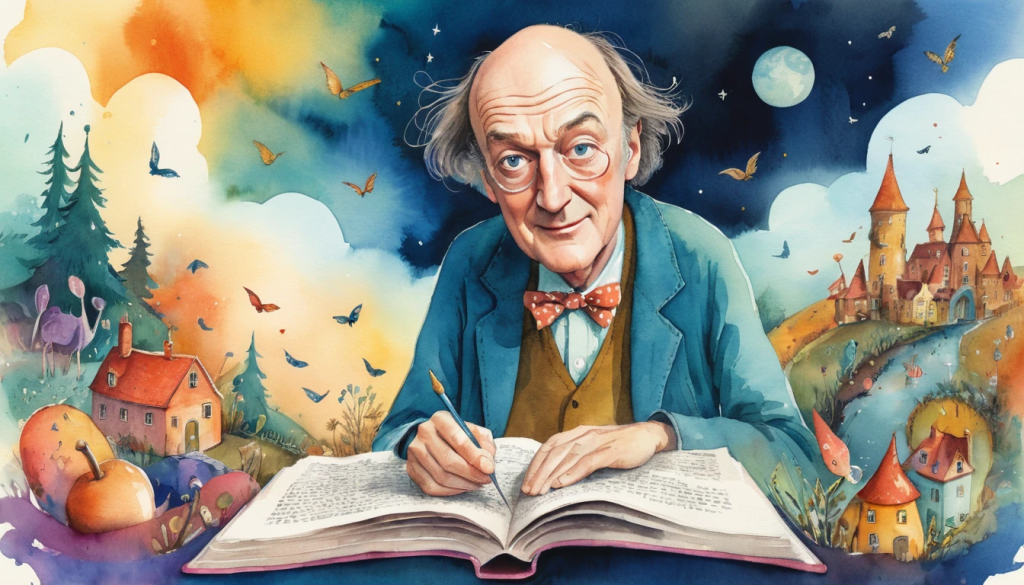
September 13, 1916
The Inventor of Gobblefunk Who Rewrote the Vocabulary of Childhood in English
On September 13, 1916, Roald Dahl was born in Llandaff, Wales, to Norwegian parents. Over the course of his career, Dahl became one of the most widely read and beloved children’s authors of the 20th century, with books like Charlie and the Chocolate Factory, James and the Giant Peach, Matilda, and The BFG enchanting generations.
What sets Dahl apart linguistically is his invention of new words and playful manipulation of English. Through what he called “gobblefunk”—his own term for whimsical neologisms—Dahl not only entertained young readers but also transformed the way English-speaking children learn, play with, and internalize language.
1. Gobblefunk and the Vocabulary of Invention
Dahl coined hundreds of words, many of which have entered English popular culture:
- “Scrumdiddlyumptious” — a compound suggesting delightful deliciousness, now widely used in playful English.
- “Oompa-Loompa” — from Charlie and the Chocolate Factory, became shorthand in English for small but energetic workers.
- “Whizzpopping” — a gleeful euphemism from The BFG, capturing Dahl’s comic treatment of taboo subjects.
- “Gobblefunk” itself — Dahl’s umbrella word for his playful approach to words, now used critically to describe his linguistic creativity.
These neologisms expanded the expressive range of English for children, reinforcing the idea that language is not fixed but alive, malleable, and fun.
2. Reinventing Children’s English
Dahl revolutionized how English-language children’s literature employed vocabulary:
- He broke from stiff Victorian and Edwardian diction, instead embracing slang, nonsense, and rhythm to mirror children’s own voices.
- His coinages became linguistic playgrounds, teaching children to decode meaning from sound and context.
- He reinforced a comic irreverence in English—words like rotters, twits, and ghastly gained renewed life in his hands.
- The use of onomatopoeia—splatch, gluggy, squelchy—made his books aurally rich, shaping how English prose could be read aloud.
Through this, Dahl not only entertained but also trained generations of English-speaking children to love words.
3. Neologisms as Cultural Vocabulary
Dahl’s invented words often escaped the page and entered wider English usage:
- “Golden Ticket” — now a metaphor in English for a once-in-a-lifetime opportunity.
- “Chocolate Factory” — has become shorthand for fantastical invention, often used metaphorically in business and design.
- “BFG” (Big Friendly Giant) — widely recognizable as a descriptor for something oversized but kind.
- “Revolting recipes” — inspired not only books but idiomatic expressions for disgusting or humorous concoctions.
His playful language thus seeped into advertising, journalism, and popular speech, proof of its linguistic staying power.
4. Influence on Literary and Critical Discourse
Critics coined new descriptors to account for Dahl’s style:
- “Dahlian” — now used to describe grotesque, comic, and inventive prose.
- “Gobblefunking” — used in English-language pedagogy to describe linguistic play modeled on Dahl.
- His works are central in discussions of children’s linguistic empowerment, where the very act of coining words is seen as giving voice and agency to young readers.
- Dahl’s prose helped expand the study of neologism, nonsense, and linguistic creativity in English literary criticism.
5. Enduring Legacy in English Vocabulary
Dahl’s words continue to thrive in the English imagination:
- Many of his neologisms have been added to the Oxford English Dictionary, cementing them as part of official English.
- Teachers and language educators use Dahl’s texts to inspire phonetic awareness, creativity, and wordplay in students.
- “Dahl Day” (his birthday) is celebrated in schools, keeping his words alive in English classrooms.
- His language is now a cultural bridge, with “scrumdiddlyumptious” or “Oompa-Loompa” instantly recognizable across the English-speaking world.
Glossary of Enduring Expressions from Roald Dahl
- Gobblefunk — Dahl’s playful approach to word invention.
- Scrumdiddlyumptious — extraordinarily delicious.
- Oompa-Loompa — fantastical workers; metaphor for small but industrious helpers.
- Whizzpopping — comic euphemism for bodily sounds.
- Golden Ticket — metaphor for rare opportunity.
- Dahlian — grotesque, comic, and inventive literary style.
Dahl’s Playful English
Roald Dahl transformed the English language not through solemn literary gravity but through irreverent joy and creativity. His gobblefunk neologisms and playful phrasing made English feel like a toy box, something children could bend, reshape, and reinvent.
In this sense, Dahl’s greatest legacy is not only his unforgettable stories but also his gift of linguistic empowerment—teaching English speakers, young and old, that words are not boundaries but possibilities. His coinages, from scrumdiddlyumptious to Golden Ticket, remain part of the living lexicon of global English, proof that playfulness itself can be a profound linguistic inheritance.
Dahl didn’t just tell stories—he rewrote the dictionary of childhood.
Curious about what happened today in history? Want to learn a new word every day?
You’ll find it all—first and in one place—at The-English-Nook.com!
If you love languages, this is your space.
Enjoy bilingual short stories, fun readings, useful vocabulary, and so much more in both English and Spanish.
Come explore!
 What Happened on This Day?
Leave a comment