
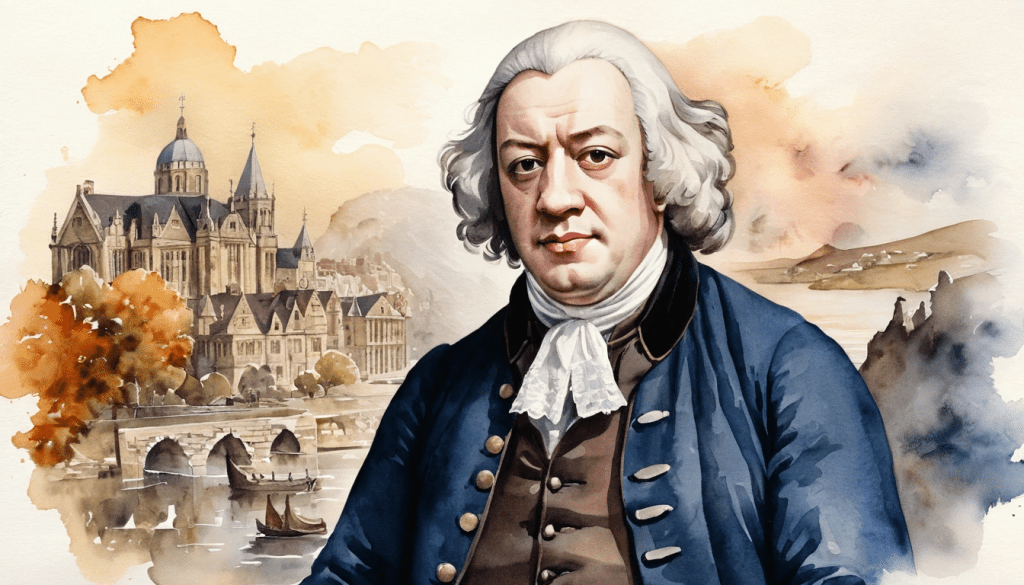
September 18, 1709
The Lexicographer Who Gave English Its First Monumental Dictionary and a Vocabulary of Criticism
On September 18, 1709, Samuel Johnson was born in Lichfield, Staffordshire. A towering figure of the English Enlightenment, Johnson was not only a poet, essayist, and critic, but also the creator of one of the most influential works in the history of the language: the Dictionary of the English Language (1755). For over 150 years, it was the definitive authority on English, shaping spelling, usage, idioms, and the very way English speakers thought about words.
Johnson’s lexicographical genius gave English a scholarly foundation, while his critical essays and conversational wit enriched its stylistic and rhetorical vocabulary. His influence is visible in idioms, critical terminology, and even in the rhythm of English prose.
1. The Dictionary and the Codification of English
Johnson’s dictionary was the first attempt to systematize the English language on a monumental scale. It did not merely list words; it defined them with wit, quotation, and judgment, giving English a cultural identity.
- “Dictionary Johnson” became a common epithet, turning his name into shorthand for linguistic authority.
- His entries fixed spellings and meanings, stabilizing words like publick → public and musick → music.
- Expressions such as “to lexicograph” and “Johnsonian definition” entered critical vocabulary, describing his method of framing meaning through literary quotation.
- His famous definitions (“lexicographer: a harmless drudge”) showed how humor could be encoded into reference works, giving English the idiom of the “witty definition.”
The Dictionary thus created not just a book, but a lexical standard that influenced English education and culture worldwide.
2. Critical Vocabulary and Prose Style
Beyond his dictionary, Johnson was a literary critic of enduring impact. His essays in The Rambler and The Idler, along with his monumental Lives of the Poets, expanded the critical vocabulary of English.
- “Johnsonian style” — now an idiom for balanced, periodic, weighty English prose.
- “Moral essayist” — a term used to describe Johnson’s contribution to the tradition of Addison and Steele, but more philosophically rigorous.
- Phrases like “critical biography” and “literary lives” gained traction through his Lives of the Poets.
- His love of antithesis and parallelism gave English the idiom of “Johnsonian cadence,” often invoked in rhetoric and oratory.
In short, Johnson not only judged English literature — he gave critics the terminology with which to do so.
3. Conversational Wit and Idiomatic Influence
Johnson’s spoken wit, preserved by James Boswell in Life of Johnson, helped immortalize many English idioms. His table talk gave rise to sayings that became part of English proverbial wisdom.
- “Patriotism is the last refuge of a scoundrel” — entered political English discourse as a phrase of enduring cynicism.
- “Clear your mind of cant” — turned into an idiom meaning to resist empty jargon.
- His sharp rebukes popularized the “Johnsonian put-down” as a genre of English repartee.
Through Boswell’s recording, Johnson’s speech became almost as influential as his dictionary, shaping English idiomatic style in conversation.
4. Moral and Philosophical Vocabulary
Johnson’s writings are steeped in reflections on morality, religion, and the human condition, giving English an enriched ethical vocabulary.
- Words like “vanity,” “melancholy,” and “resignation” were given a Johnsonian depth, used repeatedly in his essays as philosophical categories.
- The phrase “the vanity of human wishes” (title of his 1749 poem) remains a shorthand in English for moral futility.
- His religious seriousness reinforced the English idiom of the “moralizing essayist.”
By infusing English prose with gravitas, Johnson left a linguistic legacy of moral reflection.
5. Enduring Legacy in English Language and Literature
Johnson’s impact goes beyond scholarship: he became a symbol of English itself.
- “Johnsonian” remains an adjective describing anything weighty, balanced, and authoritative in English prose.
- His dictionary fixed the literary canon of English quotations, from Shakespeare to Milton, embedding them in the cultural vocabulary.
- Modern lexicography (from the OED to Merriam-Webster) stands in his shadow, using his methods of quotation and illustration.
- His life, immortalized in Boswell’s biography, introduced the idea of the “literary life” as a subject of English narrative.
In short, Johnson gave English not just a dictionary, but a language of criticism, conversation, and cultural self-consciousness.
Glossary of Johnsonian Contributions
- Dictionary Johnson — authority on English usage.
- Johnsonian style — weighty, balanced prose.
- Witty definition — lexicographical humor.
- Patriotism… refuge of a scoundrel — enduring political idiom.
- Clear your mind of cant — critique of jargon.
- Vanity of human wishes — shorthand for futility.
- Johnsonian put-down — sharp verbal wit.
Samuel Johnson’s Monument in Words
Born on September 18, 1709, Samuel Johnson stands as the single most important figure in the history of English lexicography and literary criticism. His Dictionary codified spelling and meaning, his essays enriched critical vocabulary, and his conversation gave English idioms of wit and moral clarity. Through both pen and personality, Johnson ensured that English had not only a structure, but also a voice of authority. His legacy is linguistic, literary, and cultural: the enduring “Johnsonian monument of words.”
Samuel Johnson: the man who didn’t just define words—he defined English itself.
Curious about what happened today in history? Want to learn a new word every day?
You’ll find it all—first and in one place—at The-English-Nook.com!
If you love languages, this is your space.
Enjoy bilingual short stories, fun readings, useful vocabulary, and so much more in both English and Spanish.
Come explore!
 What Happened on This Day?
Leave a comment