
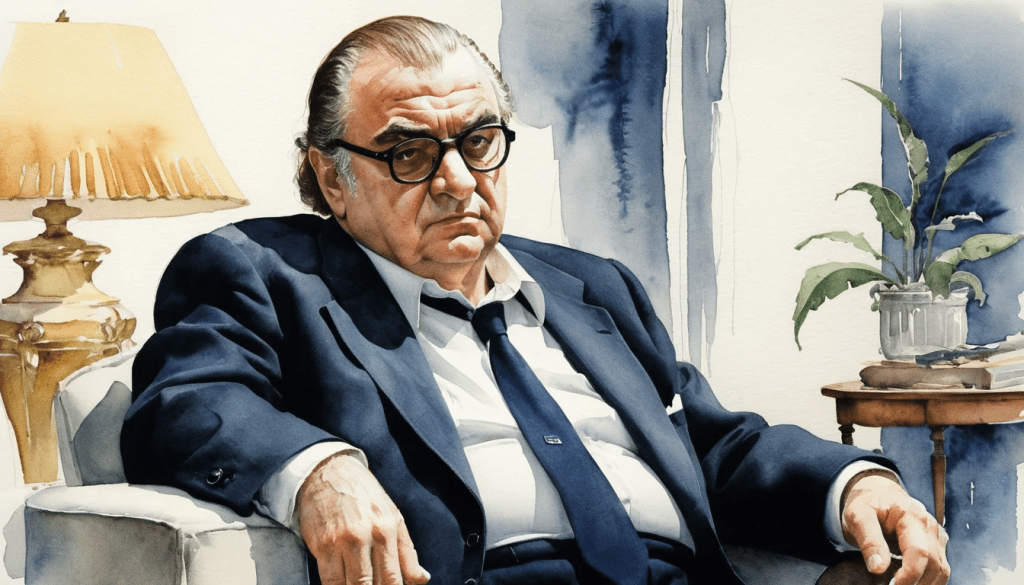
October 15, 1920
The Novelist Who Gave English Its Language of Honor, Family, and Power
On October 15, 1920, Mario Puzo was born in New York City to Italian immigrant parents. A novelist, screenwriter, and cultural storyteller, he forever changed the landscape of English-language popular fiction with his 1969 masterpiece, The Godfather. Through this work — and its legendary film adaptations — Puzo created a new idiom of crime, loyalty, and family that entered the very bloodstream of modern English.
His prose combined the rhythms of street speech with the cadence of epic storytelling, giving the English novel a mythic realism that blurred the line between crime fiction and classical tragedy.
1. The Godfather and the Mythic Vocabulary of Power
With The Godfather, Puzo gave English an enduring vocabulary of power, loyalty, and betrayal.
- Words and phrases like “make him an offer he can’t refuse,” “the family,” “the Don,” and “going to the mattresses” became embedded in everyday English.
- His language transformed the Mafia from a secret underworld into a cultural metaphor — a way to speak about corruption, authority, and kinship.
- In doing so, Puzo fused Italian-American idiom with American English, enriching the lexicon with new emotional and moral resonances.
2. English as the Voice of the Outsider
Puzo’s fiction spoke for the immigrant imagination — those living between cultures, languages, and loyalties.
- His characters articulated their world in plain, forceful English, yet the rhythm of their speech carried the melancholy and pride of another language beneath it.
- This hybrid tone — half-street, half-epic — gave English a new register of authenticity, where crime, conscience, and ambition could coexist in one voice.
- Through his prose, Puzo showed that English could contain the poetry of the outsider, transforming marginal speech into cultural myth.
3. Dialogue and the Art of American Realism
Puzo was a master of dialogue as revelation.
- His English was cinematic: clipped, rhythmic, and charged with subtext.
- Every exchange in The Godfather advanced both plot and psychology, teaching generations of writers and filmmakers how spoken English could shape narrative power.
- The directness of his dialogue — its moral ambiguity and ironic calm — gave modern English fiction a distinct tone of fatalism and irony.
4. Legacy in English and World Culture
Few twentieth-century writers have contributed so directly to the English-speaking world’s shared mythology.
- His characters — Don Corleone, Michael, Sonny — became archetypes in English discourse, invoked far beyond literature or film.
- “The Godfather” itself entered the English lexicon as shorthand for leadership, dominance, or mentorship.
- Puzo’s fusion of American realism and classical tragedy established a stylistic model for crime fiction, journalism, and screenwriting alike.
Glossary of Enduring Expressions from Puzo
- The Godfather — now idiomatic for a figure of authority, protection, or power.
- Make him an offer he can’t refuse — emblem of persuasive, ruthless control.
- The family — metaphor for both loyalty and moral compromise in institutions.
- Puzonian realism — blending of epic tone with colloquial English.
- Language of the outsider — English charged with immigrant cadence and mythic resonance.
Puzo’s Enduring Voice
Born on October 15, 1920, Mario Puzo gave English fiction a modern mythology — one where power speaks in whispers, and the rhythms of the street become the poetry of empire and exile. Through The Godfather, he endowed the English language with an immortal lexicon of loyalty, betrayal, and fate.
One novel, one family, one myth — Puzo gave English its language of power and blood.
Curious about what happened today in history? Want to learn a new word every day?
You’ll find it all—first and in one place—at The-English-Nook.com!
If you love languages, this is your space.
Enjoy bilingual short stories, fun readings, useful vocabulary, and so much more in both English and Spanish.
Come explore!
 What Happened on This Day?
Leave a comment