
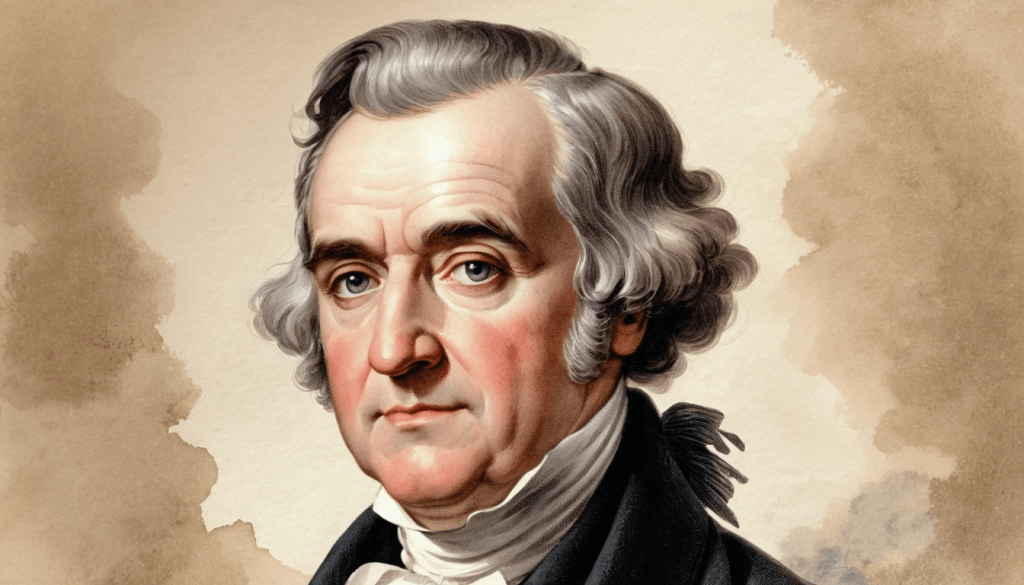
October 16, 1758
The Man Who Gave English a Republic of Its Own
On October 16, 1758, Noah Webster was born in West Hartford, Connecticut. A teacher, lawyer, lexicographer, and moral philosopher, Webster became one of the most influential figures in the linguistic history of the modern world. His life’s mission was not merely to record words, but to reshape the language of English-speaking Americans into a national expression of democratic identity.
Through his seminal works — the American Spelling Book (1783), affectionately called the Blue-Backed Speller, and the monumental American Dictionary of the English Language (1828) — Webster codified spelling, standardized grammar, and gave Americans their own voice in English. In his view, independence of speech was as essential as independence of government.
His reforms were not cosmetic but ideological: by redefining spelling, pronunciation, and meaning, Webster helped transform English from the imperial language of Britain into the living, self-determining language of America.
1. Language as a National Declaration
For Webster, language was the cornerstone of national identity.
- He believed that if the United States continued to use British English unchanged, it would remain culturally dependent on its former ruler.
- His simplified spellings — color instead of colour, honor instead of honour, defense instead of defence — were acts of linguistic independence, declaring that Americans would speak and write in their own idiom.
- He argued that a distinct language would unite the republic, bringing together citizens across regions and backgrounds.
- In this way, Webster made English itself a symbol of democracy, accessible to every reader, every classroom, and every home.
“As an independent nation,” Webster wrote, “our honor requires us to have a system of our own, in language as well as government.”
Through this conviction, English became not only a means of communication but also an instrument of nation-building.
2. The Democratization of English
Webster believed that words belonged to the people, not to aristocrats, scholars, or kings.
- His dictionary sought to reflect the living speech of American life — from the words of farmers and craftsmen to those of politicians and poets.
- He included expressions from Native American, frontier, and regional dialects, acknowledging that America’s linguistic landscape was plural and evolving.
- By codifying this diversity, he helped shape a democratic lexicon, rooted in everyday experience rather than in European refinement.
- The language he described was vigorous, plain, and direct — the spoken style that would later define American oratory and journalism.
Webster thus gave English a vernacular integrity: a faith that the everyday speaker could define what the language was and would become.
3. Education, Morality, and the Power of Words
For Webster, education was not merely intellectual training but moral cultivation through language.
- His American Spelling Book, the “Blue-Backed Speller,” sold over one hundred million copies, shaping how generations of children learned to read and write.
- Each lesson was laced with moral aphorisms and patriotic principles — lessons in virtue as well as vocabulary.
- He saw literacy as the foundation of self-governance, teaching that a literate citizenry was essential to the republic’s survival.
- In this sense, Webster’s English was also ethical English: disciplined, orderly, and grounded in public virtue.
Through classrooms across the new nation, his words formed not only sentences but citizens.
4. Lexicography as Cultural Philosophy
Webster’s Dictionary was more than a linguistic record — it was a philosophy of national life.
- He defined over 70,000 words, many newly American in usage or origin.
- His preface revealed a distinctly moral view of language: that words reflected the character of a people and could therefore shape it.
- By emphasizing clarity, simplicity, and moral fortitude in English, he gave the nation a language of rational optimism and civic pride.
- Unlike earlier British lexicographers such as Samuel Johnson, whose work carried aristocratic gravity, Webster’s diction was republican, practical, and forward-looking.
His English was the language of a people in motion, confident in their right to define their own cultural and intellectual destiny.
5. The Lasting Legacy of Webster’s English
Few individuals have had so direct an impact on how English is written, spoken, and conceived.
- Webster’s spelling reforms became the foundation of American orthography, still distinguishing American English from British English today.
- His emphasis on education and clarity shaped the rhetoric of American politics, the prose of journalism, and the style of modern public discourse.
- The Merriam-Webster Dictionary, which carries his name, continues his mission to record English as a living, democratic phenomenon.
- His work also influenced later movements in linguistic reform — from spelling simplification to the development of global English.
Through him, the English language learned how to be many things at once: national and international, formal and common, old and ever new.
Glossary of Enduring Expressions from Webster
- American English — a distinct national form of English defined by spelling, idiom, and cultural independence.
- Websterian reform — the rational simplification of spelling to reflect logic and pronunciation.
- Democratic lexicon — vocabulary drawn from everyday speech rather than elite usage.
- Blue-Backed Speller — the foundational textbook that united literacy and morality in early America.
- Language of nationhood — English as the expression of civic unity and identity.
- Linguistic independence — the belief that political freedom requires linguistic autonomy.
Webster’s Enduring Voice
Born on October 16, 1758, Noah Webster transformed the English language from a colonial inheritance into a national instrument of democracy. Through his spelling reforms, dictionaries, and devotion to education, he gave Americans more than words — he gave them a linguistic identity.
His legacy is written every time an American spells color without a u, says defense instead of defence, or opens a Merriam-Webster Dictionary. Through him, English became a republic of its own.
One dictionary, one people, one language — Webster gave English its American destiny.
Curious about what happened today in history? Want to learn a new word every day?
You’ll find it all—first and in one place—at The-English-Nook.com!
If you love languages, this is your space.
Enjoy bilingual short stories, fun readings, useful vocabulary, and so much more in both English and Spanish.
Come explore!
 What Happened on This Day?
Leave a comment