
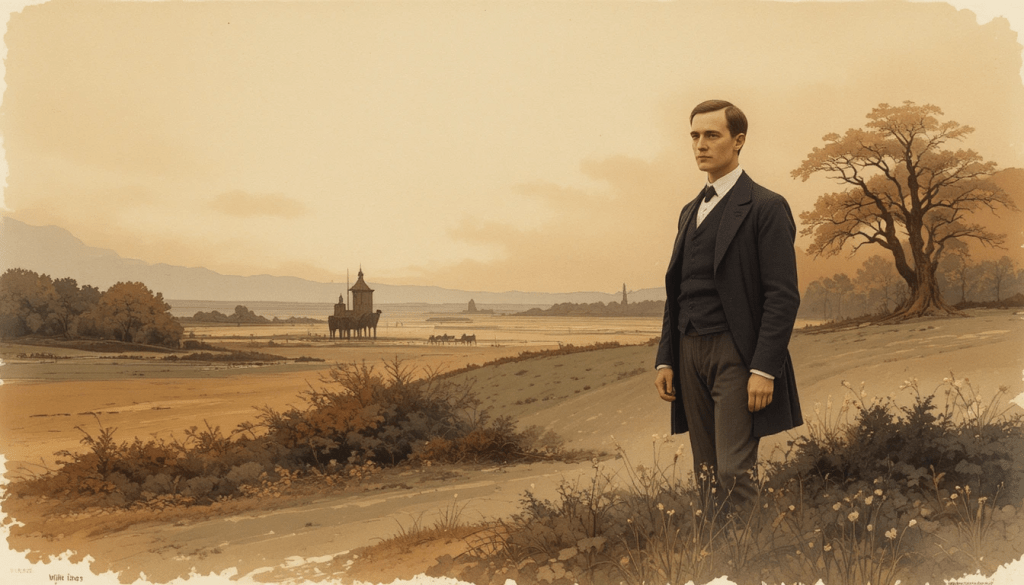
October 18, 1865
An Apostle of English Prose and the Art of Style
On October 18, 1865, Logan Pearsall Smith was born in Millville, New Jersey. An Anglo-American essayist, aphorist, and prose stylist, Smith devoted his life to the craft of English expression — to precision, grace, and the cultivated music of language. Though not a major novelist or poet, he remains a minor classic of style, a writer revered by those who love English for its elegance and restraint.
Educated at Harvard, Balliol College, Oxford, and deeply influenced by the moral and aesthetic sensibilities of late Victorian and Edwardian thought, Smith became a paragon of the cultivated essay. His works — including Trivia (1917), More Trivia (1921), and Words and Idioms (1925) — capture a quiet, reflective intelligence devoted to the beauty of language itself.
1. The Aphorist’s Voice
Smith’s prose distilled entire philosophies into brief, crystalline sentences.
- His Trivia series turned daily observation into miniature essays of wit and melancholy, revealing the spiritual texture of ordinary life.
- Like La Rochefoucauld or Oscar Wilde, he used aphorism to blend humor, skepticism, and truth.
- In English letters, his concise, epigrammatic tone helped revive an aphoristic tradition that continues to influence modern essayists and columnists.
2. The Cult of Style
Smith’s essays and notebooks are an education in good English prose.
- His lifelong obsession with purity of diction and rhythm made him a model for writers who value clarity over ornament.
- His book Words and Idioms remains a minor classic of English usage, bridging scholarship and literary sensibility.
- Smith believed that style was not decoration but moral discipline — the outward sign of an inward order of thought.
“Style is life itself; the form of one’s thought, the grace of one’s spirit.”
Through such reflections, Smith anticipated the later prescriptivism of writers like William Strunk Jr. and E. B. White, who shared his belief that good English is clear English.
3. Transatlantic Sensibility
As an Anglo-American intellectual, Smith’s work embodies the cultural bridge between British refinement and American clarity.
- His polished prose reflected the Oxford sensibility of the Bloomsbury age, yet his tone retained the New World skepticism of his Quaker upbringing.
- He contributed essays to literary circles that valued taste, civility, and balance — virtues increasingly rare in modern discourse.
- His correspondence and friendships connected him to figures like Walter Pater, Henry James, and Virginia Woolf, linking him to the broader movement of aesthetic modernism.
4. Enduring Influence
Though his reputation is modest, Smith’s impact on English style and tone endures.
- Writers, editors, and critics continue to quote his aphorisms for their clarity and wit.
- His devotion to the “right word” anticipated modern debates about style guides, linguistic precision, and literary ethics.
- In the study of English prose, he stands as a patron saint of refinement — the writer’s writer, the critic’s conscience.
Glossary of Enduring Ideas from Smith
- Aphoristic prose — condensed wisdom in elegant form.
- Purity of style — English as an art of balance and moral grace.
- Trivia — the art of finding philosophy in the ordinary.
- Linguistic conscience — the belief that clear expression mirrors clear thought.
Smith’s Lasting Legacy
Born on October 18, 1865, Logan Pearsall Smith stands as one of the quiet masters of English prose, a stylist who turned precision into poetry and reflection into art. His work reminds readers that language is not merely communication but cultivation — an act of thought, taste, and moral care.
One word, one phrase, one perfect cadence — Smith made English a mirror of the well-lived mind.
Curious about what happened today in history? Want to learn a new word every day?
You’ll find it all—first and in one place—at The-English-Nook.com!
If you love languages, this is your space.
Enjoy bilingual short stories, fun readings, useful vocabulary, and so much more in both English and Spanish.
Come explore!
 What Happened on This Day?
Leave a comment