
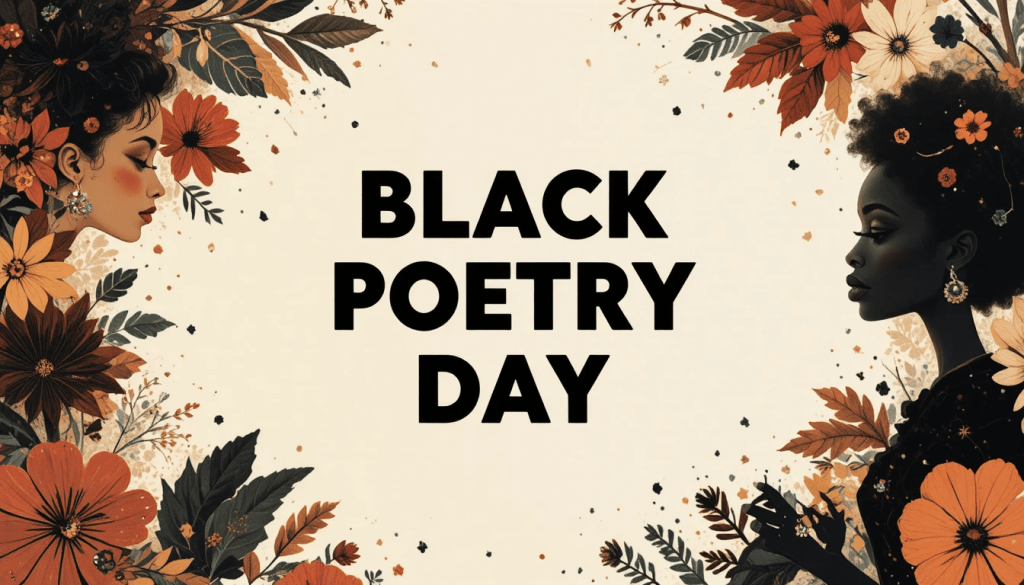
October 17
Celebrating the Voices and Vision of African American Poets
October 17 is observed in the United States as Black Poetry Day, a commemoration of the rich and enduring contributions of Black poets to American and English-language literature. The date honors the birthday of Jupiter Hammon (1711–ca. 1806) — the first published African American poet — whose 1761 poem “An Evening Thought: Salvation by Christ, with Penitential Cries” marked the beginning of a distinct Black poetic tradition in English.
This day serves not only as a tribute to Hammon’s pioneering voice but also as a celebration of the long continuum of Black creativity, resilience, and expression through poetry. From the spirituals and slave narratives of the 18th and 19th centuries to the Harlem Renaissance, the Black Arts Movement, and contemporary spoken-word performance, Black Poetry Day recognizes the ways in which language, rhythm, and storytelling have been instruments of both resistance and renewal.
1. Origins and Historical Context
Black Poetry Day was established to honor Jupiter Hammon’s birth on October 17, 1711, on Long Island, New York.
- Hammon was enslaved for most of his life, yet his poetry reflects deep religious conviction, moral reflection, and the early stirrings of a Black literary consciousness.
- His publication predates the work of Phillis Wheatley, whose Poems on Various Subjects, Religious and Moral (1773) would make her one of the first African American women poets to be published.
- Together, these early poets laid the foundation for a Black literary tradition that fused biblical language, oratory, and personal vision to articulate the experience of bondage and the longing for spiritual and social freedom.
2. The Expanding Tradition
From Hammon’s devout verse to the modern cadences of Langston Hughes, Gwendolyn Brooks, Amiri Baraka, Audre Lorde, Maya Angelou, and Nikki Giovanni, Black poetry in English has evolved as a dynamic continuum of cultural self-definition.
- The Harlem Renaissance (1920s–1930s) transformed poetry into a vehicle of cultural pride and racial affirmation, where rhythm and jazz-like phrasing gave new vitality to the English lyric.
- The Civil Rights and Black Arts movements of the 1960s and 1970s carried the language of protest and self-assertion into the public sphere, using poetry as a weapon of liberation and community-building.
- In recent decades, slam poetry, spoken word, and hip-hop lyricism have extended this tradition, bringing oral performance back to the center of poetic practice and reshaping English poetic diction for new generations.
Through all its transformations, Black poetry remains a living archive of struggle, imagination, and hope.
3. Themes and Aesthetic Power
Black Poetry Day invites reflection on the enduring themes that give this body of work its moral and emotional force:
- Freedom and identity — the right to name oneself and to speak one’s truth in a language historically used for oppression.
- Memory and ancestry — poetry as a vessel for collective remembrance and cultural survival.
- Voice and rhythm — the blending of the oral and the written, the sacred and the secular, the personal and the political.
- Justice and vision — poetry as prophecy, resistance, and renewal.
In celebrating these themes, the day reminds us that poetry is both art and action, language and liberation.
4. Modern Significance
Today, Black Poetry Day stands as both a literary and cultural observance — a time for schools, libraries, and readers to explore the works of Black poets past and present. It calls attention to the vital role of African American voices in shaping not only the content but also the cadence and character of English poetry itself.
From the metaphoric grace of Rita Dove, to the experimental intensity of Terrance Hayes, to the performance brilliance of Amanda Gorman, Black poets continue to expand the possibilities of English — transforming language into a living, breathing act of history and imagination.
5. Enduring Legacy
Black Poetry Day is thus not merely a commemoration but a continuing affirmation — a reminder that the English language has been enriched, deepened, and reimagined through Black experience. It celebrates how poets have turned pain into art, silence into speech, and oppression into song.
Every October 17, we honor the ancestral voices that forged this tradition and the new voices that carry it forward.
“I, too, sing America.” — Langston Hughes
Curious about what happened today in history? Want to learn a new word every day?
You’ll find it all—first and in one place—at The-English-Nook.com!
If you love languages, this is your space.
Enjoy bilingual short stories, fun readings, useful vocabulary, and so much more in both English and Spanish.
Come explore!
 What Happened on This Day?
Leave a comment