
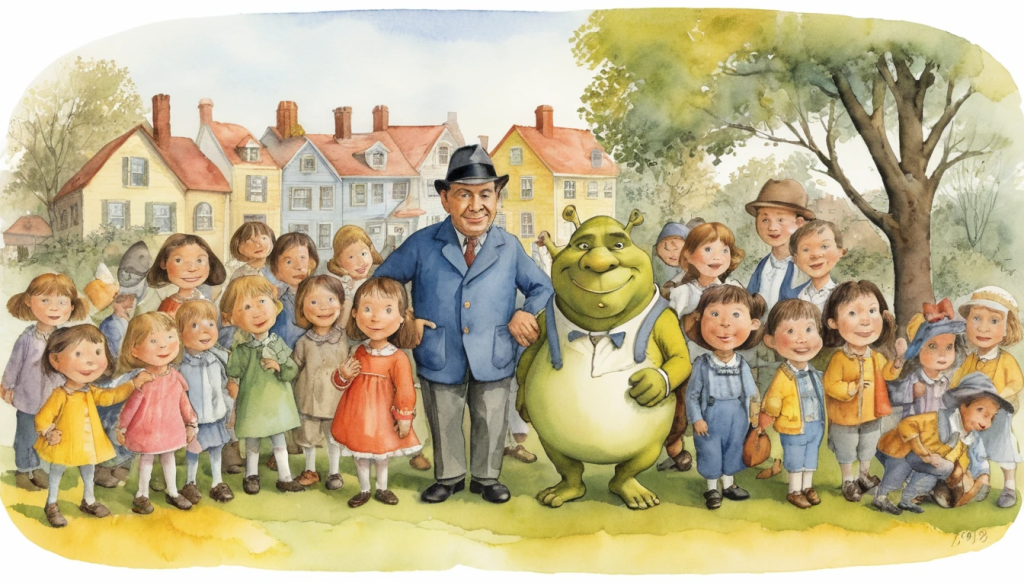
November 14, 1907
The Master of Whimsy Who Gave English a New Voice for Childhood
On November 14, 1907, William Steig was born in New York City, entering the world in the heart of a linguistic crossroads that would later shape his distinctive voice. Known first as a New Yorker cartoonist and later as a beloved children’s author, Steig developed a style — both verbal and visual — that redefined how English could sound when spoken to children without ever speaking down to them.
Across his long career, he blended wit, emotional honesty, inventive vocabulary, and a deeply human sense of play, creating stories that expanded the linguistic imagination of generations.
His works, including Sylvester and the Magic Pebble (1969), Doctor De Soto (1982), and the now-legendary Shrek! (1990), continue to shape the rhythms and humor of children’s English in the late 20th and early 21st centuries.
1. The Cartoonist Who Taught English to Smile
Before he became a children’s author, Steig spent decades crafting sophisticated, psychologically rich cartoons for The New Yorker.
His cartoons’ captions — concise, ironic, slyly literate — helped redefine the possibilities of mid-century American English humor, where a few words could suggest entire emotional universes.
This mastery of brevity carried into his children’s prose:
- He used precise yet playful diction (“gallivant,” “befuddled,” “melancholy”),
- introduced complex emotional states with simple language,
- and showed that children could embrace richness of vocabulary if treated as intelligent readers.
His cartoonist’s sense of timing gave his English a spoken, musical quality, making his stories feel as if they were being whispered by a wise, winking friend.
2. A New Emotional Realism in Children’s Literature
Steig brought to children’s English a fresh emotional depth, exploring fear, courage, embarrassment, loneliness, and love — not sentimentally, but with a gentle matter-of-factness.
He trusted children to understand the world’s ambiguities, and he used English to open emotional doors rather than close them.
In Sylvester and the Magic Pebble, for example, his language carries real heartbreak and real joy, employing a tone that respects the complexity of childhood.
In Doctor De Soto, he blends moral wit and comic tension, using animal characters and crisp English sentences to deliver timeless drama.
His English was warm, humorous, and wise — a combination that helped move children’s fiction away from moralistic simplicity toward a more psychologically rich storytelling tradition.
3. Shrek! and the Legacy of Linguistic Mischief
With Shrek! (1990), Steig created a character whose voice — irreverent, grumpy, and oddly poetic — would leap beyond the page into global popular culture.
Though the animated films expanded the world far beyond Steig’s original book, the core tone of comic subversion came directly from his prose:
an English that reveled in contradiction, silliness, and the unexpected beauty of the grotesque.
Steig’s playful manipulation of English idioms, insults, and rhythms helped legitimize a new kind of children’s voice — one that celebrated individuality, strangeness, and joy in linguistic experimentation.
A Lasting Presence in English for Young Readers
Born on November 14, 1907, William Steig spent nearly a century shaping how children read, speak, and imagine the world.
He showed that children’s English can be rich without being pretentious, playful without being trivial, and emotionally profound without losing its sense of wonder.
His stories remain proof that a few well-chosen English words — illuminated by a sense of humor and a generous heart — can stay with a reader for an entire lifetime.
In Steig’s hands, English learned once again how to play.
Where others simplified English, Steig taught it to smile, stretch, and play.
Curious about what happened today in history? Want to learn a new word every day?
You’ll find it all—first and in one place—at The-English-Nook.com!
If you love languages, this is your space.
Enjoy bilingual short stories, fun readings, useful vocabulary, and so much more in both English and Spanish.
Come explore!
 What Happened on This Day?
Leave a comment