
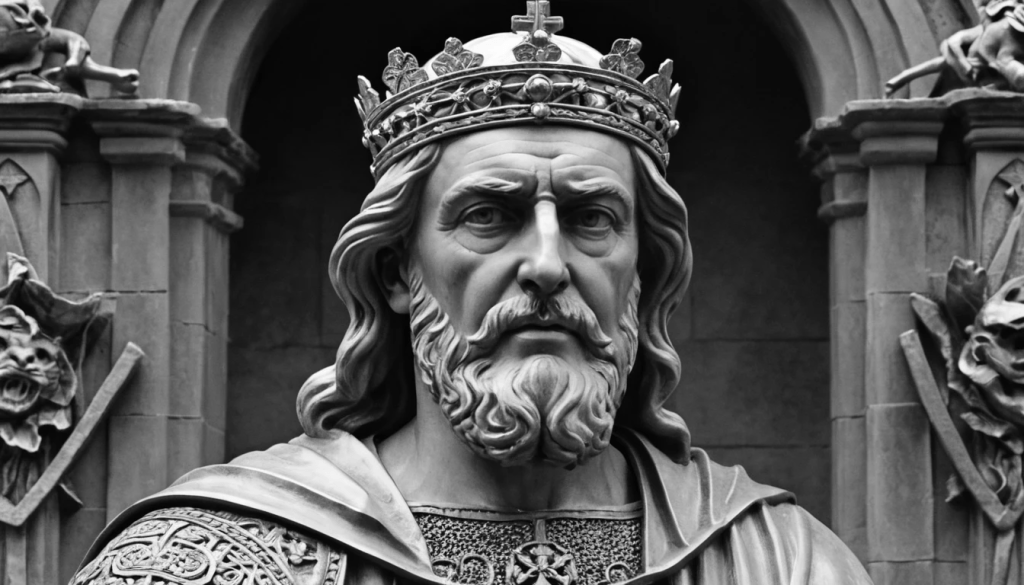
November 15, 655
A Warrior-King’s Fall and the Birth of England’s Literary Future
On November 15, 655, at the Battle of the Winwæd, Penda of Mercia, the formidable last great pagan king of Anglo-Saxon England, was killed. His death marked far more than a military defeat: it signaled the end of the old Germanic religious order and accelerated a cultural transformation that would alter the linguistic, literary, and intellectual destiny of the English language.
Though Penda left behind no written works, his absence reshaped the conditions that made English literacy, Christian scholarship, and Old English literature possible.
1. Penda’s Mercia: The Last Stronghold of the Old Oral World
During Penda’s reign, Mercia embodied the pre-Christian cultural model:
- Old English was almost entirely oral, performed through songs, genealogies, heroic narratives, and legal customs remembered by speech, not writing.
- Social authority depended on memory, ritual, and oral law, not written texts.
- The heroic ethos — the worldview underlying works like Beowulf — remained dominant.
As Christianity spread through Northumbria, East Anglia, and Kent, Penda stood as the chief political power resisting the monastic literacy that accompanied the new religion.
His reign preserved:
- a linguistically pure Old English lexicon (little Latin influence),
- traditional Germanic poetic structure,
- and an England not yet shaped by the book.
He was the last guardian of an unwritten English.
2. A Death That Opened England to the World of Books
The consequences of Penda’s death were immediate and profound.
With his defeat:
- Northumbria’s Christian kings gained supremacy, and missionaries expanded southward.
- Mercia, long closed off, became accessible to monastic education and Latin learning.
- New religious houses — such as those later at Lichfield, Peterborough, Medeshamstede, and Repton — became centers of literacy and manuscript culture.
Through these monasteries:
- Old English began to be written in a consistent script.
- Latin vocabulary entered English in waves (religion, administration, education).
- The first Mercian scribes, poets, and translators emerged within a generation.
Penda’s death thus marks the moment when England turned decisively toward the written word.
3. The Birth of an English Literary Tradition
The Christianization made possible by Penda’s fall enabled the creation of a vast corpus of early English literature.
Within the century following his death, England produced:
- Bede’s Ecclesiastical History — shaping the earliest prose tradition.
- Old English biblical translations and commentaries.
- Hagiographies, homilies, and poetic retellings of Scripture.
- The Ruthwell Cross and the earliest versions of The Dream of the Rood.
- The linguistic environment that would ultimately nurture Beowulf into written form.
These works exist because the Christian monastic culture — impossible under Penda’s rule — established the first sustained tradition of written Old English.
Through literacy, English moved from a heroic oral culture to a language capable of theology, history, poetry, philosophy, and law.
4. The Linguistic Legacy of a King Who Never Wrote
Ironically, Penda — a king who resisted Christianity and left no texts — shaped the future of the English language in invisible but decisive ways.
His death allowed:
- the rapid Latinization of vocabulary (church, altar, school, bishop, priest),
- the rise of West Saxon and Mercian literary dialects,
- the spread of written English into every social stratum,
- and the formation of educational systems that preserved the language.
Without the monastic scriptoria that followed his defeat, the English language might never have developed the textual infrastructure needed to survive Viking invasions or flourish in later centuries.
Penda’s fall ensured that English would become not just a spoken tongue, but a written civilization.
The Turning Point in the Story of English
The death of Penda of Mercia on November 15, 655, is one of the unseen but crucial pivots in the history of English.
It ended the last major pagan resistance, opened the way for literacy, welcomed Latin as a force of intellectual expansion, and created the cultural conditions necessary for English literature to exist at all.
Without Penda’s defeat, there may have been no Bede, no Old English poetry, no early English Bible, and no literary tradition from which later English culture could grow.
In his passing, the English language entered its written life — and the long journey toward becoming one of the world’s great literary languages truly began.
When Penda fell, English learned to write.
Curious about what happened today in history? Want to learn a new word every day?
You’ll find it all—first and in one place—at The-English-Nook.com!
If you love languages, this is your space.
Enjoy bilingual short stories, fun readings, useful vocabulary, and so much more in both English and Spanish.
Come explore!
 What Happened on This Day?
Leave a comment