
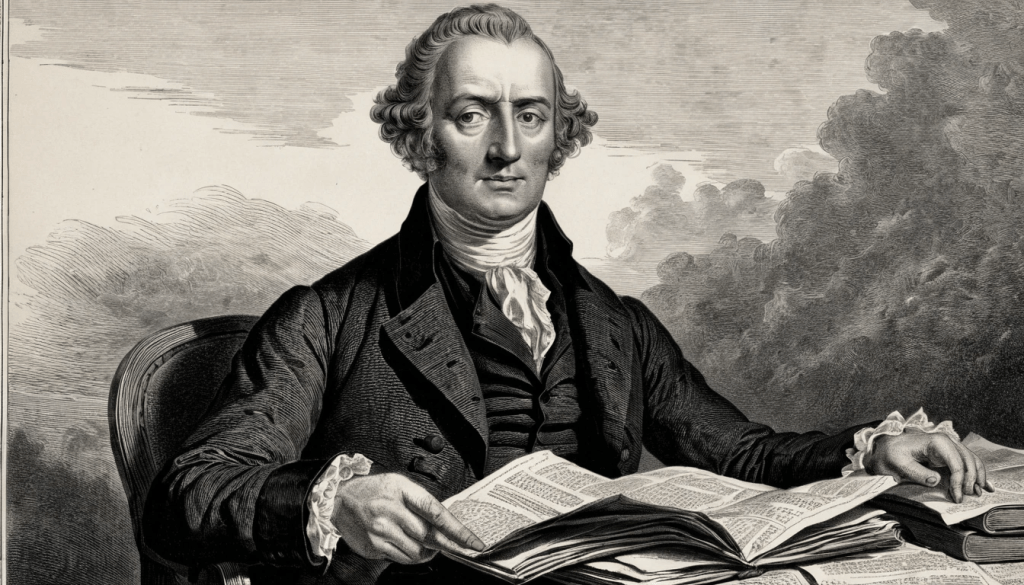
November 16, 1812
The Businessman Who Helped Give English Its Modern Public Voice
On November 16, 1812, John Walter I, the founder of The Times of London, died at Teddington. Though not himself a literary stylist or public intellectual, Walter’s role in the history of the English language is enormous. By founding and shaping what would become one of the most influential newspapers in the English-speaking world, he helped define the tone, structure, and expectations of modern journalistic English.
Walter bridged the late 18th century’s world of pamphlets, partisan sheets, and commercial bulletins with a new ideal: a newspaper that spoke with clarity, authority, and public responsibility, reaching across social classes and national boundaries. The English that newspapers use today — crisp, factual, impersonal, civic — owes a significant debt to the publishing culture he initiated.
1. Founding The Times: A New Voice for Public English
Originally launched in 1785 as The Daily Universal Register, the paper became The Times in 1788, signaling Walter’s ambition to create a publication with broad public reach and lasting influence.
Under his direction, the paper became known for:
- regular, systematic reporting
- parliamentary coverage that shaped public understanding of politics
- commercial and foreign news crucial to a rapidly globalizing Britain
- editorial commentary that balanced opinion with evidence
In an era when many English publications were still overtly partisan or sensational, Walter’s vision introduced a more disciplined, structured, and trustworthy mode of public communication.
2. Shaping the Language and Conventions of English Journalism
Perhaps Walter’s most enduring contribution lies in the linguistic norms that The Times helped standardize. Through consistency, reach, and reputation, the newspaper influenced how English would be written in public life.
Key developments included:
- A shift toward concise, neutral reportage rather than rhetorical or florid prose
- A tone of civic seriousness, avoiding both gossip and polemic
- Regularized sentence structures that favored clarity over embellishment
- A vocabulary of political and commercial English that would spread across the empire
- The early separation between “news” and “editorial opinion” — a distinction still fundamental to journalistic ethics
These changes gave English a new public register: the language of journalism, which millions would read daily, shaping ideas of what “proper,” educated, and modern English looked like.
3. Influence Across Britain and the English-Speaking World
Because The Times circulated widely within Britain and across the British Empire, Walter’s linguistic and editorial innovations were amplified on a global scale.
The paper’s influence contributed to:
- the international spread of Standard Written English
- a shared Anglo-world vocabulary for governance, trade, and public life
- a new expectation that news be accurate, timely, and responsibly sourced
- the rise of journalism as a profession governed by linguistic norms
By the mid-19th century, The Times was often referred to as “the Thunderer,” a symbol of the power — linguistic as much as political — that Walter had set in motion.
An Enduring Legacy in English Public Language
John Walter I’s death on November 16, 1812, closed the life of a man who quietly transformed the linguistic fabric of the modern world. The newspaper he founded became a model for English-language journalism everywhere, and the style he helped institute continues to shape:
- how news is written
- how information is communicated
- how public English sounds
Through The Times, Walter gave English a new voice — one authoritative, accessible, and designed for an increasingly literate society. His influence persists in every headline, report, and editorial written in modern journalistic English.
The man who taught English how to speak to the public.
Curious about what happened today in history? Want to learn a new word every day?
You’ll find it all—first and in one place—at The-English-Nook.com!
If you love languages, this is your space.
Enjoy bilingual short stories, fun readings, useful vocabulary, and so much more in both English and Spanish.
Come explore!
 What Happened on This Day?
Leave a comment