
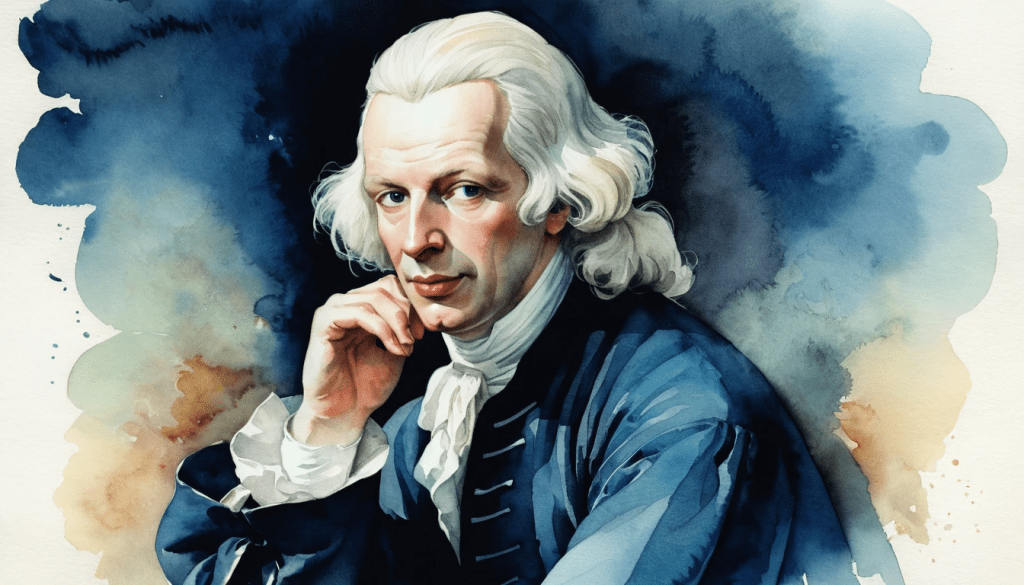
November 24, 1713
The Playful Innovator Who Turned Narrative Itself Into a Joke — and a Masterpiece
On November 24, 1713, Laurence Sterne was born in Clonmel, County Tipperary. An English-born novelist, humorist, clergyman, and one of literature’s most joyful disruptors, Sterne changed the shape and rhythm of English prose forever. With The Life and Opinions of Tristram Shandy, Gentleman (1759–1767) and A Sentimental Journey Through France and Italy (1768), he challenged every assumption about how a story should be told, turning digression, interruption, and typographical play into forms of comic genius. Few writers have had a deeper influence on the modern English novel, from its structure to its sense of humor.
1. A Revolutionary Narrative Voice
With Tristram Shandy, Sterne launched one of the boldest experiments in English fiction. He broke apart conventional storytelling by using:
- digressions that wander delightfully off-topic
- self-conscious commentary on the process of writing
- jokes about time, memory, and language
- non-linear, fragmentary storytelling
- visual tricks (blank pages, black pages, marbled pages)
This novel — apparently chaotic, but artistically precise — became a landmark of narrative innovation. Sterne’s mischievous voice created a sense of intimacy between narrator and reader, one that modern writers still strive to imitate.
His work showed that the English novel need not be orderly or predictable: it could be playful, self-aware, and structurally daring.
2. Humor, Sentiment, and the Inner Life
Sterne blended bawdy humor with deep tenderness, creating a style that was simultaneously comic and humane. In A Sentimental Journey, he introduced a new kind of emotional immediacy, pioneering a mode of personal, introspective travel writing in English.
He explored:
- the quirks of human behavior
- the workings of the mind
- the interplay between emotion and comedy
- the everyday gestures that reveal character
This combination of sentimentality and wit helped shape the emerging tradition of psychological fiction, pushing the English novel toward greater emotional subtlety.
3. Influence and Legacy
Laurence Sterne’s influence radiates across centuries. Later writers — especially those interested in form, irony, and experimentation — looked to him as a precursor. His admirers include:
- James Joyce
- Virginia Woolf
- Samuel Beckett
- Italo Calvino
- Milan Kundera
- Salman Rushdie
Modernism, metafiction, postmodernism, the comic novel — all owe a debt to Sterne’s bold reimagining of how English narrative can work.
His sense of timing, self-awareness, and comic subversion helped define an entire lineage of English humor, influencing not just novels, but essays, satire, and theatrical comedy.
A Permanent Fixture in the History of the English Novel
Born on November 24, 1713, Laurence Sterne remains one of the great innovators of English literature. His works are reminders that storytelling is not merely a vehicle for plot, but a playful, elastic form capable of surprising and delighting readers.
He taught English prose how to laugh at itself — and in doing so, he opened the door to countless experiments in narrative freedom.
The writer who taught the novel how to wink.
Curious about what happened today in history? Want to learn a new word every day?
You’ll find it all—first and in one place—at The-English-Nook.com!
If you love languages, this is your space.
Enjoy bilingual short stories, fun readings, useful vocabulary, and so much more in both English and Spanish.
Come explore!
 What Happened on This Day?
Leave a comment