
November 25, 1120
The Tragedy That Threw a Kingdom Into Chaos — and Set the Stage for Linguistic Change
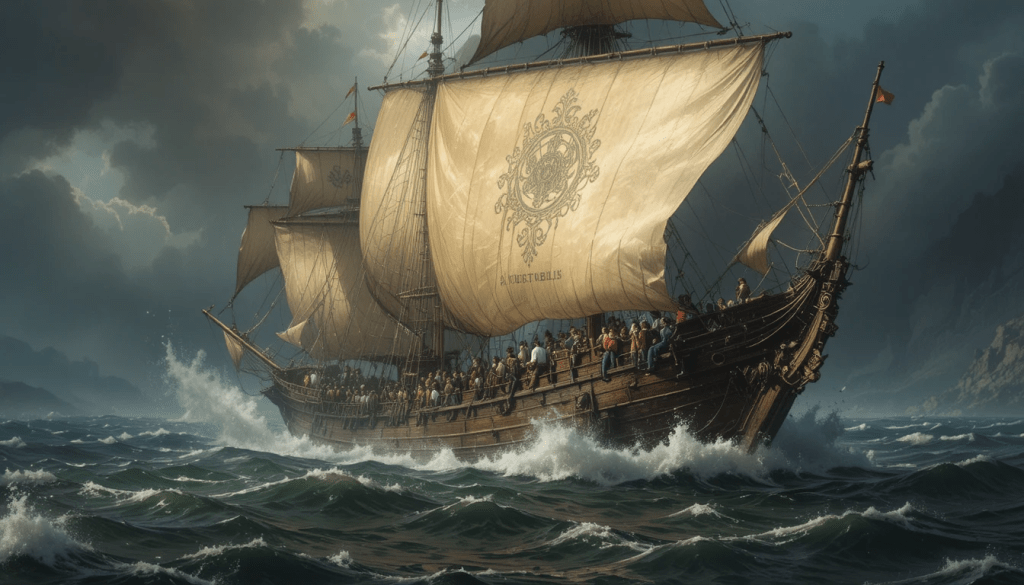
On the night of November 25, 1120, the White Ship — one of the finest vessels of its age — struck a rock and sank off the Norman coast near Barfleur. Nearly all aboard drowned, including William Adelin, the only legitimate son and heir of King Henry I of England. The disaster also claimed many young nobles from the most prominent families of Norman England. The political shockwave was immediate and devastating, and its long-term consequences reached far beyond the royal court.
1. A Succession Lost, a Kingdom Unmoored
William Adelin’s death left Henry I without a male heir, and the English crown without a clear line of succession. Henry attempted to secure the throne for his daughter, Empress Matilda, but on his death in 1135 the English nobility instead declared Stephen of Blois king — a choice that plunged the realm into nearly two decades of civil war known as The Anarchy (1135–1154).
This period of instability reshaped governance, law, and the structure of power in England. The authority of the monarchy was challenged, noble families realigned, and social order was repeatedly upended. These shifts had cultural and linguistic consequences: who governed, who wrote, and who administered justice all changed — and with them, the languages used in those domains.
2. Why This Matters for the History of English
Although the sinking of a single ship did not directly change the vocabulary or grammar of English, its political consequences profoundly altered the environment in which English evolved. The Anarchy transformed the social and institutional landscapes that determine which languages hold prestige, who uses them, and for what purposes.
Here is how:
• It weakened central authority, empowering monasteries and local chroniclers
With royal government fractured, monasteries and regional lords gained influence over record-keeping and historical writing.
- Chroniclers wrote primarily in Latin, but many were bilingual clerics exposed to both Anglo-Norman French and vernacular English.
- This kept written English traditions alive during a period when French dominated the royal court.
• It disrupted Norman aristocratic cohesion
The disaster removed much of the younger Norman elite who had grown up speaking French as a mark of status.
- Their replacements — often men with stronger local roots — had closer contact with English-speaking communities.
- This accelerated the blending of Old English and Norman French cultures, a process essential to the emergence of Middle English.
• It encouraged regional variation in law and custom
Because royal justice collapsed during the civil war, different regions developed their own practices.
- These local legal cultures interacted with local English dialects, strengthening them rather than allowing a centralized, French-speaking court to dominate.
- When English eventually returned to public administration in the 13th–14th centuries, it inherited this rich regional diversity.
• It set the stage for the Plantagenet reforms
The end of The Anarchy brought Henry II and the Plantagenet dynasty to power. Their reforms — especially those in law and administration — helped create stable institutions in which English could slowly regain authority.
- Over the next 200 years, English reappeared in courts, proclamations, and literature.
- This renaissance was possible in part because the earlier political chaos had weakened French’s absolute dominance.
In short: the White Ship tragedy altered who ruled England, how power was exercised, and what languages were used in court, law, and literature — all crucial factors in the long evolution from Old English to Middle English.
3. A Turning Point in England’s Political and Linguistic Story
The sinking of the White Ship on November 25, 1120 remains one of the most consequential maritime disasters in medieval Europe. Politically, it opened the door to civil war; culturally, it altered the makeup of England’s ruling class; linguistically, it helped create the conditions in which English would eventually reassert itself after centuries of Norman French influence.
The tragedy at Barfleur reminds us that the path of a language is shaped not only by writers and scholars, but also by the unpredictable accidents of history — a single shipwreck altering the destiny of a kingdom and, with it, the future of English.
One shipwreck, one lost heir — and a language forever changed.
Curious about what happened today in history? Want to learn a new word every day?
You’ll find it all—first and in one place—at The-English-Nook.com!
If you love languages, this is your space.
Enjoy bilingual short stories, fun readings, useful vocabulary, and so much more in both English and Spanish.
Come explore!
 What Happened on This Day?
Leave a comment