
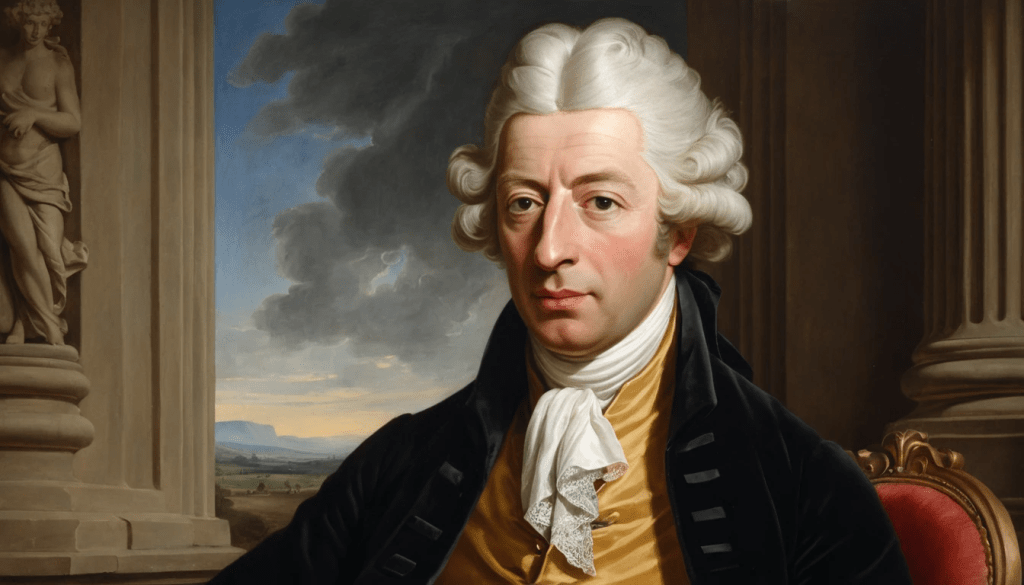
November 26, 1731
A Quiet Revolutionary at the Threshold Between Augustan Wit and Romantic Feeling
On November 26, 1731, William Cowper was born in Hertfordshire, England. One of the most influential English poets of the late eighteenth century, Cowper stands at a pivotal crossroads in literary history. His work bridged the gap between the formal, polished diction of the Augustan age and the natural, emotionally resonant voice that would later define Romantic poetry. Through works such as The Task (1785), his celebrated hymns, and his translations of Homer, Cowper transformed the tone of English verse, bringing it closer to everyday speech, daily experience, and the inner life.
1. A New Poetic Language: Clear, Humane, and Conversational
Cowper departed from the rhetorical grandeur of Pope, Dryden, and Johnson, instead cultivating a language of:
- plain, idiomatic English, attentive to natural speech
- domestic detail and rural observation
- gentle humor and moral reflection
- personal experience, deeply shaped by emotional and spiritual struggle
In The Task, he turned ordinary objects — sofas, gardens, walks, pets — into subjects of poetic meditation. His tone was intimate rather than declamatory, more akin to a familiar conversation than a public performance.
This shift helped redefine what was considered “poetic language” in English. Cowper opened the door for poetry to speak quietly, personally, and in the rhythms of everyday life — a major step toward full Romanticism.
2. How Cowper Helped Change the Course of the English Language
Cowper’s influence on the English language lies not in introducing new vocabulary, but in reshaping the stylistic possibilities of literary English. He influenced the evolution of the language through:
• Elevating Ordinary English Diction
By writing in a clean, conversational idiom, he legitimized the use of simple, unadorned English in serious poetry.
This challenged the idea that high literature required classical vocabulary or heroic couplets.
• Expanding Emotional and Psychological Expression
Cowper wrote openly about introspection, sorrow, faith, and daily anxieties.
His honesty broadened the expressive territory of English verse and influenced the tone of later poets.
• Influencing Religious and Devotional English
His Olney Hymns (many still sung today) shaped the sound and clarity of English hymnody, strengthening a style of plain-spoken sacred language.
• Preparing the Ground for Wordsworth and Coleridge
Wordsworth called Cowper “the best modern poet,” citing his naturalness, moral depth, and simplicity as direct precedents for Romantic poetic theory.
Cowper’s style thus shaped how English poetry would speak for generations.
In short, Cowper helped English literary language move away from aristocratic polish toward a more democratic, humane voice — one that modern readers instantly recognize.
3. A Lasting Legacy in English Letters
Cowper’s poetry and hymns remained widely read throughout the nineteenth century and deeply influenced the tone of the Romantic movement. His quiet introspection, compassionate view of human frailty, and love for the natural world resonated with writers from Wordsworth to Elizabeth Barrett Browning.
His Homer translation shaped nineteenth-century expectations of epic poetry in English, while his more personal works helped create a space for the interior, reflective lyric.
Born on November 26, 1731, William Cowper stands as a foundational figure in the evolution of modern English poetic language — a poet who taught English verse to speak gently, honestly, and in the rhythms of everyday life.
The poet who made English whisper — and changed it forever.
Curious about what happened today in history? Want to learn a new word every day?
You’ll find it all—first and in one place—at The-English-Nook.com!
If you love languages, this is your space.
Enjoy bilingual short stories, fun readings, useful vocabulary, and so much more in both English and Spanish.
Come explore!

 What Happened on This Day?
Leave a comment