
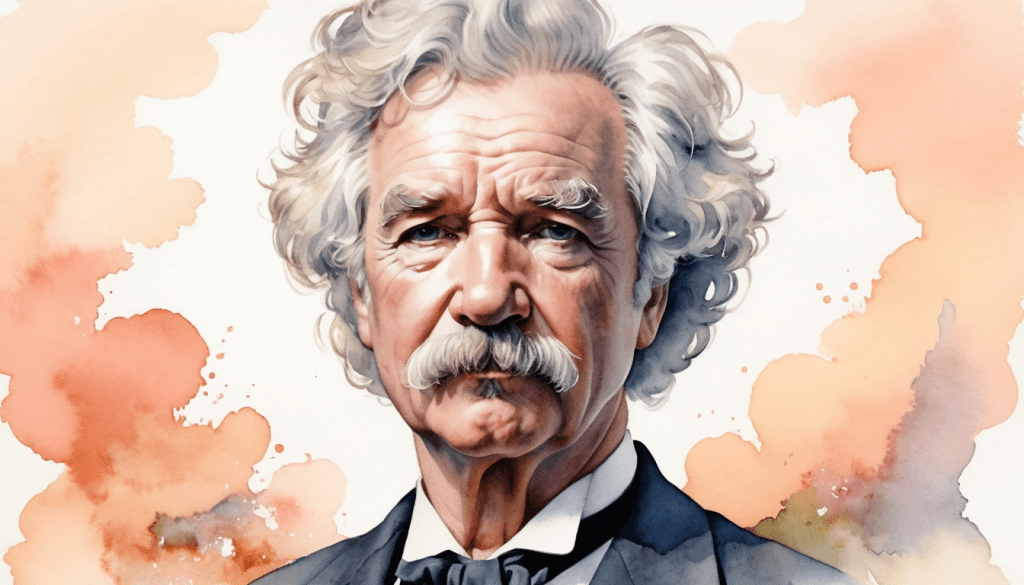
November 30, 1835
The Voice of the Mississippi That Changed the Sound, Rhythm, and Democratic Spirit of the English Language
Mark Twain was born on November 30, 1835, in the small frontier town of Florida, Missouri — a beginning as humble and unadorned as the prose style he would later champion. Raised in nearby Hannibal on the banks of the Mississippi River, Twain absorbed the stories, dialects, and contradictions of a young, raw, and rapidly changing America. Over the next seven decades he would become printer, journalist, humorist, world traveler, celebrity lecturer, and one of the most influential writers ever to shape English-language literature.
Through works such as The Innocents Abroad (1869), Roughing It (1872), The Adventures of Tom Sawyer (1876), Life on the Mississippi (1883), and The Adventures of Huckleberry Finn (1884), Twain created a new kind of English prose: vivid, colloquial, humorous, skeptical, morally urgent, and deeply attentive to the voices of ordinary people. Ernest Hemingway famously wrote, “All modern American literature comes from one book by Mark Twain called Huckleberry Finn.” And indeed, the transformation is unmistakable.
1. A Life of Wanderers, Riverboats, and Restless Curiosity
Twain’s life itself reads like a novel — one filled with mischief, near-disasters, failed business ventures, restless travel, and sharp observation of American society. As a young man he apprenticed as a printer and typesetter, later becoming a steamboat pilot — a profession that gave him his name (“mark twain,” meaning a river depth of two fathoms). His experiences in mining towns, frontier settlements, European capitals, and Pacific islands provided him with a vast human and linguistic canvas.
This range became the foundation of his literary power: Twain understood how people actually spoke — across class, race, region, and experience — and he committed those voices to the page with unprecedented fidelity. This set him apart from the polished, “proper” English that still dominated 19th-century fiction.
2. How Mark Twain Transformed the English Language
Twain’s influence on the English language is profound and multifaceted. He did not simply write stories; he altered the expectations and possibilities of English prose itself. His innovations include:
a. Making vernacular American English worthy of great literature
Before Twain, “high” English literature was dominated by British norms: formal diction, elegant syntax, and refined dialogue. Twain broke this pattern. With Huckleberry Finn — narrated in the voice of an unschooled boy — he proved that the living speech of ordinary Americans could be a vehicle for depth, irony, social critique, and beauty.
b. Elevating dialects to an art form
Twain’s ear for speech was meticulous. He reproduced:
- the dialects of Missouri river people
- the speech of enslaved Black Americans
- frontier slang
- educated and uneducated patterns
- varying regional accents
He even included a preface describing his system of dialect differentiation. This was not caricature but a linguistic map of 19th-century America — a groundbreaking use of dialect in English fiction.
c. Shaping modern narrative voice
Twain helped pave the way for later writers to experiment with:
- first-person narration
- unreliable narrators
- free indirect discourse
- child or naïve perspectives
This contributed directly to modernism and realism, influencing writers like Hemingway, Steinbeck, Faulkner, Toni Morrison, Robert Louis Stevenson, and even British stylists like Orwell.
d. Expanding English through humor and satire
Twain’s wit was sharp, democratic, and often politically radical. His satire introduced into English:
- crisp, ironic understatement
- dry, deadpan humor
- inverted logic
- a mixture of comedy and moral outrage
These techniques influenced not only novels, but the tone of English-language journalism, essays, stand-up comedy, and political commentary.
e. Contributing idioms and vocabulary to the English lexicon
Twain popularized or coined many expressions still in use. He gave English new turns of phrase and sharpened many more, embedding them in cultural memory.
f. Humanizing English prose
Twain expanded what English narrative could feel like:
earthy rather than refined, democratic rather than elite, morally earnest yet deeply funny.
He helped shape the English of the American century.
3. A Permanent Cornerstone of English and American Literary History
Mark Twain’s birth on November 30, 1835 heralded the arrival of a writer whose voice would alter the trajectory of English prose. By trusting the real rhythms of the American vernacular — in all its humor, cruelty, beauty, and contradiction — Twain liberated the language from its aristocratic constraints and opened the door to new forms of realism.
Twain’s work stands at the crossroads of English linguistic history:
- between British and American styles,
- between formal prose and everyday speech,
- between satire and moral witness,
- between youthful adventure and pointed social critique.
His legacy endures not simply because his stories are beloved, but because he fundamentally reshaped the expressive possibilities of English itself.
Mark Twain reminds us that the evolution of a language is driven not only by scholars and grammarians but by storytellers — those who listen closely to the living world and render it faithfully, humorously, and truthfully on the page.
He didn’t just write stories — he rewrote the sound of English.
Curious about what happened today in history? Want to learn a new word every day?
You’ll find it all—first and in one place—at The-English-Nook.com!
If you love languages, this is your space.
Enjoy bilingual short stories, fun readings, useful vocabulary, and so much more in both English and Spanish.
Come explore!
 What Happened on This Day?
Leave a comment