
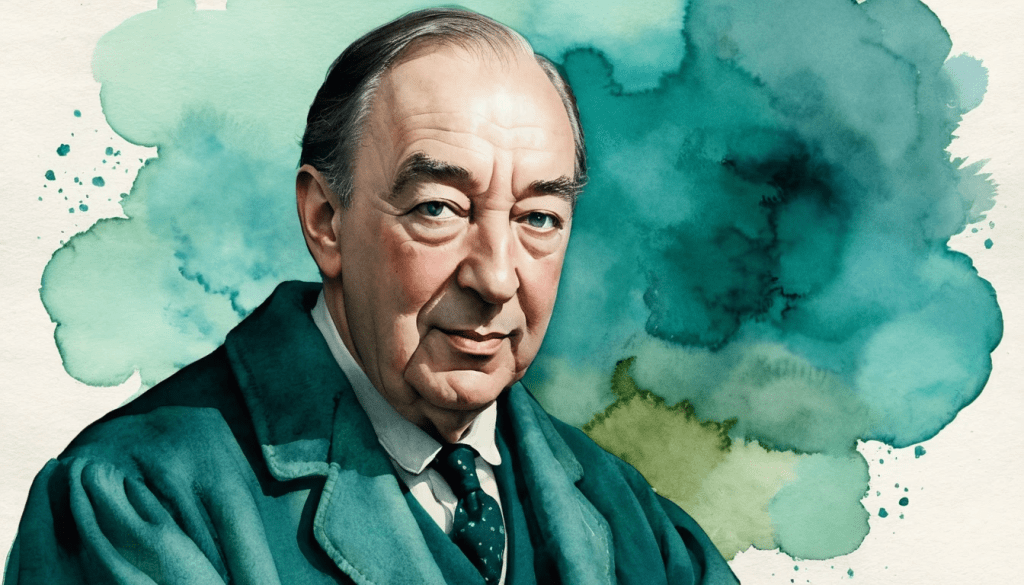
November 29, 1898
A Life That Bridged Scholarship and Story
C. S. Lewis was born on November 29, 1898, in Belfast, into a world still steeped in Victorian certainty yet on the edge of modern upheaval. From childhood Lewis lived among books, myths, and imagined worlds, a habit that shaped him into a scholar of medieval and Renaissance literature, a professor at Oxford and later Cambridge, and ultimately one of the most widely read authors in the English-speaking world.
Through works ranging from The Chronicles of Narnia to Mere Christianity, The Screwtape Letters, and his volumes of literary criticism, Lewis wrote with rare versatility. He brought the precision of a philologist, the imagination of a myth-maker, and the moral seriousness of a philosopher — all expressed in lucid, accessible English prose. Few writers have affected so many genres or so many readers.
1. A Literary Life That Redefined Storytelling
Lewis’s career stands at the crossroads of scholarship and creativity. His fiction — children’s stories, fantasies, and allegories — mingled the rhythms of medieval romance with the directness of modern English. His academic writings placed him among the century’s major critics. And his religious essays, many drawn from wartime radio broadcasts, reached an enormous audience.
Lewis wrote with a belief in the power of story to reveal truth. He treated myth, fable, and imagination not as escapes from reality but as its clarifying mirrors. As a result, his narratives continue to shape how English-speaking cultures think about moral choice, heroism, redemption, and the inner life.
2. How C. S. Lewis Influenced the English Language
Though not a reformer of grammar or inventor of new vocabulary in the strict sense, Lewis profoundly shaped the tone, texture, and expressive possibilities of modern English. His impact can be understood in several dimensions:
- He expanded the reach of mythic English prose.
Lewis fused biblical resonance, Old English simplicity, and medieval cadence into a style that felt ancient yet modern. This blend helped define the language of modern fantasy and continues to influence writers who seek that mix of clarity and grandeur. - He advanced a model of lucid, accessible philosophical English.
In essays and broadcasts collected in Mere Christianity and elsewhere, Lewis demonstrated how difficult ideas could be rendered in plain, conversational English without losing depth. His cadence — reasoned, warm, and steady — reshaped English-language Christian apologetics and popular nonfiction. - He enriched English with symbolic language and memorable imagery.
Terms and phrases such as “deep magic,” “sons of Adam,” “the shadowlands,” and “further up and further in” have entered English cultural vocabulary, carrying with them a sense of moral and imaginative weight. - He helped legitimize children’s literature as serious English prose.
By writing children’s stories with literary craft and philosophical resonance, Lewis raised the expectations for children’s English prose. Narnia helped define the style, tone, and thematic reach of modern children’s fantasy. - He influenced the narrative rhythm of modern English fiction.
Lewis favored a clear, unhurried narrative voice — descriptive but not ornate, moral without sermonizing. This voice became a model for later writers of fantasy, spiritual nonfiction, and imaginative fiction in the English language.
In all these ways, Lewis affected not only what English literature talked about but how English could sound: measured but imaginative, grounded yet capable of wonder.
3. A Lasting Presence in English Letters
C. S. Lewis’s influence continues across the English-speaking world. His novels remain in print in dozens of countries; his essays are quoted in classrooms, churches, and public discourse; his scholarly books still inform the study of medieval literature. Modern fantasy, from children’s literature to epic world-building, bears his stamp. And generations of readers learned through his prose how English can convey moral imagination with clarity and grace.
The child born on November 29, 1898 did not merely write stories — he helped shape how English-speaking cultures tell stories, ponder meaning, and use language to explore both the visible and invisible worlds.
Lewis stands as a reminder that the English language evolves not only through poets or philologists, but through storytellers of uncommon vision — writers who enlarge the imaginative space in which the language can live and breathe.
From Narnia to Oxford, Lewis didn’t just tell stories — he reshaped the language of wonder.
Curious about what happened today in history? Want to learn a new word every day?
You’ll find it all—first and in one place—at The-English-Nook.com!
If you love languages, this is your space.
Enjoy bilingual short stories, fun readings, useful vocabulary, and so much more in both English and Spanish.
Come explore!
 What Happened on This Day?
Leave a comment