
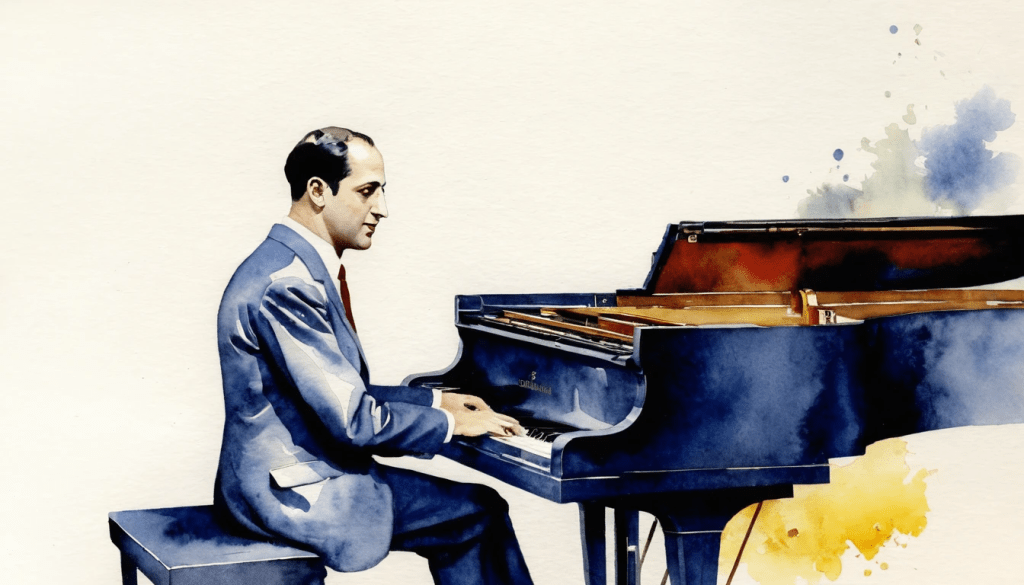
December 6, 1896
The Arrival of the American Voice Who Rewrote the English of Popular Song
On December 6, 1896, Ira Gershwin was born in New York City. As one of the great architects of the American musical, Ira — often working with his brother George — reshaped how English could move, rhyme, and sparkle within song. His lyrics helped define the vocabulary, humor, and emotional cadence of twentieth-century popular music.
Gershwin brought literary sophistication into the mainstream without sacrificing immediacy or charm. Through Broadway, Hollywood, and jazz, his language became part of everyday English, reinforcing the idea that popular song could be both colloquial and artfully crafted.
1. The Lyric Craftsman Who Modernized American English in Song
Ira Gershwin transformed how everyday English sounded when set to music.
- He blended urban idiom, witty wordplay, and tight rhyme structures into lyrics that felt natural yet elegant.
- His phrasing helped popularize a conversational tone in American song, influencing generations of lyricists from Cole Porter to Stephen Sondheim.
- By capturing the rhythms of spoken American English, he made song lyrics feel like living language — clever but never forced.
In Gershwin’s lyrics, English became a language of breezy sophistication.
2. Shaping the 20th-Century English-Language Songbook
Gershwin’s work helped establish the linguistic norms of the Great American Songbook.
- Songs like “’S Wonderful,” “Embraceable You,” “I Got Rhythm,” “They Can’t Take That Away from Me,” and “Love Is Here to Stay” set standards for lyric clarity and emotional economy.
- His skillful internal rhymes and rhythmic syncopations expanded what English lyrics could do within jazz and popular melody.
- Broadway and Hollywood adopted his stylistic template, making his linguistic influence global.
His lyrics became part of the canon through which English expresses romance, nostalgia, and urbane wit.
3. A Bridge Between High Literary Play and Popular Entertainment
Gershwin’s genius lay in merging artistic polish with mass appeal.
- He brought a literary sensibility to popular song, using metaphor, irony, and subtle emotional turns.
- His playful approach to English — clipped idioms, reversed phrases, unexpected rhymes — delighted audiences and challenged fellow lyricists.
- His work demonstrated that American popular culture could produce writing of enduring elegance.
He proved that the English of popular music could be an art form equal to poetry and theater.
4. Influence Beyond Lyrics: The Cultural English of the Jazz Age
Gershwin helped shape how English felt in the era of jazz, modernity, and cultural exuberance.
- His lyrics captured the optimism, speed, and wit of early twentieth-century America.
- Expressions from his songs entered everyday speech, subtly influencing idiom and tone.
- His collaborations contributed to a shared Anglo-American cultural vocabulary — one exported worldwide through film, radio, and jazz standards.
Through Gershwin, the English language acquired a new register of lightness, charm, and syncopated rhythm.
Glossary of Enduring Ideas from Gershwin
Conversational lyricism — song language modeled on natural speech.
Jazz-age diction — rhythmic, playful phrasing tied to the musical pulse of the era.
Popular elegance — accessible English shaped with literary craft.
Internal rhyme and wit — hallmark features of modern American song lyrics.
The American songbook voice — the shared language of 20th-century English popular music.
Gershwin’s Enduring Voice
Born on December 6, 1896, Ira Gershwin helped modern English discover its musical vernacular — witty, conversational, precise, and irresistibly singable. His influence runs through the entire English-language song tradition, from Tin Pan Alley to Broadway to jazz standards across the world.
One lyricist, one language, one enduring rhythm — Gershwin taught English how to dance.
He didn’t just write lyrics — he taught English how to swing.
Curious about what happened today in history? Want to learn a new word every day?
You’ll find it all—first and in one place—at The-English-Nook.com!
If you love languages, this is your space.
Enjoy bilingual short stories, fun readings, useful vocabulary, and so much more in both English and Spanish.
Come explore!

 What Happened on This Day?
Leave a comment