
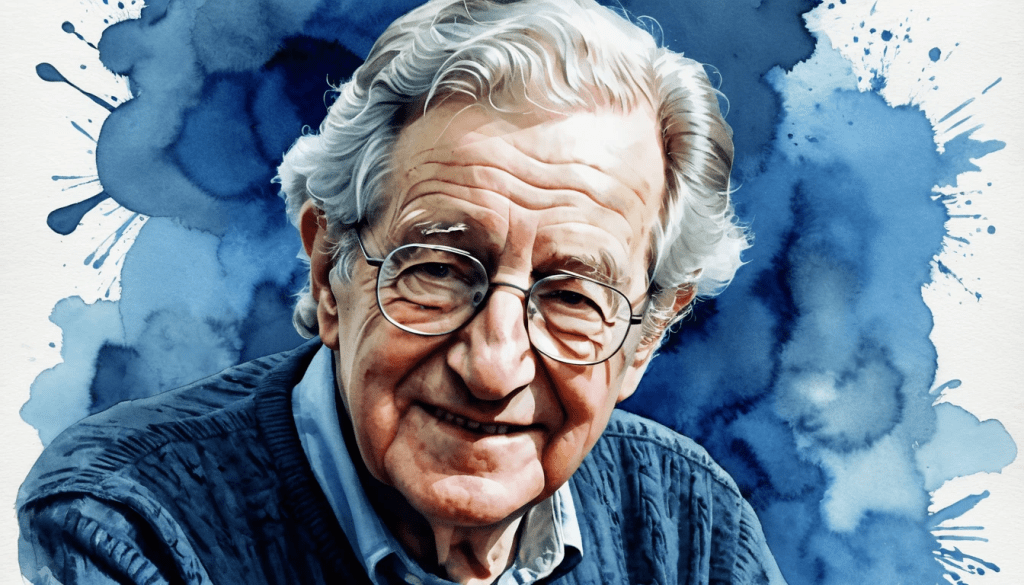
December 7, 1928
The Birth of the Scholar Who Gave Modern Linguistics Its Grammar of Thought
On December 7, 1928, Avram Noam Chomsky was born in Philadelphia — an event whose intellectual consequences would ripple through the study of language, mind, and modern English linguistics. During the mid-twentieth century, when linguistics in the English-speaking world was still dominated by structuralism and behaviorist psychology, Chomsky proposed a radically different understanding: that the human capacity for language is innate, universal, and governed by mental structures that precede experience.
With Syntactic Structures (1957) and a cascade of later works, he overturned existing models and created a new scientific paradigm. For the English language, this transformation was profound: Chomsky’s frameworks redefined the study of English grammar, reshaped academic writing about language, and provided a shared conceptual vocabulary for linguists around the world.
He did not merely shift the study of English — he reoriented the entire intellectual landscape in which English-language linguistics takes place.
1. The Architect of Generative Linguistics: A New Science of Language
Chomsky’s most enduring contribution is the concept of generative grammar — the idea that humans possess an internal system capable of generating infinite sentences from finite rules.
- He argued that language is not learned by imitation but is a manifestation of an underlying mental structure.
- This theory directly challenged behaviorism, which dominated American linguistic thought at the time.
- His approach framed language as a biological endowment, making linguistics a branch of cognitive science.
For English-language scholarship, this marked a revolutionary moment. Chomsky’s ideas transformed linguistics from descriptive cataloguing into a rigorous, theory-driven discipline centered on universal human cognition.
2. Transforming the Study of English Grammar
Chomsky’s influence on the analysis of English grammar is unparalleled in modern times.
- He recast English syntax as a system of hierarchical, rule-governed structures operating beneath the surface of everyday speech.
- The distinction between deep structure and surface structure gave linguists a way to explain how very different sentences can express similar underlying relations.
- Concepts such as movement, transformations, and binding principles changed how grammar is taught, researched, and understood.
For decades, English grammar textbooks — especially in universities — were shaped by Chomskyan models. Even fields that later moved beyond generative grammar still rely on the terminology and conceptual scaffolding he established.
In short, to study English grammar in the late twentieth century was to work in the intellectual terrain Chomsky cleared.
3. Recasting English-Language Linguistics as Cognitive Science
Chomsky’s influence extended beyond grammar into the very methodology of English-speaking academic linguistics.
- He shifted the field from fieldwork-based structuralism to cognitive, theory-driven analysis.
- English became the primary language of generative-linguistic publication, turning English into the global lingua franca of the discipline.
- His ideas helped form the early foundations of modern cognitive science, linking linguistics with psychology, philosophy, neuroscience, and computer science.
As a result, English-language linguistics departments worldwide adopted a more interdisciplinary, mind-centered approach — one that persists today even in schools that critique or revise Chomsky’s theories.
4. A New Vocabulary for English Intellectual Thought
Chomsky enriched English with an analytical vocabulary that reshaped both linguistic and philosophical discourse.
Words and concepts he popularized include:
- deep structure / surface structure
- universal grammar
- competence vs. performance
- recursive syntax
- poverty of the stimulus
- modularity of mind
These terms became part of English-speaking academia’s everyday toolkit, influencing fields from philosophy of mind to education theory.
Just as Hobbes gave English political vocabulary, Chomsky gave English a new language for understanding language.
5. Influence Beyond Linguistics: English as a Language of Critique and Inquiry
Outside of linguistics, Chomsky’s political writings also shaped the English-language intellectual world.
- His critiques of media, power, and U.S. foreign policy formed a provocative new register of English political prose — lucid, analytical, and unsparing.
- He demonstrated how precise, logically structured English could function as a tool of social critique.
- His writing style — terse, technical, and unornamented — influenced academic prose across disciplines.
Chomsky’s linguistic theories and political writings formed a dual legacy: English learned from him both how to analyze sentences and how to analyze systems of power.
6. The Reverberations of Chomsky’s Legacy for English Today
Chomsky’s influence endures wherever English is studied or taught.
- Modern English-as-a-second-language pedagogy often draws on generative concepts, even indirectly.
- Debates over grammar, innate structures, and cognitive universals continue to unfold entirely within the conceptual vocabulary he built.
- New linguistic frameworks — minimalism, optimality theory, usage-based grammar — define themselves in relation to Chomsky, whether extending or disputing his claims.
The intellectual topography of English-language linguistics remains fundamentally Chomskyan.
Glossary of Enduring Ideas from Chomsky
Generative grammar — the mental system that produces infinite expressions from finite principles.
Universal grammar — innate structures underlying all human languages.
Deep structure — the abstract, conceptual form of a sentence.
Surface structure — the outward, spoken form of a sentence.
Competence vs. performance — the knowledge of language versus its real-world use.
Recursion — the ability to embed structures within structures, a hallmark of human language.
Modularity — the idea that language is a specific cognitive faculty.
Chomsky’s Enduring Voice
Born on December 7, 1928, Noam Chomsky became the most consequential linguist of the modern era. His theories reshaped not only our understanding of language in general, but the ways English grammar, syntax, and linguistic theory are conceptualized, taught, and debated.
One mind, one theory, one profound realignment — Chomsky taught English-language linguistics to look inward, to see language not merely as sound or text, but as the architecture of human thought itself.
Chomsky didn’t just change linguistics—he rewired how English thinks about thinking.
Curious about what happened today in history? Want to learn a new word every day?
You’ll find it all—first and in one place—at The-English-Nook.com!
If you love languages, this is your space.
Enjoy bilingual short stories, fun readings, useful vocabulary, and so much more in both English and Spanish.
Come explore!
 What Happened on This Day?
Leave a comment