
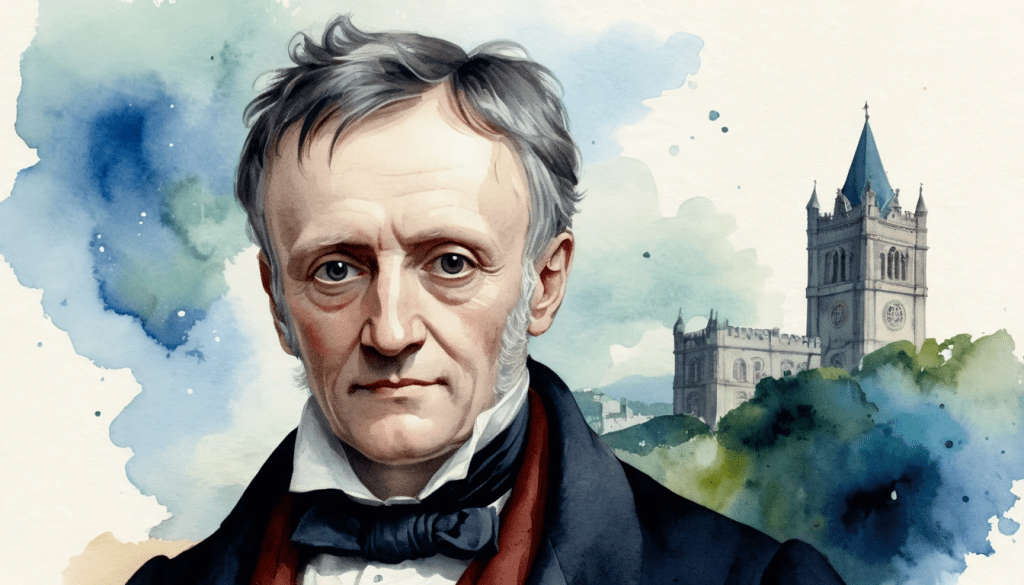
December 8, 1859
The Essayist Who Turned English Prose Into a Landscape of the Mind
On December 8, 1859, Thomas De Quincey died in Edinburgh, leaving behind one of the most distinctive bodies of prose in English literature. Known above all for Confessions of an English Opium-Eater (1821), he transformed the English essay into a vehicle for psychological depth, dreamlike imagery, and philosophical introspection.
In an age when prose often prized clarity and reason, De Quincey made the inner life—its anxieties, visions, obsessions, and imaginative flights—the center of literary expression. He reshaped English prose into something fluid, musical, and hallucinatory, influencing generations of stylists, autobiographers, and modern psychological writers.
His voice, hovering between confession and creation, helped establish the English-language personal essay as a form capable of emotional complexity and artistic grandeur.
1. Architect of the Modern English Personal Essay
De Quincey expanded the English essay far beyond the moral reflections of Addison or the conversational wit of Charles Lamb.
- He introduced psychological depth, treating subjective experience as a literary subject worthy of elaborate exploration.
- His prose blended autobiography, philosophy, criticism, and dream-narrative into a single expressive continuum.
- Confessions became a foundational work for the English-language tradition of memoir and autofiction.
Through him, the English essay evolved into an instrument for inner narrative, capable of charting the labyrinth of the mind.
- 2. Musical Prose and the Invention of the “Dream Essay”
De Quincey’s style helped transform English prose rhythm.
- His sentences flowed with an almost symphonic cadence—long, rolling, hypnotic.
- He coined the distinction between a “literature of knowledge” and a “literature of power,” defining the latter as prose that moves the reader through emotion and rhythm rather than instruction.
- His nocturnal imagery, opium visions, and rhetorical crescendos created a new genre: the dream essay, a fusion of poetic language and narrative prose.
This style influenced later English prose from Stevenson to Pater, from Woolf to Joyce—writers who understood that English prose could be as musical as verse.
3. A Visionary Critic of English Literature
Beyond autobiography, De Quincey was one of the great English-language literary critics of the 19th century.
- His essays on Shakespeare, Milton, Wordsworth, and German Romanticism shaped Victorian critical discourse.
- He helped introduce English audiences to continental thinkers and aesthetics.
- His critical prose combined scholarship with imaginative elaboration, showing that literary criticism could itself be a form of artistry.
His essays set a precedent for the creative critic, a model embraced by later English stylists such as Edmund Wilson, F. R. Leavis, and Harold Bloom.
4. Influence on English Psychological Writing
De Quincey’s introspective method influenced the development of English-language writing on:
- addiction and altered states
- memory, trauma, and consciousness
- the relationship between dreams and identity
Writers as diverse as Poe, Baudelaire, Dostoevsky (in translation), and later English-language modernists drew from his interior landscapes. His blending of sensation and reflection contributed to the rise of psychological realism and the confessional mode in English literature.
He made English prose a medium not just of narrative, but of inner experience.
Glossary of Enduring Ideas from De Quincey
- Literature of power — prose that moves rather than instructs
- Dream-essay — imaginative, hallucinatory prose narrative
- Interiority — the mind as a literary subject
- Musical prose — rhythm and cadence as vehicles of meaning
- Confessional voice — the self as narrative center
De Quincey’s Enduring Voice
When Thomas De Quincey died on December 8, 1859, English literature lost one of its most inventive stylists—yet his influence on the language only deepened. He showed that prose could drift like memory, swell like music, and plunge into the subconscious with poetic intensity.
Through his confessions, essays, and visionary rhythms, he turned English prose into a mirror of the mind.
One life, one voice, one unfolding dream — De Quincey taught English how to think in sentences that breathe.
Curious about what happened today in history? Want to learn a new word every day?
You’ll find it all—first and in one place—at The-English-Nook.com!
If you love languages, this is your space.
Enjoy bilingual short stories, fun readings, useful vocabulary, and so much more in both English and Spanish.
Come explore!
 What Happened on This Day?
Leave a comment