
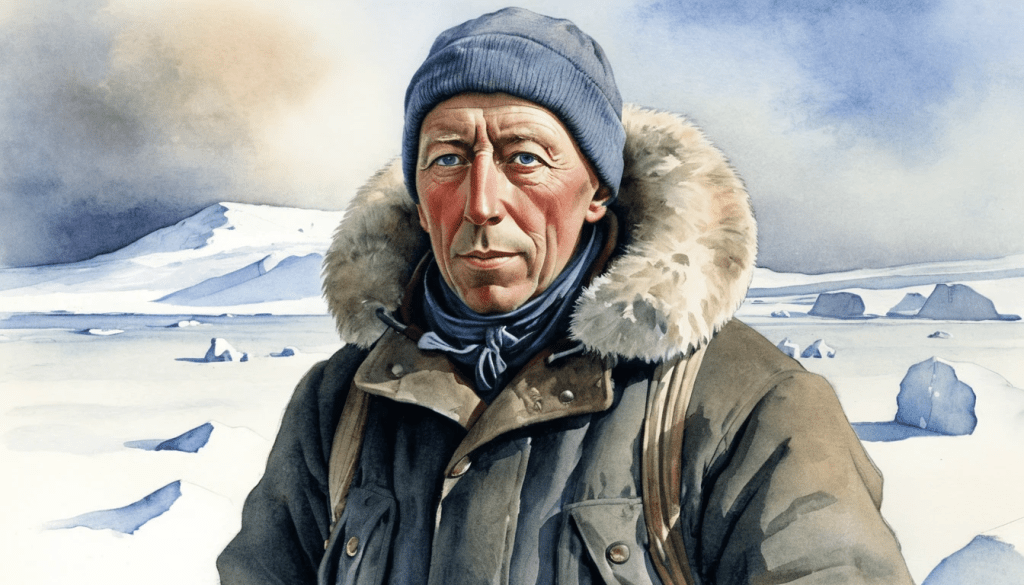
December 14, 1911
The Day Exploration Became a Global Story in English
On December 14, 1911, Norwegian explorer Roald Amundsen became the first human to reach the South Pole. Though Amundsen himself wrote primarily in Norwegian, his expedition triggered an extraordinary wave of English-language exploration writing—diaries, memoirs, reports, lectures, and popular histories that reshaped how English narrated extreme experience.
The race to the Pole, quickly reframed in English-speaking culture through comparison with Robert Falcon Scott’s doomed British expedition, generated a new genre of modern exploration literature. In these texts, English prose learned to combine scientific precision, personal testimony, endurance narrative, and existential reflection.
The South Pole became not just a geographic destination, but a narrative proving ground for English nonfiction.
1. The Birth of Modern Polar Narrative in English
Amundsen’s success catalyzed an outpouring of English-language writing about polar exploration.
- Accounts of the expedition emphasized planning, logistics, and discipline, shifting exploration writing away from romantic improvisation toward technical realism.
- English readers encountered a new style of factual storytelling—measured, observational, and grounded in survival detail.
- The Pole became a site where English nonfiction tested its capacity to describe extremity without melodrama.
Through polar writing, English prose sharpened its ability to convey endurance, precision, and restraint.
2. Diaries, Memoirs, and the Authority of First-Person English
The South Pole expeditions elevated the diary and memoir as authoritative narrative forms.
- English-language journals and personal accounts became central to how exploration was documented and understood.
- First-person narration balanced scientific reporting with emotional immediacy.
- The intimacy of diary prose influenced later English travel writing, war memoirs, and expedition journalism.
These texts helped establish firsthand testimony as a core mode of modern English nonfiction.
3. Tragedy, Comparison, and the English Moral Narrative
Amundsen’s achievement became inseparable in English writing from the tragedy of Scott’s expedition.
- English accounts framed the South Pole as a moral and cultural test: preparation versus idealism, pragmatism versus heroism.
- The contrast sharpened English nonfiction’s ability to construct comparative narratives—success and failure told side by side.
- These stories shaped English ideas of leadership, endurance, and national character.
Through polar literature, English learned to narrate not just events, but judgments.
4. Influence on 20th-Century English Travel and Nature Writing
The literary afterlife of the South Pole extended far beyond polar history.
- Polar narratives influenced later English travel writers, environmental authors, and adventure journalists.
- The style—plain, factual, quietly dramatic—became a model for serious nonfiction.
- The Antarctic landscape entered English as a symbolic space: isolation, purity, extremity, and human limits.
From exploration to environmental writing, the South Pole shaped how English tells stories of place and survival.
Glossary of Enduring Narrative Ideas from the South Pole
- Exploration nonfiction — factual narrative shaped by lived experience
- Diary authority — the power of firsthand documentation
- Comparative narrative — success defined against failure
- Extreme environment prose — restraint under pressure
- Geography as symbol — landscape as moral testing ground
The South Pole’s Enduring Narrative Legacy
On December 14, 1911, Roald Amundsen reached the South Pole—but English literature gained something equally enduring: a new model for telling real stories at the edge of human experience. Through diaries, memoirs, and reflective nonfiction, English learned how to narrate endurance, precision, and the quiet drama of survival.
The Pole became a sentence English has been finishing ever since.
One journey, one frozen horizon, one enduring genre — the South Pole taught English how to write at the limits of the world.
Curious about what happened today in history? Want to learn a new word every day?
You’ll find it all—first and in one place—at The-English-Nook.com!
If you love languages, this is your space.
Enjoy bilingual short stories, fun readings, useful vocabulary, and so much more in both English and Spanish.
Come explore!
 What Happened on This Day?
Leave a comment