
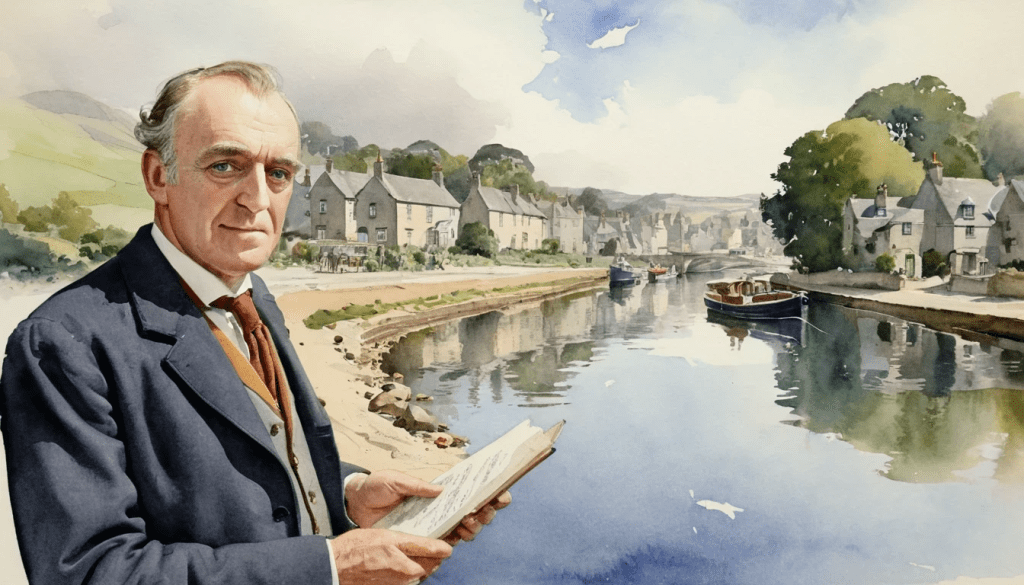
December 18, 1870
The Master of English Prose Who Turned Wit into a Form of Violence
On December 18, 1870, Hector Hugh Munro, known to the English-speaking world as Saki, was born in Akyab, British Burma. Though his literary career was relatively brief, Saki became one of the most technically accomplished and stylistically influential short-story writers in the English language.
At a time when English prose was often expansive, moralizing, or sentimental, Saki refined a radically different approach: compression, irony, and precision. His stories present a polished surface of civility beneath which cruelty, power, and indifference operate with ruthless efficiency. Few writers have demonstrated so clearly how English can imply far more than it states — and how a single sentence, placed correctly, can destroy an entire social order.
Saki did not merely entertain.
He trained English prose in discipline, restraint, and menace.
1. Precision as an Ethical and Stylistic Ideal
Saki elevated precision to a governing principle of English prose.
- His sentences are meticulously balanced, stripped of excess modifiers or emotional guidance.
- Narrative explanation is withheld, forcing readers to infer motive and consequence.
- Language operates with clockwork control, where timing is everything.
This approach helped establish a modern prose ideal: that clarity and restraint can be more powerful than elaboration.
2. Wit as a Structural Force, Not Decoration
Saki’s wit is integral, not ornamental.
- Humor drives plot, reveals character, and enacts social critique simultaneously.
- Jokes often function as traps, setting up moral or narrative reversals.
- Laughter is frequently the mechanism by which cruelty is delivered.
In his work, English wit becomes a tool of exposure — a way of stripping away comforting illusions.
3. The Weaponization of Polite English
One of Saki’s greatest contributions was his use of polite English speech as camouflage.
- Characters speak in impeccable social registers while committing moral or emotional violence.
- Conventional phrases and courteous dialogue conceal domination, revenge, and indifference.
- The gap between what is said and what is done becomes the story’s engine.
This technique permanently altered how English writers understood irony and subtext.
4. Darkness Without Moral Correction
Unlike Victorian moralists, Saki offers no reassurance.
- Innocence is often punished rather than rewarded.
- Cruelty frequently succeeds without consequence.
- The narrative voice remains cool, even amused.
This refusal of moral closure pushed English prose toward the tonal skepticism of modernism and influenced later writers who rejected sentimental resolution.
5. Shaping the Modern English Short Story
Saki’s influence on short-story form is profound and lasting.
- Stories are tightly framed, often unfolding within limited social spaces.
- Dialogue carries narrative weight equal to description.
- Endings are abrupt, shocking, and irrevocable.
These techniques helped define the modern short story as a form built on compression, implication, and finality.
6. Style as a Philosophy of Language
Saki’s prose embodies a philosophy about English itself.
- Language should reveal power relations, not disguise them.
- Excess sentiment dulls perception.
- Precision is a moral stance as much as a stylistic one.
He demonstrated that English can be elegant without being humane — and that this tension is itself revealing.
Glossary of Enduring Prose Innovations from Saki
- Sentence lethality — meaning delivered through timing and restraint
- Polite cruelty — violence masked by social language
- Structural wit — humor as narrative engine
- Irony through understatement — absence of commentary as critique
- Modern compression — narrative density over explanation
Why December 18 Matters in English Prose History
Born on December 18, 1870, Saki occupies a pivotal place in the evolution of English prose style. He stands at the threshold between Victorian expansiveness and modern precision, proving that English could be sharpened without losing elegance.
His stories remain unsettling not because they are cruel, but because they are exact.
December 18 marks the birth of a writer who taught English how to kill softly — with balance, silence, and perfect timing.
One voice, one blade, one enduring lesson:
English is most dangerous when it is calm.
Curious about what happened today in history? Want to learn a new word every day?
You’ll find it all—first and in one place—at The-English-Nook.com!
If you love languages, this is your space.
Enjoy bilingual short stories, fun readings, useful vocabulary, and so much more in both English and Spanish.
Come explore!
 What Happened on This Day?
Leave a comment