
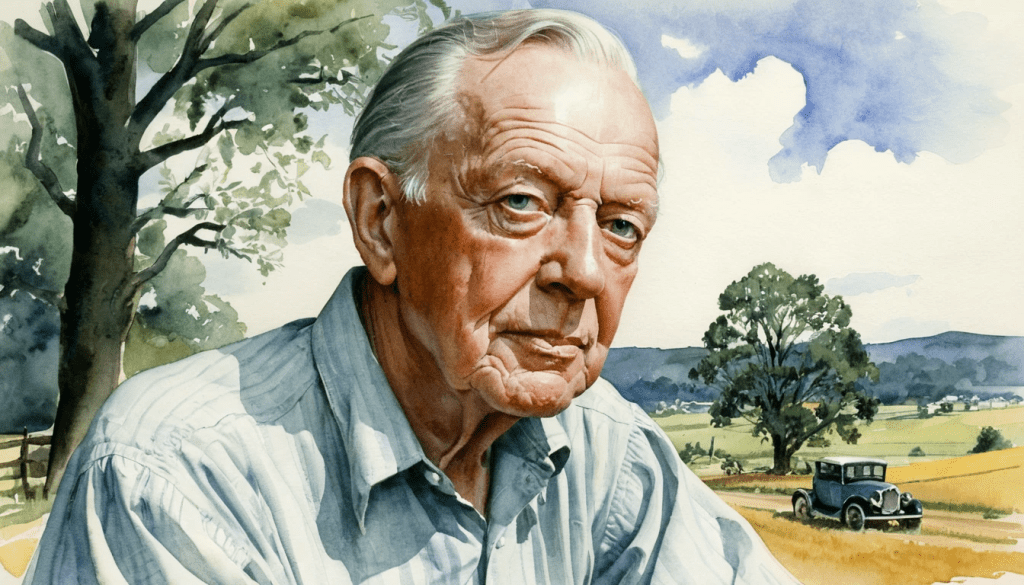
December 17, 1903
The Novelist Who Made American English Sound Uncomfortable—and Necessary
On December 17, 1903, Erskine Caldwell was born in White Oak, Georgia. A central figure in twentieth-century American realism and naturalism, Caldwell brought into English literature voices long excluded from polite narrative: the speech of rural poverty, economic desperation, and social neglect.
Through novels such as Tobacco Road and God’s Little Acre, Caldwell forced English prose to confront the linguistic realities of the American South—not as regional color, but as social evidence. His work shaped how English represents dialect, class, and systemic inequality.
He did not make English prettier.
He made it honest.
1. Regional Speech as Literary Substance
Caldwell elevated Southern rural dialect to a central narrative force.
- He represented spoken American English without translation into standardized prose.
- Syntax, rhythm, and vocabulary carried social meaning.
- Dialect was not comic ornament—it was the medium of lived reality.
His work expanded what counted as “literary” English, insisting that marginalized speech deserved narrative authority.
2. English and the Language of Poverty
Caldwell’s fiction made economic deprivation linguistically visible.
- Repetition, blunt diction, and limited vocabulary mirrored material scarcity.
- English prose reflected restricted choices, closed systems, and cyclical hardship.
- The style itself enacted the conditions it described.
By aligning language with circumstance, Caldwell deepened English realism into social diagnosis.
3. Naturalism and Social Critique in American English
Caldwell extended the naturalist tradition into the Depression-era South.
- Human behavior is shaped by environment, hunger, and institutional failure.
- Moral judgment gives way to structural explanation.
- English prose becomes an instrument of exposure rather than consolation.
His influence can be traced in later socially critical fiction that treats language as evidence rather than embellishment.
4. Influence on 20th-Century English-Language Realism
Caldwell’s impact extends beyond his immediate moment.
- He influenced how later writers handled regional speech without sentimentality.
- His work informed debates about representation, exploitation, and voice in English fiction.
- Journalists, documentarians, and novelists borrowed his stark, unadorned style.
He helped normalize the idea that English literature must speak in many accents.
5. Controversy, Censorship, and the Limits of Polite English
Caldwell’s books were frequently banned or condemned.
- His frank treatment of sex, hunger, and degradation challenged middle-class norms.
- English prose became a site of cultural conflict over what could be said—and how.
- The backlash revealed the boundaries of acceptable language in American literary culture.
Caldwell tested those boundaries, and in doing so, widened them.
Glossary of Enduring Ideas from Caldwell
- Dialect realism — speech as social document
- Naturalist prose — environment shaping language and behavior
- Poverty diction — scarcity reflected in style
- Regional authority — local English as legitimate literature
- Social exposure — narrative as critique
Caldwell’s Enduring Linguistic Provocation
Born on December 17, 1903, Erskine Caldwell forced English to confront lives it preferred not to hear. By placing rural Southern speech and economic deprivation at the center of narrative, he expanded the moral and linguistic reach of American English.
His prose reminds us that language does not merely describe reality—it reveals whose voices a culture is willing to recognize.
One region, one relentless realism, one widened English — Caldwell made the language speak where it had once stayed silent.
Curious about what happened today in history? Want to learn a new word every day?
You’ll find it all—first and in one place—at The-English-Nook.com!
If you love languages, this is your space.
Enjoy bilingual short stories, fun readings, useful vocabulary, and so much more in both English and Spanish.
Come explore!
 What Happened on This Day?
Leave a comment