
December 22, 1866
The Architect of Modern Children’s Prose in English
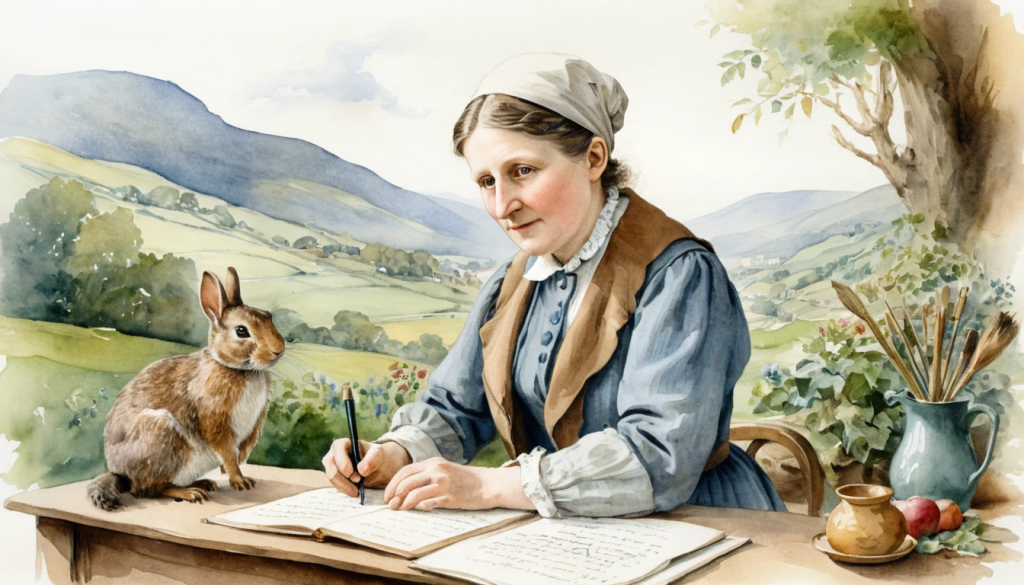
On December 22, 1866, Beatrix Potter was born in London. Few writers have shaped the sound, rhythm, and emotional intelligence of English children’s literature as profoundly as Potter. As both author and illustrator, she transformed how English addresses young readers—replacing moralizing narration with intimacy, precision, and psychological insight.
Through books such as The Tale of Peter Rabbit, The Tale of Jemima Puddle-Duck, and The Tale of Benjamin Bunny, Potter established a narrative voice that remains foundational: conversational but exact, gentle yet unsentimental, playful without condescension. Her influence extends beyond individual stories into the very grammar of how English tells stories to children.
She did not simplify language.
She trusted it.
1. Precision Without Simplification
Potter revolutionized children’s prose by refusing to dilute English.
- Her sentences are short, clear, and syntactically complete.
- Vocabulary is precise rather than vague or babyish.
- Meaning arises from context, not explanation.
This approach taught generations of writers that children can handle linguistic exactness when it is emotionally grounded.
2. The Conversational Narrative Voice
Potter helped standardize a narrative voice that feels spoken rather than preached.
- The narrator addresses the child reader with warmth and confidence.
- Tone is calm, observant, and gently humorous.
- Moral judgment emerges through consequence, not instruction.
This voice became a model for English children’s storytelling in the twentieth century and beyond.
3. Psychological Realism in Miniature
Potter’s animals behave like children, not allegories.
- Curiosity, fear, disobedience, and embarrassment drive the plots.
- Consequences are real but proportionate.
- Characters learn through experience rather than moral lecture.
English children’s literature learned from Potter how to portray inner life with respect and realism.
4. Animal Characters as Linguistic Anchors
Potter’s animal figures reshaped English storytelling patterns.
- Names, behaviors, and speech rhythms entered cultural memory.
- Anthropomorphic animals became vehicles for everyday emotional truths.
- English vocabulary absorbed these characters as reference points.
Her rabbits, ducks, and hedgehogs became part of English narrative shorthand.
5. Image and Text as a Single Language
Potter’s illustrations are inseparable from her prose.
- Visual detail reinforces narrative pacing and emotional tone.
- Text and image function as a single communicative system.
- This integration influenced how English children’s books are structured and read.
She expanded the idea of what “writing” means in children’s literature.
6. Lasting Influence on English Childhood Imagination
Potter’s impact extends across generations.
- Her narrative style influenced countless English-language writers for children.
- Her books remain among the most widely read and imitated.
- She helped define the emotional register of English childhood storytelling.
Even writers who move beyond her style do so within a framework she helped establish.
Glossary of Enduring Contributions from Potter
- Child-directed prose — language addressed directly to young readers
- Conversational narration — warmth without condescension
- Psychological realism — emotional truth at a small scale
- Narrative consequence — learning through experience
- Text-image unity — storytelling across modes
Why December 22 Matters in English Literary History
Born on December 22, 1866, Beatrix Potter occupies a central place in the history of English children’s literature. She taught English how to speak to children with respect, clarity, and imaginative trust—creating a narrative voice that still defines the genre.
December 22 marks the moment when English began speaking to children not as pupils, but as people.
One voice, one rabbit, one enduring language of childhood — Beatrix Potter reshaped English storytelling from the nursery outward.
Curious about what happened today in history? Want to learn a new word every day?
You’ll find it all—first and in one place—at The-English-Nook.com!
If you love languages, this is your space.
Enjoy bilingual short stories, fun readings, useful vocabulary, and so much more in both English and Spanish.
Come explore!
 What Happened on This Day?
Leave a comment