
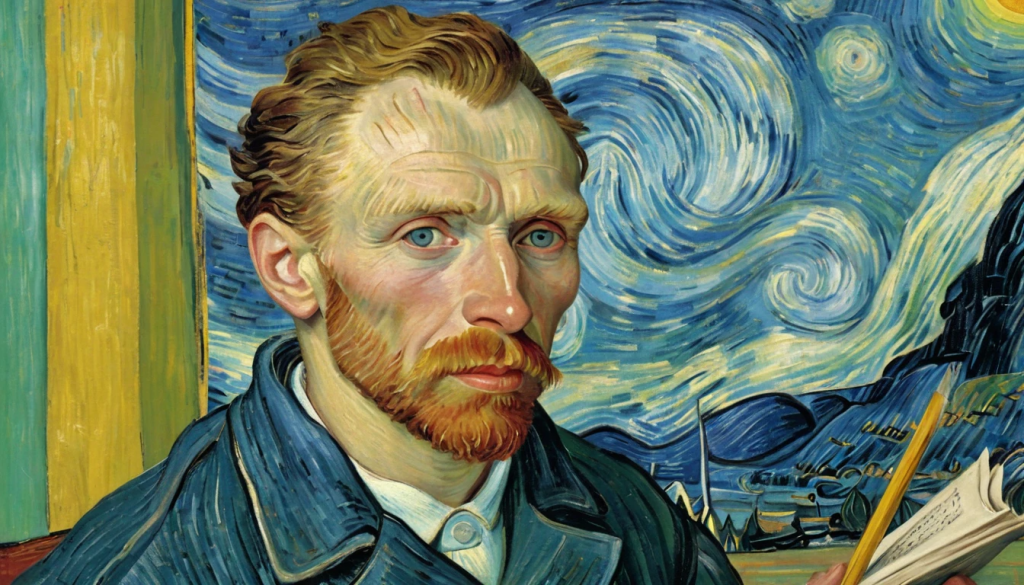
December 23, 1888
The Moment Personal Suffering Entered Literature as Deliberate Self-Narration
On December 23, 1888, in Arles, Vincent van Gogh suffered a psychological crisis that culminated in the mutilation of his own ear. While the act itself belongs to medical and art history, its enduring significance lies in what followed: a sustained, disciplined body of writing through which Van Gogh attempted to understand, explain, and survive his own condition.
In the months and years surrounding this event, Van Gogh’s letters—especially those addressed to his brother Theo—emerged as one of the most important bodies of autobiographical prose in modern literature. Through them, inner experience became narrative, suffering became structured language, and creativity was articulated as a problem of expression rather than mystique.
This date marks a turning point in how modern literature learned to speak about the self.
1. The Letter as a Primary Literary Form
Van Gogh’s correspondence occupies a central place in modern epistolary literature.
- His letters move fluidly between observation, confession, aesthetic theory, and narrative reflection.
- They combine immediacy with compositional control, resisting incoherence even at moments of crisis.
- Daily experience is shaped into communicable form, addressed to a real reader.
In English translation, these letters helped reestablish the letter as a legitimate literary genre rather than a mere historical document.
2. Language as Survival and Self-Maintenance
For Van Gogh, writing was not ancillary to life—it was stabilizing.
- Language functioned as a means of holding consciousness together.
- Thought becomes visible through sentence structure and repetition.
- Writing imposes continuity on psychological fragmentation.
This model deeply influenced English-language autobiographical writing, particularly confessional prose in the twentieth century.
3. The Construction of the Modern Artistic Self
Van Gogh’s letters actively build a narrative identity.
- He frames his life as a moral and creative struggle rather than a medical anomaly.
- Artistic purpose is repeatedly reaffirmed through language.
- The self is not discovered but written into coherence.
English literary culture absorbed this approach, shaping how artists, writers, and intellectuals narrate their own lives.
4. Expressive Prose Without Ornament
Van Gogh’s style is emotionally direct yet formally disciplined.
- Imagery is precise and grounded in perception.
- Sentences balance urgency with analytical reflection.
- Emotion is communicated without rhetorical excess.
This manner of expressive prose became a model for authenticity in English literary culture, influencing diaries, memoirs, and creative nonfiction.
5. Creativity, Crisis, and the Ethics of Representation
The December 23 incident shaped a lasting cultural narrative.
- Artistic creativity became associated with psychological extremity.
- Literature inherited the challenge of representing suffering without exploitation.
- Van Gogh’s own writing complicates the romantic myth by emphasizing labor, discipline, and responsibility.
English writers learned to approach creative crisis as a linguistic and ethical problem rather than a spectacle.
6. The Afterlife in English Literature and Criticism
Van Gogh’s letters generated a vast English-language literary response.
- Biographers shaped the correspondence into narrative arcs of meaning.
- Poets and novelists treated Van Gogh as an emblem of modern isolation and perseverance.
- Literary critics used the letters to study voice, self-representation, and creative psychology.
Through this reception, Van Gogh became a literary figure as much as a painter.
7. Translation and the Transmission of Voice
The movement of Van Gogh’s letters into English was transformative.
- Translators preserved urgency, clarity, and tonal variation.
- English gained access to a voice both vulnerable and intellectually rigorous.
- The letters became staples in literature, art history, and creative writing curricula.
Their influence crosses national and disciplinary boundaries.
Glossary of Enduring Literary Ideas from Van Gogh
- Epistolary selfhood — identity shaped through addressed writing
- Expressive discipline — emotion controlled through form
- Narrative survival — language as psychological continuity
- Creative labor — art as sustained effort rather than inspiration
- Ethical introspection — suffering shaped into communicable meaning
Why December 23 Matters in Literary History
December 23, 1888, marks a decisive moment in the history of modern literature—not because of the act itself, but because it forced language to confront interior crisis directly and responsibly. Van Gogh’s letters established a model of self-writing in which pain is neither hidden nor sensationalized, but patiently articulated.
From this moment onward, modern literature understood that inner life could be written with clarity, discipline, and moral seriousness.
One crisis, one correspondence, one enduring lesson:
language can give form to what would otherwise dissolve.
Curious about what happened today in history? Want to learn a new word every day?
You’ll find it all—first and in one place—at The-English-Nook.com!
If you love languages, this is your space.
Enjoy bilingual short stories, fun readings, useful vocabulary, and so much more in both English and Spanish.
Come explore!
 What Happened on This Day?
Leave a comment