
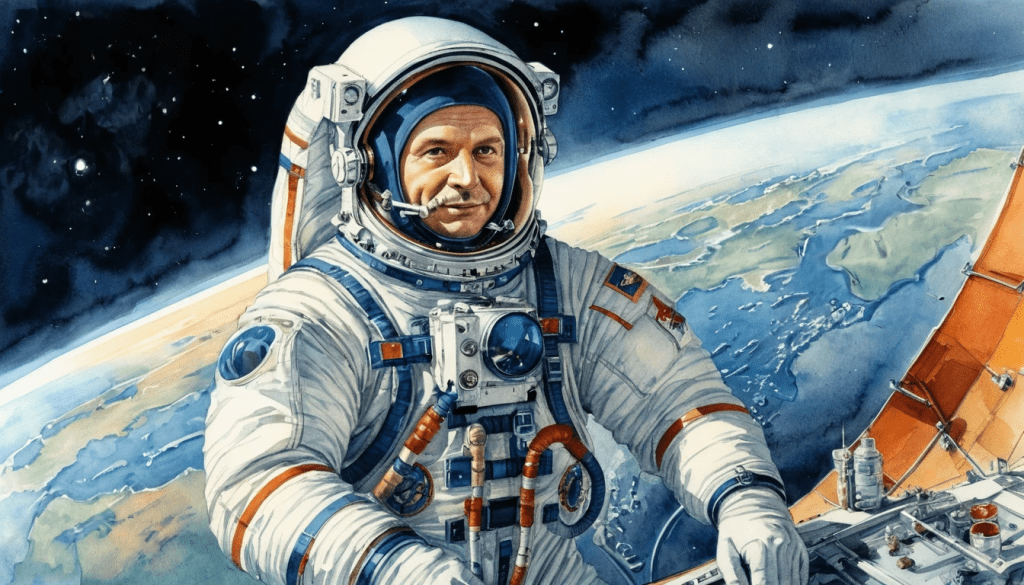
January 8, 1994
When Human Duration Forced English to Evolve
On January 8, 1994, Russian cosmonaut Valeri Polyakov launched aboard the Mir space station on a mission that would last 437 consecutive days, the longest continuous human spaceflight in history. Though conceived as a medical experiment, the mission quickly became a linguistic challenge. For the first time, scientific English was required to describe not isolated moments of danger or discovery, but the sustained reality of human life beyond Earth. The vast archive of logs, medical records, psychological assessments, and post-mission analyses generated by the flight entered the global scientific conversation largely through English, subtly extending the language’s capacity to document endurance, adaptation, and time itself.
1. Long-Duration Spaceflight as a New Genre of English Prose
Polyakov’s mission helped establish long-duration spaceflight writing as a distinct form of English nonfiction. English prose was pushed to describe months of routine without narrative climax, bodily change without crisis, and existence defined by repetition rather than event. This demanded a shift away from dramatic reportage toward sustained analytical clarity, shaping how English would later be used to document prolonged observation in science and exploration.
Clarifying points
- Endurance replaces event as the organizing principle
- Observation outweighs narrative drama
- Scientific prose adapts to extended duration
2. Medical English Under Extreme Conditions
The medical documentation produced during the mission refined English usage in space medicine, particularly in the description of gradual physiological processes such as musculoskeletal atrophy, cardiovascular adaptation, and neurovestibular change. English medical prose adjusted to track cumulative transformation rather than sudden pathology, strengthening its ability to convey slow, measurable change with precision and restraint.
Clarifying points
- Focus on gradual change rather than acute illness
- Increased reliance on time-based measurement
- Precision prioritized over expressive language
3. Translation and the Globalization of Scientific English
Much of Polyakov’s documentation originated in Russian and entered international circulation through English translation. This process reinforced English as the shared language of aerospace science while also stabilizing technical terminology across research cultures. Translation here functioned not as literary mediation but as structural alignment, shaping how scientific English presents data, uncertainty, and duration.
Clarifying points
- English serves as international scientific medium
- Terminology becomes standardized through repeated use
- National prose styles converge toward clarity
4. The Language of Isolation and Psychological Endurance
The mission required English to articulate psychological states sustained over extraordinary periods of isolation. Rather than dramatizing stress, the documentation developed a vocabulary for endurance as maintenance—describing equilibrium, monotony, and resilience without emotional excess. This restrained language influenced later English-language writing on confinement, extreme environments, and long-term human performance.
Clarifying points
- Endurance framed as stability, not heroism
- Emotional restraint in psychological description
- New vocabulary for sustained isolation
5. Time, Routine, and Narrative Compression
One of the most demanding linguistic challenges posed by the Polyakov mission was how to represent time itself. English documentation evolved strategies for compressing hundreds of nearly identical days into analyzable prose, balancing the presence of a human subject with statistical abstraction. These techniques reshaped how English handles duration in scientific narrative.
Clarifying points
- Time treated as data rather than story
- Routine summarized analytically
- Narrative compression refined
6. Objectivity and the Human Voice in Scientific English
Polyakov’s records helped normalize a form of English scientific prose that allows restrained acknowledgment of the human subject without sacrificing objectivity. Fatigue, perception, and adaptation appear in the language without sentimentality, offering a model for ethical and credible scientific reporting that remains standard today.
Clarifying points
- Limited first-person presence
- Human experience acknowledged without memoir
- Objectivity preserved
7. Influence on Later English-Language Space Writing
Later English-language texts on the International Space Station, Mars mission planning, and long-duration habitation inherit both the vocabulary and the narrative discipline developed during Polyakov’s flight. Endurance, continuity, and cumulative change are now assumed linguistic categories in space science, rather than exceptional conditions.
Clarifying points
- Endurance becomes a baseline assumption
- Linguistic continuity across missions
- Methodological influence persists
8. A Quiet Expansion of English Capability
Unlike literary milestones marked by stylistic innovation, the Polyakov mission expanded English quietly but permanently. It demonstrated that English could sustain precision across immense spans of time, describe slow biological and psychological transformation, and remain exact under unprecedented conditions. This capacity now underpins aerospace science, medicine, and future exploration narratives.
Clarifying points
- Precision over long duration
- Language for unprecedented human states
- Endurance recognized as linguistic category
Vocabulary and Linguistic Legacy
The Polyakov mission helped consolidate and stabilize existing English vocabulary rather than introduce new loanwords, refining how the language is used in scientific contexts:
- long-duration spaceflight — fixed as a formal technical category
- countermeasures — normalized in medical and physiological contexts
- physiological deconditioning — standard term for gradual bodily decline
- adaptation (neutral scientific sense) — adjustment without implied improvement
- baseline / deviation — paired analytical framework for time-based measurement
- operational endurance — applied to human systems as well as machines
Stylistically, the mission reinforced:
- nominalization for analytical distance
- time-indexed syntax (“by mission day 312”)
- restrained first-person scientific reporting
Conclusion
Beginning on January 8, 1994, Valeri Polyakov’s mission forced English to follow the human body farther and longer than ever before—and to do so without drama, excess, or metaphor. In meeting that challenge, scientific English quietly expanded its expressive range, proving capable of precision, patience, and endurance. The mission did not change what English is made of; it changed what English can sustain.
English learned how long a human life can last.
Curious about what happened today in history? Want to learn a new word every day?
You’ll find it all—first and in one place—at The-English-Nook.com!
If you love languages, this is your space.
Enjoy bilingual short stories, fun readings, useful vocabulary, and so much more in both English and Spanish.
Come explore!
 What Happened on This Day?
Leave a comment