
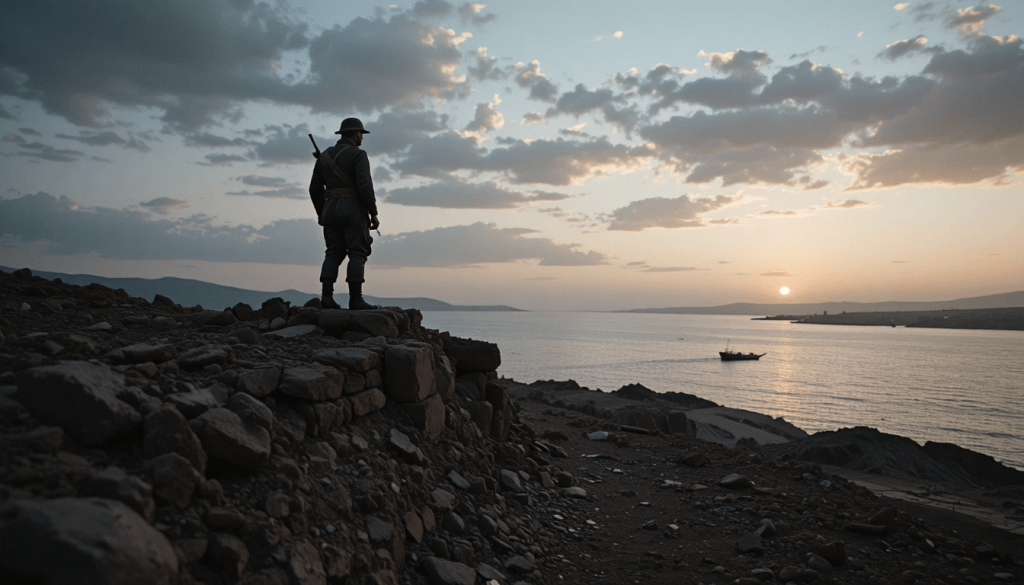
January 9, 1916
When Modern War Forced English to Speak Plainly
On January 9, 1916, the last Allied troops were evacuated from the Gallipoli peninsula, bringing to an end one of the most costly and psychologically formative campaigns of the First World War. Though militarily a failure for the British Empire and its allies, Gallipoli became a defining moment in the history of English-language war writing. The campaign generated an enormous body of letters, diaries, dispatches, memoirs, poems, and later histories that forced English to confront modern warfare without triumphal rhetoric. From this point onward, English increasingly spoke of war in tones of futility, endurance, irony, and loss rather than glory.
1. Gallipoli and the Collapse of Heroic War Prose
Before Gallipoli, much English war language still drew on Victorian ideals of honor, sacrifice, and noble suffering. The campaign’s failure—and the scale of its casualties—made such language increasingly untenable. English prose emerging from Gallipoli replaced elevated rhetoric with blunt description, understatement, and moral uncertainty. Soldiers’ accounts describe confusion, mismanagement, and physical misery in plain, almost bureaucratic English, marking a decisive shift away from romanticized war narrative.
Clarifying points
- Decline of heroic and imperial rhetoric
- Rise of plain, factual description
- Increased skepticism toward official language
2. Letters and Diaries as Primary English War Texts
Gallipoli produced thousands of personal documents written by ordinary soldiers, many of which entered English literary history through publication and quotation. These texts favored direct syntax, limited metaphor, and emotional restraint, shaping how English would later record lived experience in wartime. The authority of the first-person eyewitness voice became central, redefining authenticity in English nonfiction prose.
Clarifying points
- Personal writing gains literary authority
- Eyewitness English replaces official narrative
- Emotional control over rhetorical flourish
3. Gallipoli and the Language of Futility
The campaign helped establish futility as a central concept in English war discourse. Writers struggled to articulate loss without meaning, effort without result, and courage without reward. English prose adapted by developing a vocabulary of irony, repetition, and negation—what did not happen, what was wasted, what achieved nothing. This linguistic orientation would later define much First World War literature.
Clarifying points
- Futility becomes a dominant theme
- Language emphasizes negation and loss
- Irony replaces patriotic certainty
4. Poetry, Memory, and the Restraint of English Elegy
Although Gallipoli did not produce a single canonical poet on the scale of the Western Front, its influence is evident in English war poetry’s tonal discipline. Poems and later commemorative texts associated with the campaign adopt restrained diction, muted emotion, and controlled rhythm. English elegiac language becomes quieter, more formal, and less rhetorical, reflecting the difficulty of finding meaning in defeat.
Clarifying points
- Elegy becomes restrained rather than exalted
- Controlled diction replaces emotional excess
- Silence and understatement gain expressive power
5. ANZAC Writing and the Globalization of English War Prose
Gallipoli was foundational for Australian and New Zealand writing in English. ANZAC soldiers’ accounts contributed regional inflections to English war prose while sharing its emerging modern characteristics: plain style, irony, and skepticism toward authority. This reinforced English as a global language of war experience, capable of absorbing different accents without altering its core stylistic direction.
Clarifying points
- Expansion of English war prose beyond Britain
- Regional voices within a shared style
- Global consolidation of modern war English
6. Military Failure and Bureaucratic English
The campaign’s mismanagement generated inquiries, reports, and official analyses written in a newly defensive bureaucratic English. This language—cautious, procedural, and evasive—became a recognizable register. Gallipoli thus contributed to the widening gap in English between official discourse and lived experience, a tension that would dominate 20th-century political and military writing.
Clarifying points
- Growth of bureaucratic war language
- Contrast between official and personal English
- Institutional prose becomes cautious and abstract
7. Gallipoli in Later English Memory and Narrative
In later decades, Gallipoli became a touchstone in English-language histories, novels, and films, often used to symbolize tragic miscalculation. The language surrounding the campaign stabilized into a vocabulary of inevitability, sacrifice, and waste. English learned to narrate historical failure with solemn clarity rather than apology or myth-making.
Clarifying points
- Gallipoli becomes symbolic shorthand
- Language of tragic inevitability develops
- Failure narrated without melodrama
8. A Turning Point in English War Discourse
The end of the Gallipoli campaign marked a quiet but decisive transformation in English. War could no longer be written as adventure or moral testing alone. English proved capable of sustaining ambiguity, restraint, and moral discomfort over long narratives of loss. This linguistic shift would define modern war writing for the rest of the century.
Clarifying points
- Acceptance of ambiguity in war language
- Endurance replaces glory
- Modern war prose takes shape
Vocabulary and Linguistic Legacy
The Gallipoli campaign helped stabilize and reinforce key patterns and terms in English war discourse:
- futility — central concept in modern war writing
- evacuation — neutral, procedural term replacing heroic framing
- attrition — abstract noun describing loss without progress
- casualties — depersonalized statistical language
- miscalculation — analytical term for strategic failure
- endurance — moral value detached from victory
Stylistically, the campaign reinforced:
- plain declarative syntax
- understatement as ethical stance
- separation between official rhetoric and personal testimony
Conclusion
When the Battle of Gallipoli ended on January 9, 1916, it closed a military campaign but opened a new chapter in the history of English. The language of war emerged changed—stripped of ornament, wary of certainty, and capable of expressing loss without consolation. Gallipoli taught English how to speak honestly about failure, and in doing so, helped shape the modern voice of war literature.
After Gallipoli, English stopped pretending.
Curious about what happened today in history? Want to learn a new word every day?
You’ll find it all—first and in one place—at The-English-Nook.com!
If you love languages, this is your space.
Enjoy bilingual short stories, fun readings, useful vocabulary, and so much more in both English and Spanish.
Come explore!
 What Happened on This Day?
Leave a comment