
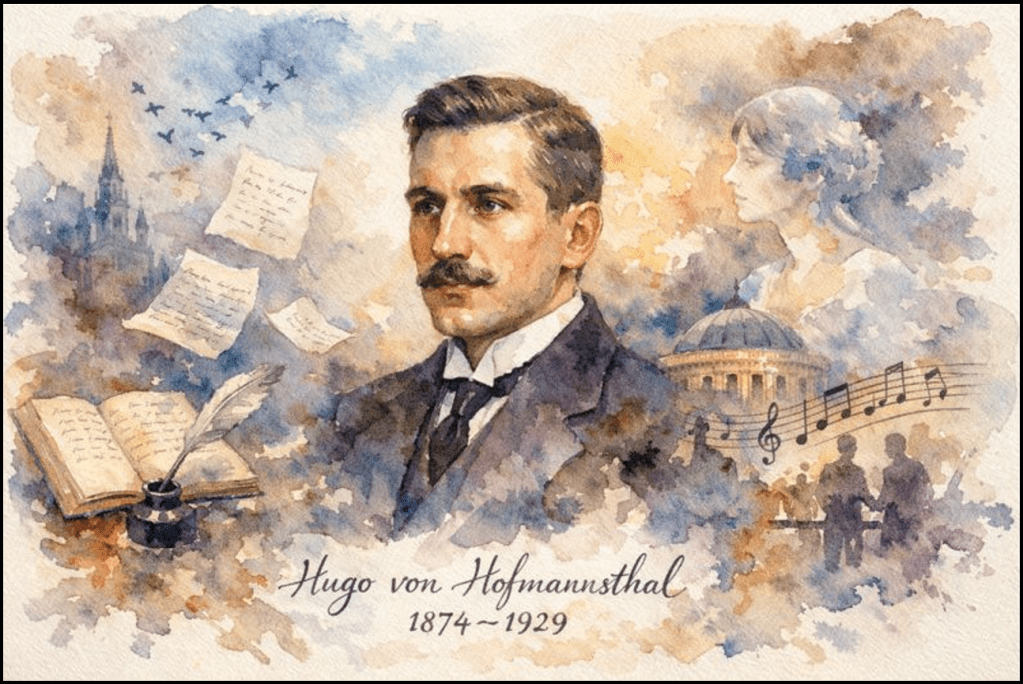
February 1, 1874
When English Modernism Learned the Limits of Speech
On February 1, 1874, Hugo von Hofmannsthal was born in Vienna. A poet, dramatist, essayist, and one of the central figures of Viennese modernism, Hofmannsthal profoundly shaped how the modern crisis of language itself would be understood—well beyond German. Through translation, criticism, opera, and comparative modernist studies, his work entered English as a crucial reference point for thinking about silence, fragmentation, interiority, and the failure of inherited language.
Although he did not write in English, Hofmannsthal helped English learn how to speak about what cannot be fully said.
The Crisis of Language and Modern Consciousness
Hofmannsthal’s most famous prose text, The Lord Chandos Letter (1902), became foundational in English-language discussions of modernism. In it, language is presented as no longer capable of transparently naming reality—a theme that would echo throughout 20th-century English literature.
English criticism absorbed from Hofmannsthal a vocabulary for linguistic doubt, including terms such as crisis of representation, linguistic exhaustion, semantic breakdown, and inexpressibility. These concepts became central to how English scholars interpret writers like T. S. Eliot, Virginia Woolf, and Samuel Beckett.
- Language as unstable medium
- Meaning as fractured rather than inherited
- Silence as expressive force
Through Hofmannsthal, English learned to analyze not only what texts say, but where they falter.
Shaping English Modernist Drama and Poetics
Hofmannsthal’s plays and libretti—especially his collaborations with Richard Strauss (Der Rosenkavalier, Elektra)—were widely translated and staged in the English-speaking world. These works influenced how English-language drama understands psychological depth, symbolic action, and compressed dialogue.
His dramatic language, rich with implication rather than exposition, reinforced an English modernist preference for:
- suggestion over statement
- atmosphere over plot explanation
- symbolic gesture over realistic speech
This approach fed directly into English theatrical modernism and later experimental drama.
Interior Life and Ethical Ambiguity
Hofmannsthal’s writing is deeply concerned with inwardness—moments of hesitation, moral uncertainty, and emotional opacity. In English translation, this contributed to a refined vocabulary for discussing interior states without confession.
Terms such as interiority, moral hesitation, psychological opacity, and ethical ambiguity gained traction in English literary discourse partly through engagement with his work. English criticism learned to articulate states of mind that resist clarity without dismissing them as vague.
Opera, Libretto, and the Expansion of English Literary Forms
Because Hofmannsthal worked extensively in opera, his influence also expanded how English understands literary language beyond the printed page. His libretti demonstrated that language could be poetic, symbolic, and dramatically economical while functioning within music.
This reinforced English critical attention to:
- text as performative object
- rhythm and repetition as meaning-making
- collaboration between verbal and non-verbal arts
Such ideas later shaped English studies of lyric drama, film, and multimedia storytelling.
Comparative Modernism and English Theory
In English-language scholarship, Hofmannsthal is frequently discussed alongside Rilke, Kafka, Joyce, Eliot, and Woolf, helping establish modernism as a transnational phenomenon rather than a purely Anglophone one. His work expanded the English critical lexicon for global modernism, especially around ideas of decadence, transition, symbolism, and late culture.
This comparative framing allowed English to develop a more nuanced, less triumphalist account of modernity—one attentive to loss as well as innovation.
Conclusion
Hugo von Hofmannsthal’s birth on February 1 marks the arrival of a writer who profoundly shaped how English would come to understand modernism’s deepest anxiety: that language itself might fail. Through translation, performance, and criticism, he taught English how to speak precisely about silence, fracture, and inner life.
February 1 stands as a significant date in English literary history—not because Hofmannsthal wrote in English, but because he helped English learn how to think when words begin to break.
When words break, thought learns to listen.
Curious about what happened today in history? Want to learn a new word every day?
You’ll find it all—first and in one place—at The-English-Nook.com!
If you love languages, this is your space.
Enjoy bilingual short stories, fun readings, useful vocabulary, and so much more in both English and Spanish.
Come explore!
 What Happened on This Day?
Leave a comment