
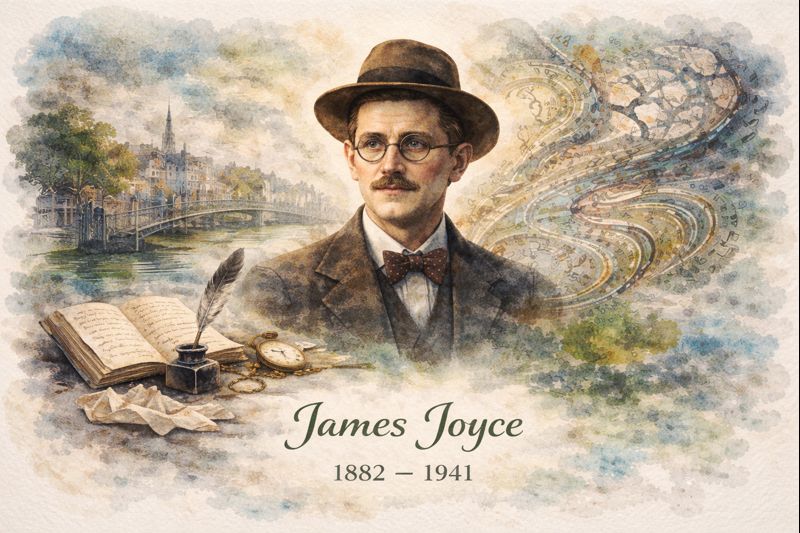
February 2, 1882
When English Learned to Think Like a Mind
On February 2, 1882, James Joyce was born in Dublin. Few writers have altered the English language as radically or as permanently as Joyce. An Irish novelist, short-story writer, and poet, he stands at the very center of literary modernism, not merely for what he wrote, but for what he forced English to become. With works such as Dubliners, A Portrait of the Artist as a Young Man, Ulysses, and Finnegans Wake, Joyce transformed English into a medium capable of rendering consciousness itself—its rhythms, interruptions, memories, and obsessions.
The Reinvention of Narrative English
Joyce dismantled inherited narrative conventions and rebuilt them from within. In Ulysses (1922), English prose becomes elastic, capable of shifting registers moment by moment—moving from journalism to catechism, from parody to lyric meditation, from street slang to scholastic precision.
This expansion permanently altered what English narrative prose could do. Joyce normalized techniques such as:
- free indirect discourse pushed to its limits
- radical shifts in style and voice within a single text
- the elevation of ordinary speech into epic structure
English fiction after Joyce could no longer assume a single “neutral” narrative voice.
Stream of Consciousness and Inner Speech
Joyce is inseparable from the development of stream-of-consciousness prose, though his method was more exacting than the term suggests. He treated thought as linguistic material—fragmented, recursive, sensory, and time-bound.
Through Joyce, English acquired new ways to articulate:
- interiority as ongoing verbal flow
- associative logic rather than linear argument
- pre-verbal sensation translated into syntax
Phrases like interior monologue, psychological realism, and mental narration gained technical meaning in English criticism largely because Joyce made them unavoidable.
Everyday Language as Literary Authority
One of Joyce’s most lasting impacts was his insistence that ordinary English—spoken, regional, imperfect—was worthy of the highest literary seriousness. Dublin street talk, pub banter, advertising slogans, newspaper clichés, and bodily idioms all enter Ulysses without hierarchy.
This validated entire registers of English previously excluded from “serious” literature:
- colloquial speech
- dialect and accent
- comic and vulgar language
- bureaucratic and commercial prose
Modern English literature’s comfort with linguistic plurality owes more to Joyce than to any other single writer.
Lexical Innovation and Linguistic Density
Joyce did not merely use English; he compressed and multiplied it. His later work, especially Finnegans Wake, pushed the language toward polysemy—words layered with multiple meanings, etymologies, and languages at once.
English criticism absorbed from Joyce a heightened sensitivity to:
- wordplay as structural principle
- etymology as narrative force
- linguistic density over transparency
Even for readers who never read Finnegans Wake, its existence expanded the theoretical limits of English itself.
Irish English and Postcolonial Language
As an Irish writer working within—and against—the English language, Joyce reshaped how English could express colonial tension, cultural hybridity, and linguistic resistance. His work demonstrated that English was not monolithic, but contested and re-inflected by history and power.
This laid groundwork for later English-language writers from postcolonial contexts, and for critical vocabularies involving:
- linguistic hybridity
- colonial Englishes
- cultural translation within a single language
Joyce made English aware of its own fractures.
Critical Language and Literary Theory
Joyce’s work generated an entire subfield of English literary criticism. Terms such as modernism, mythic method, parallax, epiphany, and textual opacity entered common scholarly usage through sustained engagement with his writing.
English criticism itself became more technical, more patient, and more linguistically self-conscious because Joyce demanded it.
Conclusion
James Joyce’s birth on February 2 marks one of the most consequential moments in the history of the English language. He did not merely write great books; he retrained English to think, to hesitate, to remember, and to contradict itself.
February 2 stands as one of the most important dates in English literary history: the birth of the writer who proved that English could contain the full complexity of a human mind—and survive the effort.
Joyce didn’t just write in English—he taught it how to think.
Curious about what happened today in history? Want to learn a new word every day?
You’ll find it all—first and in one place—at The-English-Nook.com!
If you love languages, this is your space.
Enjoy bilingual short stories, fun readings, useful vocabulary, and so much more in both English and Spanish.
Come explore!
 What Happened on This Day?
Leave a comment