
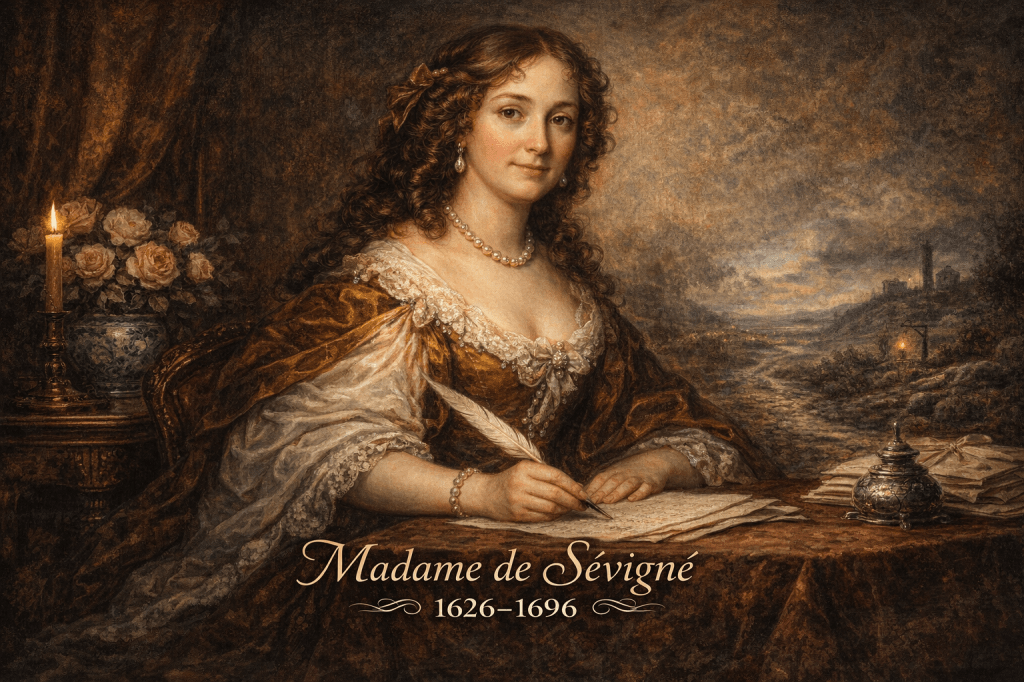
February 5, 1626
When Private Correspondence Became Literary English
On February 5, 1626, Marie de Rabutin-Chantal, Marquise de Sévigné, was born in Paris. Though a French aristocrat writing in French, Madame de Sévigné became one of the most influential figures in the history of epistolary style, and her impact traveled decisively into English through translation, imitation, and critical admiration. Her letters—especially those written to her daughter—helped shape how English came to understand personal prose as a serious literary form.
The Invention of Conversational Literary Prose
Madame de Sévigné’s letters are celebrated for their naturalness: witty, observant, emotionally expressive, and seemingly spontaneous. When translated and widely read in England from the late 17th century onward, they offered English writers a new model of prose that felt spoken rather than composed, intimate rather than rhetorical.
English absorbed from her a prose ideal marked by:
- conversational rhythm
- flexible, flowing sentences
- intimacy without informality
- wit grounded in observation
This style strongly influenced English letter-writing manuals, diaries, and eventually the personal essay.
Shaping the English Epistolary Tradition
Sévigné’s correspondence became a touchstone for English writers interested in the letter as literature. Her work helped legitimize letters as texts worth preserving, editing, and publishing—not merely private communications.
Through her influence, English refined its vocabulary for epistolary writing, stabilizing terms such as:
- familiar style
- ease and natural grace
- epistolary voice
- domestic observation
Writers like Samuel Richardson, Horace Walpole, Frances Burney, and later Jane Austen inherited an English prose tradition that valued the letter as a site of character, narrative, and social insight.
Domestic Life as Literary Subject
One of Sévigné’s most enduring contributions was her insistence that daily life, family affection, illness, gossip, and social ritual were worthy of detailed prose attention. English readers and writers learned from her that seriousness did not require grandeur.
This expanded English descriptive language around:
- domestic emotion
- maternal voice
- social nuance
- private feeling rendered with clarity
Her letters helped English move toward a prose that could register emotional depth without drama or abstraction.
Observation, Wit, and Moral Tone
Sévigné’s letters combine affectionate warmth with sharp social perception. In English reception, she became associated with a style of moral observation that avoids sermonizing, favoring irony, anecdote, and tone.
English criticism frequently uses concepts refined through her influence, such as:
- social observation
- moral wit
- ironic intimacy
- voice-driven prose
These terms remain central to how English discusses diaries, correspondence, and personal nonfiction.
Translation and the Refinement of English Prose
Because Sévigné entered English almost entirely through translation, her work also functioned as a discipline for English prose itself. Translators aimed to preserve her lightness, balance, and immediacy, reinforcing standards of clarity and elegance that shaped English stylistic taste.
Her presence in English literary culture helped establish a preference for:
- clarity over ornament
- rhythm over symmetry
- tone over thesis
These values became central to later English prose aesthetics.
Conclusion
Madame de Sévigné’s birth on February 5 marks the arrival of a writer who transformed private correspondence into a literary art—and, in doing so, taught English how to sound personal, flexible, and alive. Through translation and imitation, she helped English prose move closer to speech without losing elegance.
February 5 stands as a significant date in the history of English prose: the day we remember the letter writer who showed that intimacy itself could shape a language.
She proved that a letter could teach a language how to speak.
Curious about what happened today in history? Want to learn a new word every day?
You’ll find it all—first and in one place—at The-English-Nook.com!
If you love languages, this is your space.
Enjoy bilingual short stories, fun readings, useful vocabulary, and so much more in both English and Spanish.
Come explore!
 What Happened on This Day?
Leave a comment