
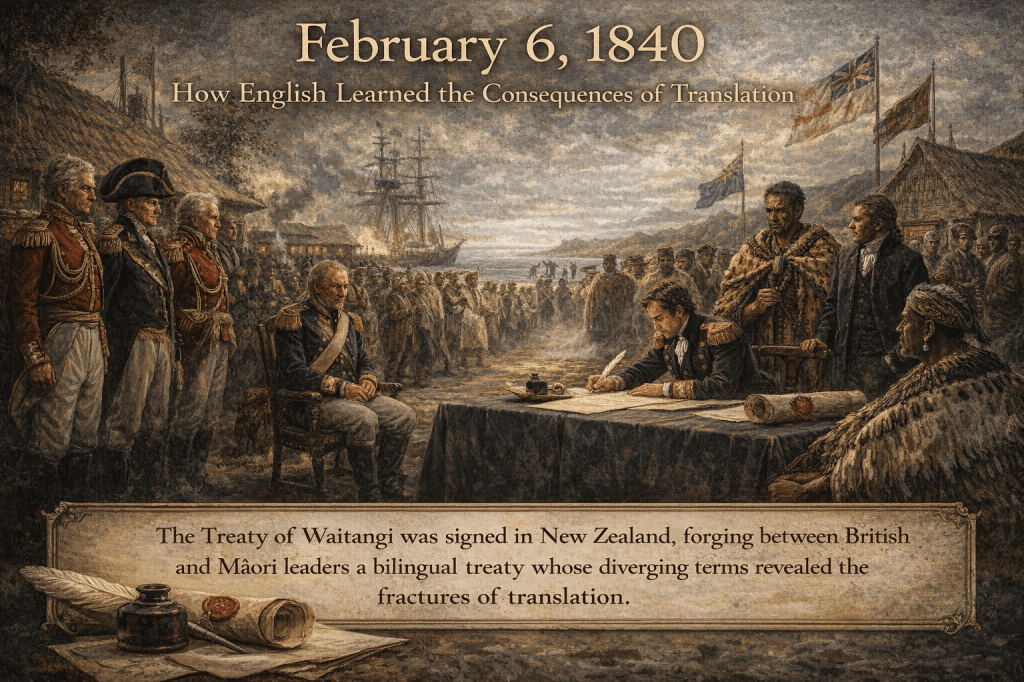
February 6, 1840
How English Learned the Consequences of Translation
On February 6, 1840, the Treaty of Waitangi was signed in New Zealand between representatives of the British Crown and Māori chiefs. While primarily a political and legal event, the treaty has had a profound and lasting impact on the history of the English language as a legal, colonial, and interpretive instrument. Few documents have more clearly demonstrated how English meaning can shift—and fracture—when law, translation, and power intersect.
English as a Colonial Legal Language
The Treaty of Waitangi was drafted in English and then translated into Māori. The two versions, however, are not semantically equivalent, especially regarding concepts of sovereignty, authority, and governance. This divergence made English central to a long-running legal and linguistic debate about meaning, intent, and legitimacy.
Key English legal terms such as sovereignty, possession, governance, and rights became focal points of dispute, revealing how abstract English legal vocabulary can obscure as much as it defines.
- English as language of authority
- Legal abstraction versus lived meaning
- Language embedded with political power
The treaty exposed English not as neutral law-speech, but as an instrument with consequences.
Translation, Ambiguity, and Semantic Drift
One of the treaty’s most significant linguistic legacies lies in its role as a case study in translation failure and semantic drift. English legal precision collided with Māori conceptual frameworks, producing enduring ambiguity.
This has deeply influenced English-language scholarship, reinforcing critical terms such as:
- interpretive discrepancy
- semantic ambiguity
- legal mistranslation
- textual indeterminacy
The Treaty of Waitangi became a foundational reference point in English discussions of how meaning changes across languages—and how law depends on that meaning.
Shaping English Legal and Historical Discourse
In the centuries since its signing, the treaty has generated an enormous body of English-language material: court decisions, parliamentary debates, historical analyses, commissions, and educational texts. Through this, English developed a more self-aware legal vocabulary around historical injustice.
Phrases such as treaty obligations, honouring the treaty, good faith interpretation, and historical redress entered common English usage in New Zealand and beyond.
English legal prose increasingly acknowledged:
- historical context as interpretive necessity
- moral responsibility within legal language
- the limits of textual literalism
This marked a shift toward more ethically reflective legal English.
English, Indigenous Language, and Bicultural Discourse
The treaty also forced English to coexist formally with another language within a national framework. This contributed to the development of bicultural and bilingual discourse in English-language governance and education.
English in New Zealand adapted by incorporating Māori terms and concepts—mana, iwi, rangatiratanga, tikanga—without direct translation, expanding English’s conceptual reach rather than replacing local meaning.
- Loanwords as conceptual bridges
- English accommodating non-English frameworks
- Language as shared, negotiated space
This enriched English as a plural and adaptive language.
A Living Text in English
Unlike many historical documents, the Treaty of Waitangi is not linguistically static. It is continually reread, reinterpreted, and renegotiated in English. Courts and scholars routinely debate not only what the treaty means, but how English itself should be read—literally, contextually, or ethically.
This has reinforced modern English critical habits such as:
- close textual reading
- attention to historical semantics
- awareness of power in interpretation
The treaty trained English readers to read more carefully.
Conclusion
The signing of the Treaty of Waitangi on February 6 marks one of the most important moments in the history of English as a legal and cultural language. It revealed the stakes of wording, the fragility of translation, and the moral weight carried by English when it speaks with authority.
February 6 stands as a landmark date in the history of English usage: the day the language was forced to confront its own limits—and the lasting consequences of how it is understood.
When English crossed languages in 1840, it discovered that meaning is never innocent.
Curious about what happened today in history? Want to learn a new word every day?
You’ll find it all—first and in one place—at The-English-Nook.com!
If you love languages, this is your space.
Enjoy bilingual short stories, fun readings, useful vocabulary, and so much more in both English and Spanish.
Come explore!
 What Happened on This Day?
Leave a comment