
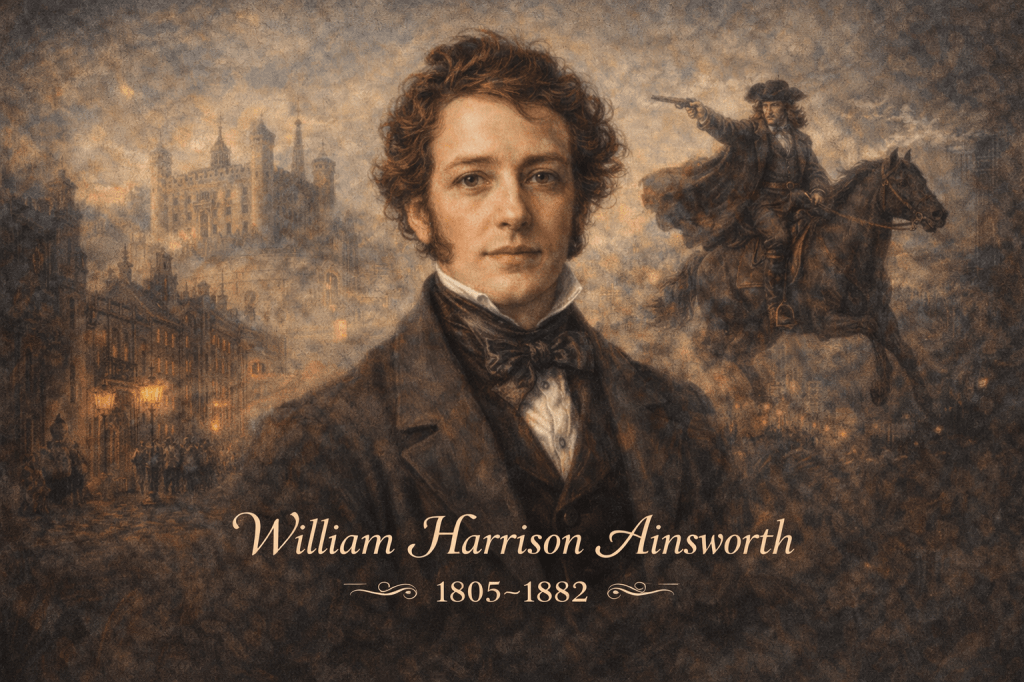
February 4, 1805
When English History Became Mass Reading
On February 4, 1805, William Harrison Ainsworth was born in Manchester, England. Ainsworth was one of the most widely read English novelists of the Victorian era, especially known for historical romances such as Rookwood (1834), The Tower of London, and Old St Paul’s. Though his reputation later dimmed in academic circles, his impact on how English history was narrated, popularized, and linguistically dramatized was immense.
Popularizing the Historical Novel in English
Ainsworth helped transform the historical novel from a learned genre into mass entertainment. Writing for a rapidly expanding reading public, he blended documented history with melodrama, folklore, and adventure, shaping an English narrative mode that was accessible, vivid, and emotionally charged.
His work expanded English prose toward:
- fast-paced historical narration
- dramatic scene-setting rooted in real locations
- a blend of archival fact and imaginative reconstruction
This helped normalize history as something that could be read for pleasure in English, not only studied.
The Mythologizing of English Outlaws and Figures
Perhaps Ainsworth’s most lasting linguistic-cultural impact comes from Rookwood, which helped cement Dick Turpin as a legendary figure in English popular imagination. Through heightened prose and theatrical dialogue, Ainsworth contributed to the romantic vocabulary of outlawry in English.
His novels reinforced and circulated terms and tones associated with:
- highwaymen and criminal folklore
- romantic rebellion
- stylized villainy and heroism
These linguistic patterns continue to echo in English adventure writing and popular historical fiction.
Victorian Serial Culture and Narrative Rhythm
Many of Ainsworth’s novels were serialized, meaning they were written to be consumed in installments. This shaped a distinct rhythmic English prose style, favoring cliffhangers, episodic tension, and memorable scenes.
Through this mode, English fiction refined techniques such as:
- suspense-driven chapter endings
- repetition for reader recall
- dramatic recap and anticipation
These devices later became foundational for popular fiction, journalism, and serialized storytelling in English.
Language, Spectacle, and Urban History
Ainsworth had a strong interest in architecture, prisons, towers, and city spaces, particularly London. His prose helped develop a spatial vocabulary of English urban history, describing places not just as settings but as narrative agents.
His work strengthened English descriptive language for:
- historic buildings as symbols
- cities as moral and social landscapes
- architecture as narrative memory
This influenced how English fiction would later treat urban space and historical atmosphere.
Critical Vocabulary and Reassessment
In modern English criticism, Ainsworth is often discussed using terms such as popular historical romance, Victorian sensationalism, serial narrative, and mythic historiography. While no longer central to the canon, he is now recognized as a key figure in the democratization of historical English prose.
His popularity also helps scholars understand how English evolved when addressing a broad, newly literate public.
Conclusion
William Harrison Ainsworth’s birth on February 4 marks the arrival of a writer who brought English history into the hands—and language—of the masses. By fusing fact, folklore, and drama, he expanded English narrative toward spectacle, accessibility, and shared cultural memory.
February 4 stands as a reminder that the English language was not shaped only by high modernists and poets, but also by popular storytellers who taught it how to captivate a nation.
He didn’t just tell history—he made it readable.
Curious about what happened today in history? Want to learn a new word every day?
You’ll find it all—first and in one place—at The-English-Nook.com!
If you love languages, this is your space.
Enjoy bilingual short stories, fun readings, useful vocabulary, and so much more in both English and Spanish.
Come explore!
 What Happened on This Day?
Leave a comment