
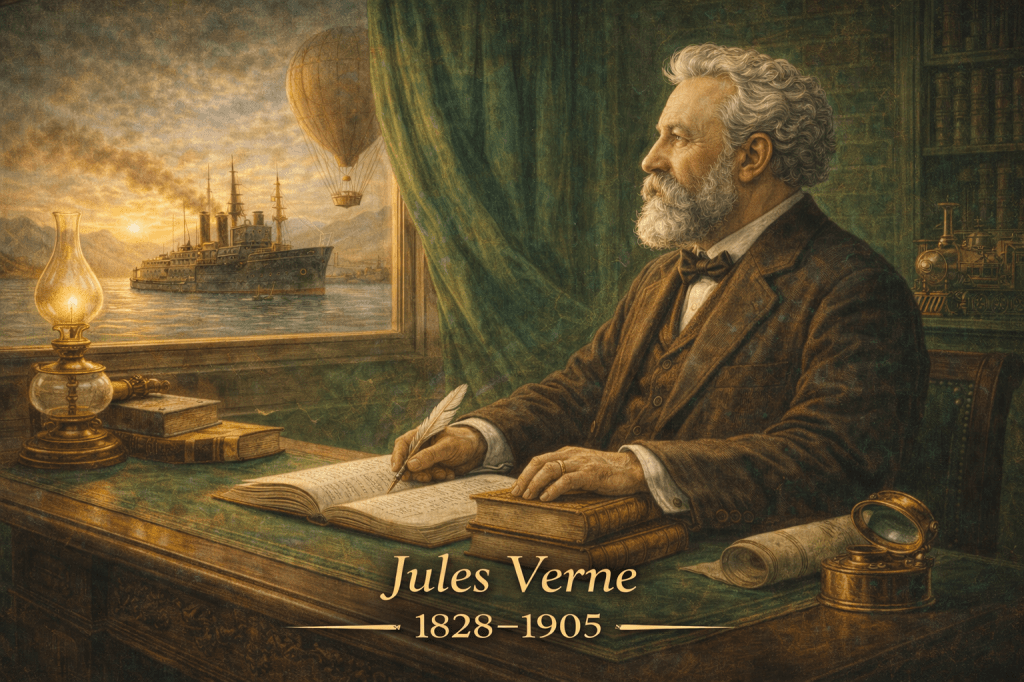
February 8, 1828
When English Learned to Treat Science as Story
On February 8, 1828, Jules Verne was born in Nantes, France. Though he wrote in French, Verne became one of the most influential figures in the history of English-language fiction, especially in the development of science fiction, adventure narrative, and popular science writing. Through rapid translation and enormous popularity in the English-speaking world, his work reshaped how English could narrate technology, exploration, and the future with factual authority and narrative excitement.
The Birth of Scientific Adventure in English
Verne pioneered a narrative mode in which speculative science is treated with the tone and structure of realism. His novels—Twenty Thousand Leagues Under the Seas, Journey to the Center of the Earth, and Around the World in Eighty Days—were eagerly translated into English and widely read across Britain and America.
Through Verne, English fiction learned to combine:
- technical explanation with forward-moving plot
- factual description with imaginative projection
- scientific vocabulary with accessible storytelling
This hybrid style became foundational for later English science fiction.
Normalizing Scientific Vocabulary in Narrative Prose
One of Verne’s most lasting impacts on English was his normalization of scientific and technical terminology within popular narrative. His translated works brought specialized vocabulary into everyday reading without didacticism.
English readers became comfortable encountering terms related to:
- oceanography and marine biology
- geology and volcanology
- astronomy and navigation
- engineering and mechanics
This prepared English for later writers who would rely heavily on scientific diction without alienating general audiences.
The Future Written in the Indicative Mood
Verne’s greatest stylistic innovation was his insistence on writing the future as if it were already real. Rather than speculative subjunctive (“might be,” “could be”), his prose favors the indicative: machines function, journeys proceed, calculations are precise.
This taught English a new narrative stance:
- speculation presented as documentation
- invention described with journalistic confidence
- imagination grounded in procedure and measurement
Modern English science fiction inherited this tone of plausible certainty directly from Verne.
Global Exploration and the Language of Wonder
Verne’s novels helped standardize a global vocabulary of exploration in English. His detailed descriptions of distant places, depths, and interiors—oceans, polar regions, subterranean worlds—expanded English’s descriptive range.
He reinforced a language of:
- geographic scale and extremity
- technological mastery of nature
- wonder framed through explanation
This language influenced not only fiction, but also travel writing, journalism, and educational prose.
Influence on English Science Fiction and Popular Culture
English-language writers from H. G. Wells to Isaac Asimov, Arthur C. Clarke, and Ray Bradbury all operate within a tradition Verne helped establish. Even when later authors challenged his optimism, they inherited his fusion of narrative momentum with scientific detail.
His impact extends beyond literature into film, comics, and educational media, shaping how English speaks about invention, progress, and exploration.
Critical Vocabulary and Genre Formation
In English criticism, Verne is frequently invoked through terms such as scientific romance, proto–science fiction, technological sublime, and didactic adventure. These concepts emerged in part to describe the narrative space he created.
English did not merely adopt Verne’s stories—it developed new critical language to account for them.
Conclusion
Jules Verne’s birth on February 8 marks a decisive moment in the history of English narrative. By teaching English how to tell scientific stories with confidence, clarity, and wonder, he made the future readable—and believable.
February 8 stands as a major date in the evolution of English fiction: the day the language learned to describe tomorrow as if it had already arrived.
He didn’t just imagine tomorrow—he made English believe it had arrived.
Curious about what happened today in history? Want to learn a new word every day?
You’ll find it all—first and in one place—at The-English-Nook.com!
If you love languages, this is your space.
Enjoy bilingual short stories, fun readings, useful vocabulary, and so much more in both English and Spanish.
Come explore!
 What Happened on This Day?
Leave a comment