
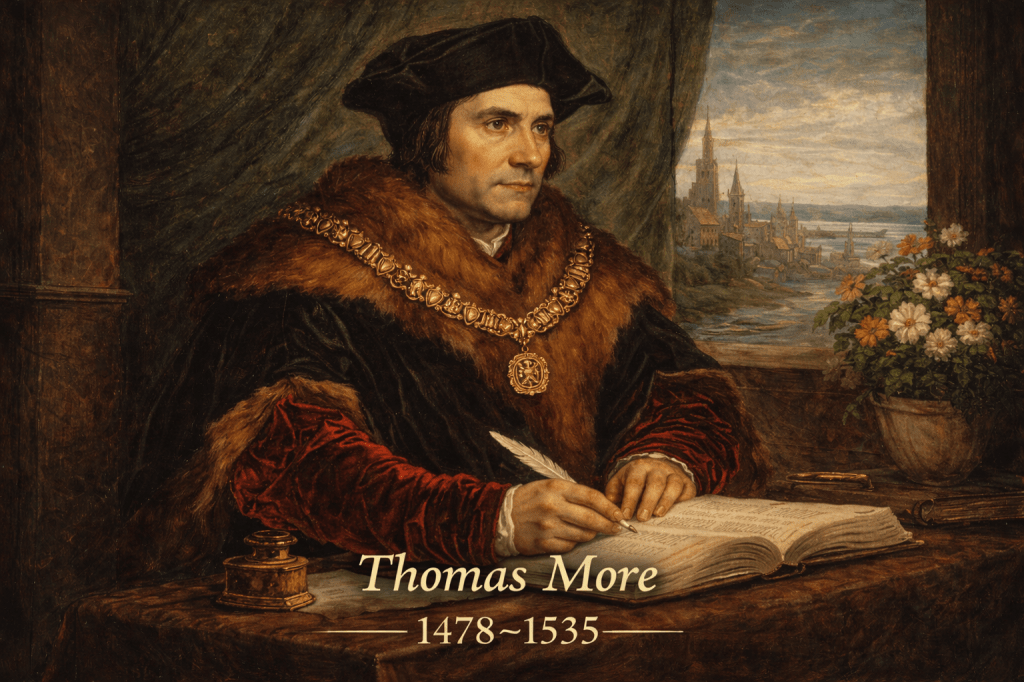
February 7, 1478
When English Learned to Think Politically Through Fiction
On February 7, 1478, Thomas More was born in London. A lawyer, statesman, Renaissance humanist, and writer, More stands at a crucial threshold in the development of English intellectual prose. With the publication of Utopia in 1516, he introduced not merely a new book, but a new linguistic and conceptual tool: the idea that social, political, and ethical systems could be explored through fictional language rather than direct polemic.
Even though Utopia was first written in Latin, its rapid translation and circulation ensured that its deepest influence unfolded within English.
The Word “Utopia” and the Expansion of English Vocabulary
More’s most visible and enduring contribution to English is the word utopia itself. Built on a deliberate Greek pun—ou-topos (no place) and eu-topos (good place)—the term entered English as both a noun and a conceptual framework.
Once absorbed into English, utopia generated an entire lexical family:
- utopian (idealistic or impractical)
- utopianism (belief in perfectibility through design)
- later opposites such as dystopia and anti-utopia
Few single neologisms in English have proven so generative, adaptable, and rhetorically powerful across centuries.
Political Thought Recast as Narrative English
Utopia reshaped English political prose by demonstrating that fiction could function as philosophy. Rather than presenting arguments in abstract form, More embedded them in dialogue, travel narrative, and reported custom.
This hybrid method trained English to accommodate:
- social critique without direct accusation
- hypothetical reasoning framed as observation
- moral debate expressed through narrative distance
As a result, English became more flexible in handling sensitive political ideas, allowing speculation, irony, and imagination to coexist with argument.
Renaissance Humanism and the Authority of English Prose
Through translation, Utopia helped establish English as a legitimate medium for serious philosophical and ethical inquiry, a role previously dominated by Latin. More’s humanist clarity—balanced syntax, controlled rhetoric, and ethical seriousness—became a stylistic benchmark.
English prose absorbed from More:
- disciplined sentence structure
- precision in moral terminology
- a tone of rational inquiry rather than dogma
These qualities influenced later English thinkers and writers such as Francis Bacon, Thomas Hobbes, and John Milton.
Irony, Ambiguity, and the Training of English Readers
One of Utopia’s most radical contributions is its deliberate ambiguity. More refuses to tell readers exactly how to judge his fictional society. This forced English readers to become interpreters rather than recipients.
English criticism developed a stable vocabulary around this challenge, including:
- ironic distance
- unstable authority
- satirical seriousness
- productive ambiguity
Through More, English learned that uncertainty could be a feature, not a flaw, of political language.
The Birth of a Tradition: Utopian and Dystopian English
The linguistic and conceptual framework More created made possible entire genres of English literature. Later writers did not merely imitate Utopia—they argued with it.
Works such as Swift’s Gulliver’s Travels, Morris’s News from Nowhere, Huxley’s Brave New World, and Orwell’s 1984 all operate within the semantic space More opened. Even when English imagines nightmare societies, it does so using vocabulary he supplied.
Conclusion
Thomas More’s birth on February 7 marks a foundational moment in the history of English thought and expression. By giving English the word utopia and a method for thinking politically through fiction, he permanently expanded the language’s capacity to imagine, criticize, and redesign society through words.
February 7 stands as one of the great conceptual turning points in English literary history: the day English learned how to name ideal worlds—and question them at the same time.
He didn’t just imagine a perfect world—he taught English how to question one.
Curious about what happened today in history? Want to learn a new word every day?
You’ll find it all—first and in one place—at The-English-Nook.com!
If you love languages, this is your space.
Enjoy bilingual short stories, fun readings, useful vocabulary, and so much more in both English and Spanish.
Come explore!
 What Happened on This Day?
Leave a comment