
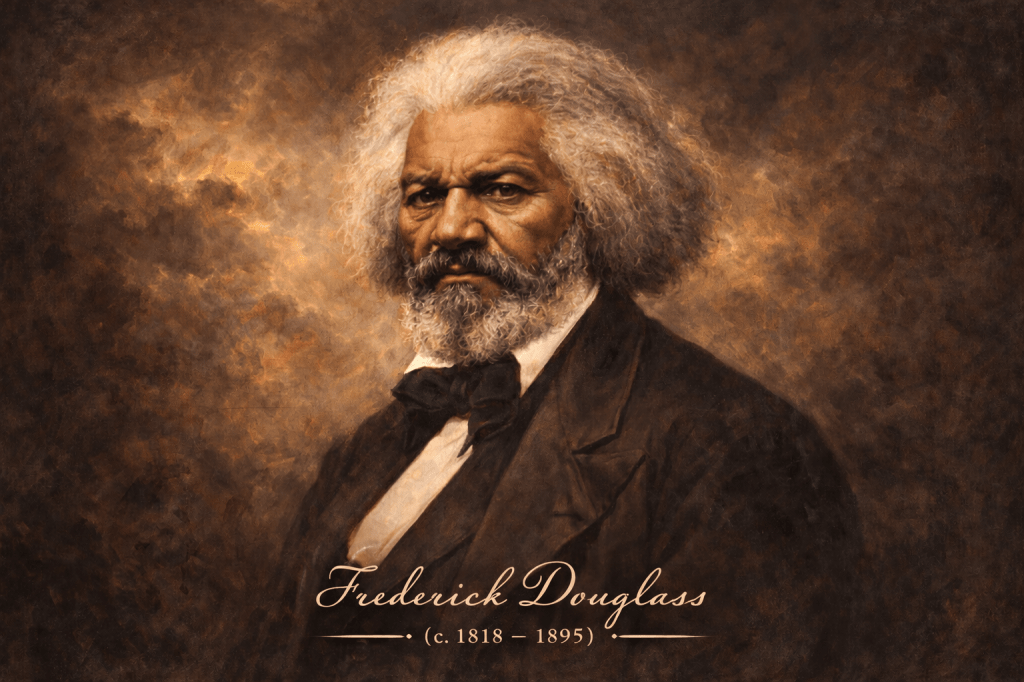
February 20, 1895
When Oratory Became a Force of Language Itself
On February 20, 1895, Frederick Douglass died in Washington, leaving behind one of the most powerful bodies of spoken and written English ever produced. A formerly enslaved man who became an intellectual, statesman, editor, and reformer, Douglass transformed English into an instrument of moral authority, civic argument, and human dignity. His speeches and autobiographies did not merely advocate freedom—they reshaped how persuasive English prose could sound, reason, and move audiences.
1. The Fusion of Oratory and Literature
Douglass proved that spoken rhetoric could achieve the structural sophistication of written prose. His speeches display features now studied as models of persuasive English:
- periodic sentences
- escalating parallelism
- rhetorical questioning
- controlled repetition
His language demonstrated that public speech could rival the artistry of canonical literature while retaining direct emotional force.
2. Autobiography as Political Language
His landmark narrative, Narrative of the Life of Frederick Douglass, established a new standard for life writing in English. He fused personal testimony with philosophical argument, helping standardize autobiographical vocabulary tied to justice and identity, including:
- self-emancipation
- moral awakening
- intellectual liberation
- human agency
These terms and structures became foundational in later memoir, protest writing, and testimonial literature.
3. Precision as Ethical Authority
Douglass’s prose is renowned for clarity, balance, and logical progression. His rhetorical method shaped expectations for serious argumentative English, especially in political and philosophical contexts. Hallmarks of his style include:
- syntactic symmetry
- exact diction
- cumulative argument
- tonal gravity
Modern academic and civic prose still reflects these standards.
4. Expanding the Vocabulary of Freedom
Through speeches, editorials, and essays, Douglass enriched English with a moral lexicon that sharpened public discourse. Words and expressions he helped popularize or redefine in political language include:
- abolition (as a moral imperative, not merely policy)
- bondage vs. freedom as philosophical opposites
- citizenship as an ethical status
- manhood as dignity rather than gender
These usages influenced reform movements across the English-speaking world.
5. The Architecture of Persuasive Rhythm
Douglass mastered cadence—the musical structure of sentences. His oratorical rhythm demonstrated how English could guide listeners’ emotions through sound alone. Scholars often analyze his speeches for:
- rising tonal sequences
- strategic pauses
- climactic phrasing
- sonic emphasis
Such techniques later shaped traditions of political speech in the United States and beyond.
6. Language as Moral Witness
His second autobiography, My Bondage and My Freedom, refined the linguistic strategy of testimony: narrating injustice with restraint so that facts speak louder than outrage. This method influenced journalistic and legal English by modeling:
- evidentiary narration
- restrained indignation
- ethical clarity
- testimonial credibility
Today these principles remain central to investigative writing and human-rights discourse.
7. A Lasting Model of Democratic English
Douglass demonstrated that English could serve as a democratic language—capable of representing the voiceless, confronting power, and articulating universal principles. His legacy persists in modern rhetorical ideals such as:
- speech as civic action
- language as moral instrument
- persuasion as ethical reasoning
- eloquence as responsibility
Conclusion
February 20 commemorates not merely the passing of a historic figure but the enduring presence of a voice that permanently altered the possibilities of English expression. Frederick Douglass showed that language, when wielded with intellect and conviction, can become a form of freedom itself.
His greatest achievement was not only what he said—but how he proved English could say it.
He proved that when language gains conscience, it becomes a force of freedom.
 What Happened on This Day?
Leave a comment