
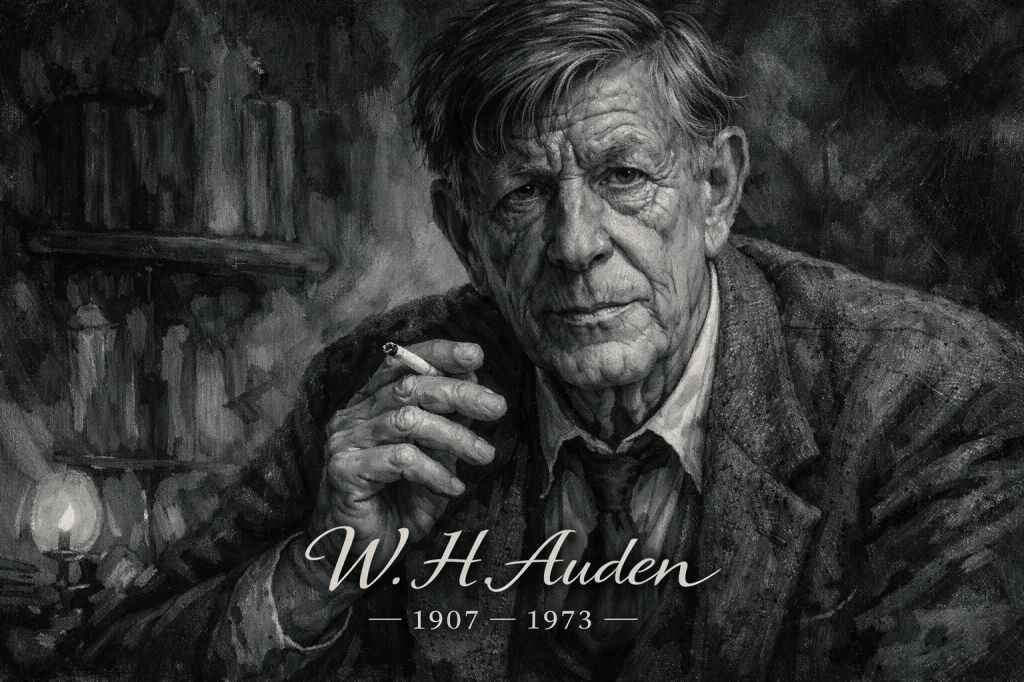
February 21, 1907
When Poetry Became Intellectual Music
On February 21, 1907, in York, a poet was born who would permanently recalibrate the expressive range of modern English. Auden transformed poetry into a medium capable of handling philosophical argument, psychological nuance, political reflection, and conversational immediacy without sacrificing rhythm or elegance. His work expanded not just poetic style but the very functional capacity of English as a literary instrument.
1. A New Kind of Poetic Voice
Auden revolutionized English poetic tone by proving that a poem could think as naturally as it sings. Instead of maintaining a single elevated register, he fused multiple linguistic modes into one fluid voice. Within a single poem, English could move between:
- everyday conversational phrasing
- academic or philosophical diction
- clinical or psychoanalytic vocabulary
- dry irony and understatement
This stylistic hybridity normalized tonal flexibility in English poetry and helped dismantle the rigid divide between “high” literary language and ordinary speech. Later poets—from formalists to free-verse writers—absorbed this principle as a basic modern expectation.
2. Form as a Mode of Thinking
Few writers have demonstrated such effortless command of English verse architecture. Auden wrote with equal authority in ballads, sonnets, villanelles, dramatic monologues, syllabic experiments, and loose conversational free verse. For him, structure was never decorative—it was cognitive. His poems illustrate that in English:
- rhythm can guide reasoning
- stanza shapes can frame argument
- rhyme can sharpen logic
- meter can regulate emotion
Because of this, his work is frequently studied not only in literature courses but in rhetoric and linguistics as evidence that form itself can function as a thinking device embedded in language.
3. Expanding the Intellectual Vocabulary of Poetry
Auden made it stylistically natural for English poetry to include terminology previously considered too abstract or technical for lyric art. His verse comfortably integrates language drawn from philosophy, politics, theology, and psychology—terms such as:
- ideology
- diagnosis
- collective guilt
- existential
By embedding analytical vocabulary inside musical lines, he demonstrated that English could sustain conceptual density without losing lyric grace. This widened the expressive field available to poets and helped establish philosophical poetry as a major modern genre, exemplified in works like The Age of Anxiety.
4. A Transatlantic English Style
After relocating to the United States in 1939, Auden became a linguistic mediator between British and American literary traditions. His later writing blends:
- British metrical discipline
- American idiomatic directness
- biblical cadence
- scholarly precision
This synthesis helped shape an increasingly international literary English during the mid-20th century—one capable of crossing national, academic, and cultural registers without losing clarity or authority.
Conclusion
February 21 marks the birth of a poet who did not merely contribute to English literature—he expanded what English itself could do. Auden proved that the language could be musical yet analytical, ironic yet sincere, conversational yet philosophical.
His lasting achievement was simple but profound: he taught English poetry how to think out loud.
He transformed poetry into music that thinks.
 What Happened on This Day?
Leave a comment