
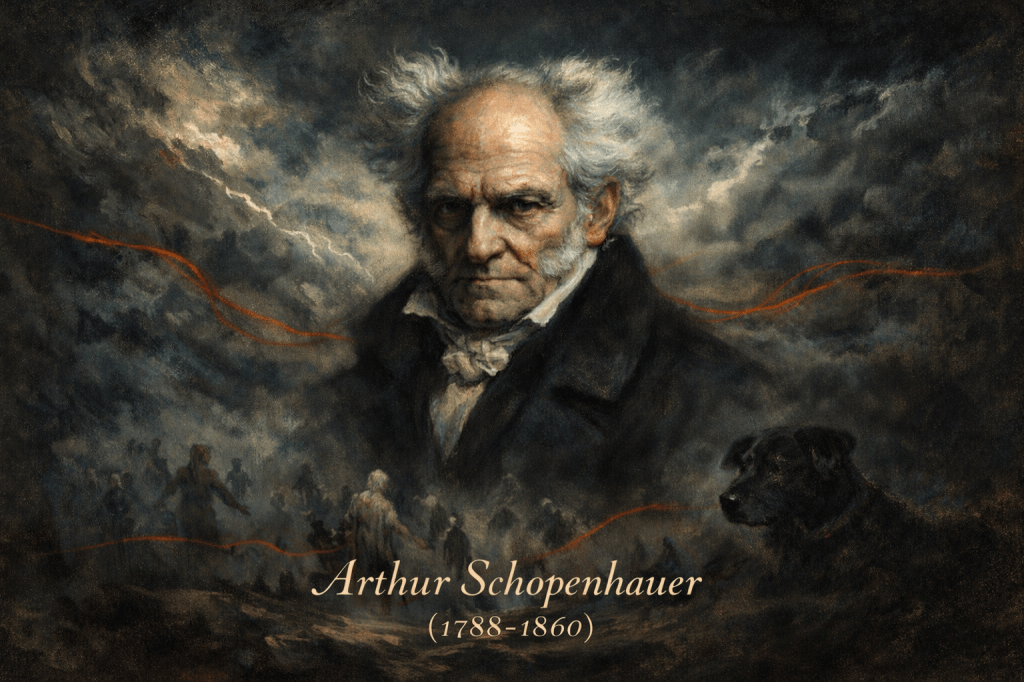
February 22, 1788
When Philosophy Gave English a Language for Pessimism
On February 22, 1788, in Danzig (now Gdańsk), a philosopher was born whose ideas would profoundly reshape the emotional and conceptual vocabulary of English literature. Though he wrote in German, Schopenhauer’s works—especially The World as Will and Representation—entered English through translation and quickly became foundational reading for writers, critics, and intellectuals. His influence was not merely philosophical; it permanently altered the tonal possibilities of English prose and poetry.
1. The Introduction of Philosophical Pessimism into Literary English
Schopenhauer provided English-language writers with a precise vocabulary for articulating existential disillusionment, metaphysical suffering, and psychological introspection. Through translation, terms and concepts such as:
- will (as blind striving force)
- representation (perceived reality)
- negation of desire
- world-weariness
entered literary-critical discourse and imaginative writing. These ideas gave authors a way to describe inner conflict and cosmic indifference with philosophical authority rather than mere emotional impression, deeply influencing later English stylists and essayists.
2. A New Tone: Intellectual Gravity and Controlled Melancholy
Schopenhauer’s prose style—calm, aphoristic, incisive—modeled a form of seriousness that English writers soon adopted. His tone demonstrated that philosophical argument could be:
- lucid without simplification
- severe without ornament
- ironic without humor
- lyrical without sentimentality
This tonal register shaped the English essay tradition and contributed to the emergence of what critics now call intellectual prose: writing that carries emotional weight through clarity rather than rhetorical flourish.
3. Conceptual Tools for Literary Psychology
Long before psychology became a formal science, Schopenhauer supplied English-language literature with analytical language for inner life. His discussions of motive, illusion, desire, and self-deception influenced novelists and critics seeking more precise ways to describe consciousness. English absorbed and normalized interpretive terms such as:
- illusion vs. reality
- hidden motive
- irrational impulse
- subconscious drive
These concepts later became standard vocabulary in literary criticism, character analysis, and narrative theory, allowing English prose to probe interiority with unprecedented subtlety.
4. A Bridge Between Philosophy and Literature
Schopenhauer’s wide readership among writers ensured that philosophy would no longer remain separate from literary art. His work helped legitimize the idea that English literature could engage directly with metaphysical speculation. Through him, philosophical discourse entered novels, poems, and essays not as abstract theory but as living language. This shift helped prepare the intellectual ground for later figures influenced by him, including Friedrich Nietzsche and many modernist writers who treated literature as a vehicle for philosophical exploration.
Conclusion
February 22 marks the birth of a thinker who expanded English not by writing in it, but by transforming what it could express. Through translation, Schopenhauer endowed English literature with a lexicon of introspection, skepticism, and metaphysical depth.
His enduring legacy is linguistic as much as philosophical: he taught English how to articulate despair with precision—and reflection with elegance.
He taught English how to give despair a disciplined voice.
 What Happened on This Day?
Leave a comment