
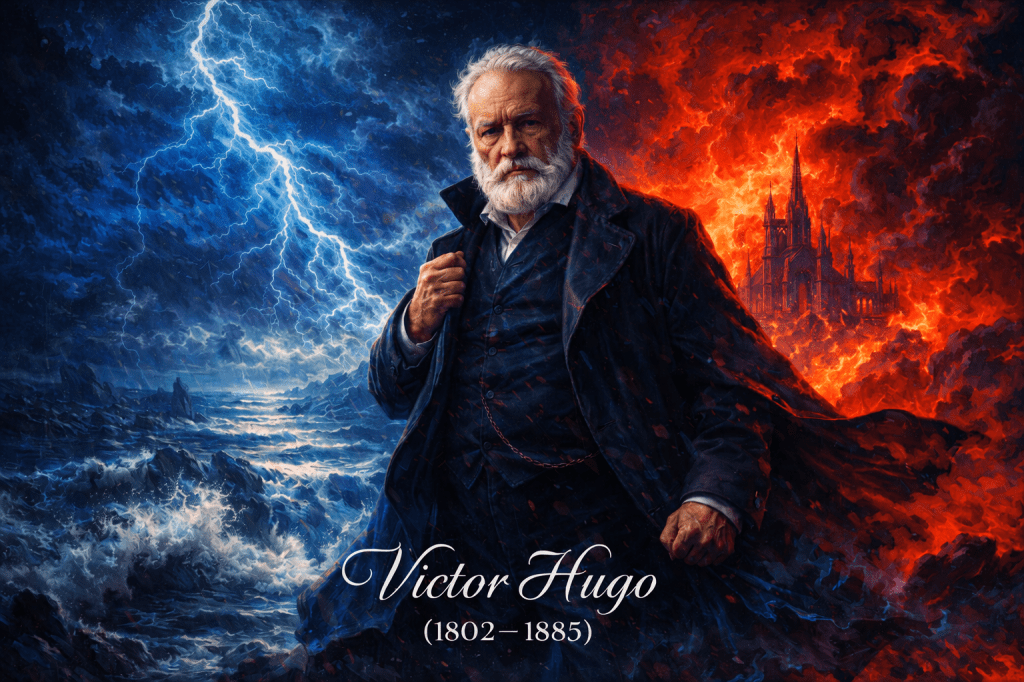
February 26, 1802
When French Romanticism Entered English Prose
On February 26, 1802, in Besançon, Victor Hugo was born. Though he wrote in French, his novels and poetry—especially Les Misérables and The Hunchback of Notre-Dame—were swiftly translated into English and became central to nineteenth-century reading culture in Britain and America. Through these translations, Hugo profoundly influenced the emotional scale, structural ambition, and moral rhetoric of English fiction.
1. Expanding the Scale of the Historical Novel
Hugo demonstrated that fiction could be architectonic—vast in scope yet unified by moral vision. English Victorian novelists absorbed this sense of magnitude.
Narrative techniques reinforced in English literature:
- panoramic historical backdrops interwoven with intimate character arcs
- dramatic contrasts between social classes
- digressive chapters functioning as philosophical essays
- symbolic settings (cathedrals, barricades, prisons) anchoring theme
- heightened emotional stakes within political turmoil
Writers such as Charles Dickens drew inspiration from Hugo’s fusion of social critique and melodramatic momentum, adopting similarly expansive plotting and vivid urban description.
2. Melodrama as Moral Instrument
Hugo elevated melodrama from sensationalism to ethical theater. His narratives use extreme suffering, coincidence, and redemption not merely for spectacle but for moral persuasion.
Stylistic and rhetorical features absorbed into English fiction:
- sharply drawn heroes and villains embodying abstract principles
- climactic confrontations staged as moral reckonings
- sentimental pathos used to awaken social conscience
- lyrical descriptions intensifying emotional resonance
- recurring motifs symbolizing justice, mercy, and fate
Victorian English prose adopted this heightened emotional register, allowing novels to function as vehicles of reform as well as entertainment.
3. Romantic Individualism and the Outcast Figure
Hugo’s protagonists—convicts, exiles, revolutionaries, deformed bell-ringers—center the dignity of the marginalized. English literature inherited this Romantic emphasis on the morally complex outsider.
Conceptual and thematic influence on English narrative:
- sympathy for the criminal as social victim
- fascination with exile, imprisonment, and redemption
- exploration of conscience as dramatic engine
- blending of personal destiny with historical upheaval
- elevation of suffering into spiritual transformation
This framework resonated strongly in nineteenth-century England, where industrialization and social inequality demanded new narrative forms capable of addressing injustice.
4. Stylistic Grandeur and Oratorical Prose
Hugo’s prose is marked by rhetorical amplitude—long, rolling sentences, elevated diction, and prophetic tone. In translation, this grandeur influenced English writers to embrace a more expansive and declarative style.
Lasting linguistic effects:
- increased tolerance for digression within narrative
- poetic imagery embedded in realist fiction
- moral aphorisms integrated into storytelling
- oscillation between intimate detail and sweeping overview
- use of architecture and landscape as metaphors for civilization
His example encouraged English prose to be bold, declarative, and emotionally unapologetic.
Final Thoughts
February 26 marks the birth of a writer who reshaped English literature without writing in English. Through translation, Victor Hugo expanded the scale and intensity of the Victorian novel, reinforcing the idea that fiction could be at once historical chronicle, social critique, and moral epic.
Hugo taught English narrative how to be grand—how to speak not only of individuals, but of nations, revolutions, and the human conscience itself.
He wrote in French—yet taught English fiction how to feel on a grand scale.
 What Happened on This Day?
Leave a comment