
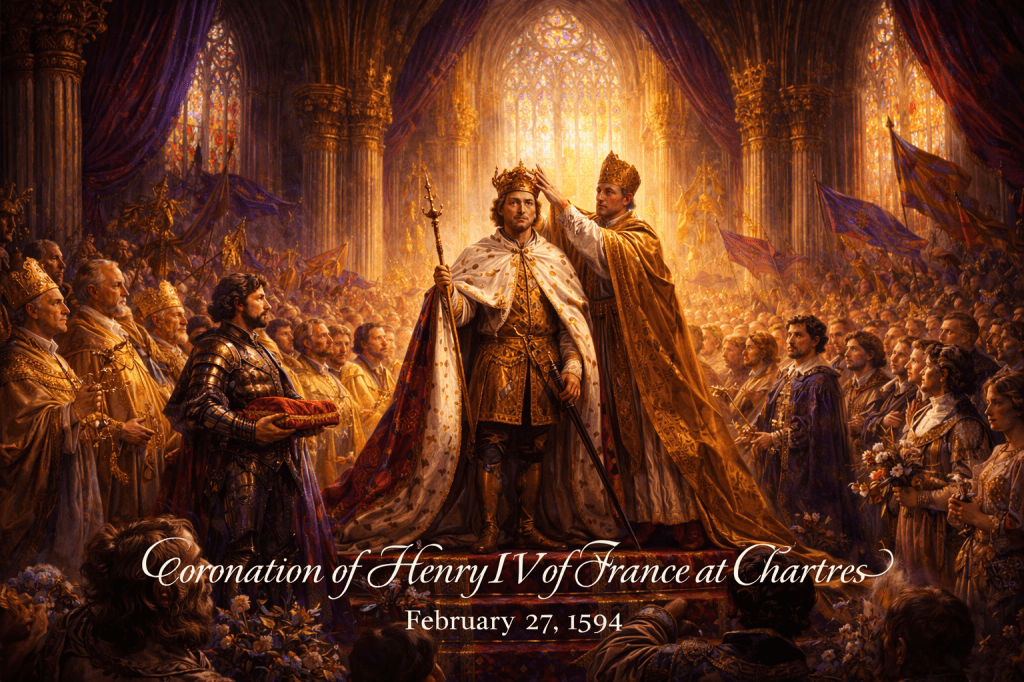
February 27, 1594
When Continental Religion and Politics Sharpened Elizabethan English
On February 27, 1594, Henry IV was crowned at Chartres after decades of brutal religious civil war in France. A former Protestant (Huguenot) leader who converted to Catholicism to secure the throne, his accession reverberated strongly in England under Elizabeth I. Though a French political event, it intensified English debates about monarchy, legitimacy, religious allegiance, and political pragmatism—leaving a clear imprint on late sixteenth-century prose.
1. Intensifying Protestant–Catholic Polemic in English Writing
Henry’s conversion became a lightning rod in English theological and political discourse. Writers debated whether his actions represented pragmatic wisdom or dangerous apostasy, and this sharpened both vocabulary and argumentative method.
Linguistic consequences in English discourse:
- More forceful use of terms such as conversion, apostasy, conscience, and toleration
- Expansion of polemical pamphlet literature responding to continental events
- Greater structural rigor in argumentative prose (claim, rebuttal, counterclaim)
- Heightened moral rhetoric surrounding monarchy and divine favor
- Clearer differentiation between spiritual conviction and political expediency
As a result, English religious prose became more analytical, more confrontational, and more rhetorically disciplined.
2. Expanding Political Vocabulary about Sovereignty and Legitimacy
Henry IV’s contested succession prompted English observers to reexamine their own assumptions about kingship and lawful rule. His ascent after civil war offered a living case study in sovereignty under pressure.
Political language reinforced in English writing:
- Increased discussion of divine right, legitimacy, and lawful succession
- Sharpened distinctions between rebellion, usurpation, and rightful claim
- Growing attention to national unity after factional conflict
- More pragmatic treatment of monarchy as political institution
- Development of comparative political analysis across European states
English political prose became more internationally aware and more conceptually nuanced in addressing authority and state stability.
3. Influence on Historical and Dramatic Expression
Continental instability, including Henry’s path to the throne, shaped the imaginative climate of English literature. Political anxiety and religious division were not abstract themes but lived realities.
Literary and rhetorical effects:
- Dramatic focus on divided loyalties and contested kingship
- Speeches emphasizing reconciliation after civil discord
- Exploration of conscience as both personal and political force
- Blending of theological language with secular governance concerns
- Heightened realism in portrayals of faction and ambition
Playwrights such as William Shakespeare, writing during this charged atmosphere, produced histories and tragedies deeply concerned with legitimacy, order, and moral authority.
4. Toward the Language of Toleration and Political Pragmatism
Henry’s reign—later associated with policies aimed at religious coexistence—contributed indirectly to evolving English discussions about governance in a divided society.
Long-term linguistic implications:
- Normalization of toleration as a serious political concept
- Clearer articulation of the distinction between private belief and public loyalty
- Acceptance of compromise as a tool of national stability
- Emergence of more secular frameworks in political reasoning
- Gradual shift from purely doctrinal argument to policy-based analysis
This development prepared English prose for the increasingly complex political philosophy of the seventeenth century.
Final Thoughts
The coronation of Henry IV on February 27, 1594, was more than a French ceremony. It sharpened English political and religious vocabulary, strengthened polemical prose, and contributed to a more analytical, internationally conscious style of Elizabethan writing.
Through continental crisis, English prose matured—becoming more precise, more argumentative, and more aware of the delicate balance between faith and power.
A French crown helped forge the sharper edge of Elizabethan English.
 What Happened on This Day?
Leave a comment