
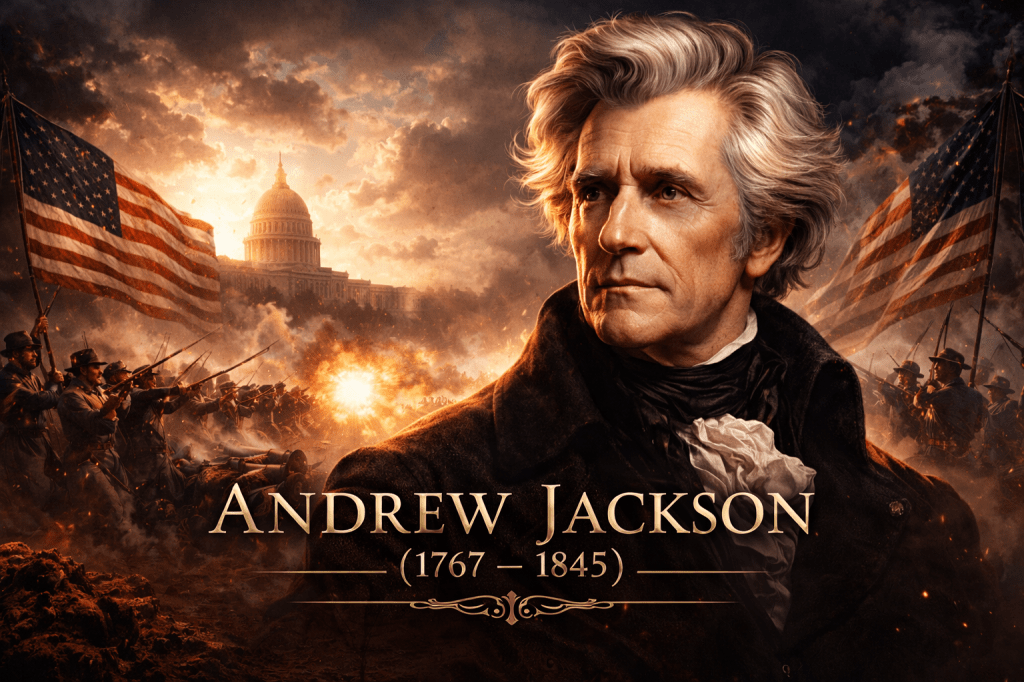
March 15, 1767
When Political English Turned Toward Direct, Popular Rhetoric
Born on March 15, 1767, Andrew Jackson would become the seventh president of the United States and one of the most influential figures in the development of American political rhetoric. Unlike many earlier statesmen who favored highly formal, classical styles of speech, Jackson cultivated a more direct, forceful, and populist language that appealed to ordinary citizens. His speeches, letters, and public statements helped shift the tone of American political communication toward a simpler and more emotionally charged form of English.
1. Popularizing Plain Political Language
Before Jackson’s rise, American political discourse often reflected the formal rhetoric of Enlightenment thinkers and classical education. Jackson’s style was noticeably different—shorter, clearer, and more direct.
Key characteristics of Jacksonian political language include:
- straightforward sentence structures
- strong declarative statements
- emotionally charged appeals to the people
- reduced reliance on classical references or scholarly vocabulary
- a tone emphasizing strength, resolve, and patriotism
This rhetorical shift helped make political speech more accessible to a broader public audience.
2. Expanding the Vocabulary of American Populism
Jackson’s political movement helped popularize terms and expressions associated with democratic participation and popular authority.
Language associated with Jacksonian politics includes:
- the common man
- popular sovereignty
- majority rule
- executive authority
- the people’s will
These expressions became central to American political debate during the nineteenth century and remain common in political discourse today.
3. Shaping the Tone of Presidential Communication
Jackson’s presidency helped establish the idea that a political leader could speak directly and forcefully to the public, rather than primarily through elite institutions or formal documents.
This influence contributed to later traditions in American political speech, including:
- speeches designed for mass audiences rather than elite listeners
- rhetoric appealing to national identity and shared struggle
- simplified language intended for wider literacy levels
- emotionally persuasive language aimed at mobilizing public opinion
Such strategies became a standard feature of democratic political communication.
4. A Lasting Influence on American Political Oratory
Jackson’s rhetorical style left a lasting mark on American political culture. Later leaders across the political spectrum adopted elements of the plainspoken, populist tone that his public persona embodied.
Long-term linguistic influence includes:
- the normalization of direct political speech
- rhetorical appeals framed around ordinary citizens and national identity
- a tradition of forceful presidential messaging
- political language designed to resonate with broad popular audiences
This shift helped shape the style of American political communication for generations.
Final Thoughts
Andrew Jackson’s birth in 1767 marks the emergence of a political figure who helped reshape the tone of American public speech. By favoring clear, direct, and emotionally powerful language, he helped move political rhetoric away from elite formality and toward a style meant for the broader public.
In doing so, Jackson contributed to the development of a distinctly American tradition of populist political English, one that continues to influence political communication today.
When politics stopped speaking to elites—and started speaking to the people.
 What Happened on This Day?
Leave a comment