
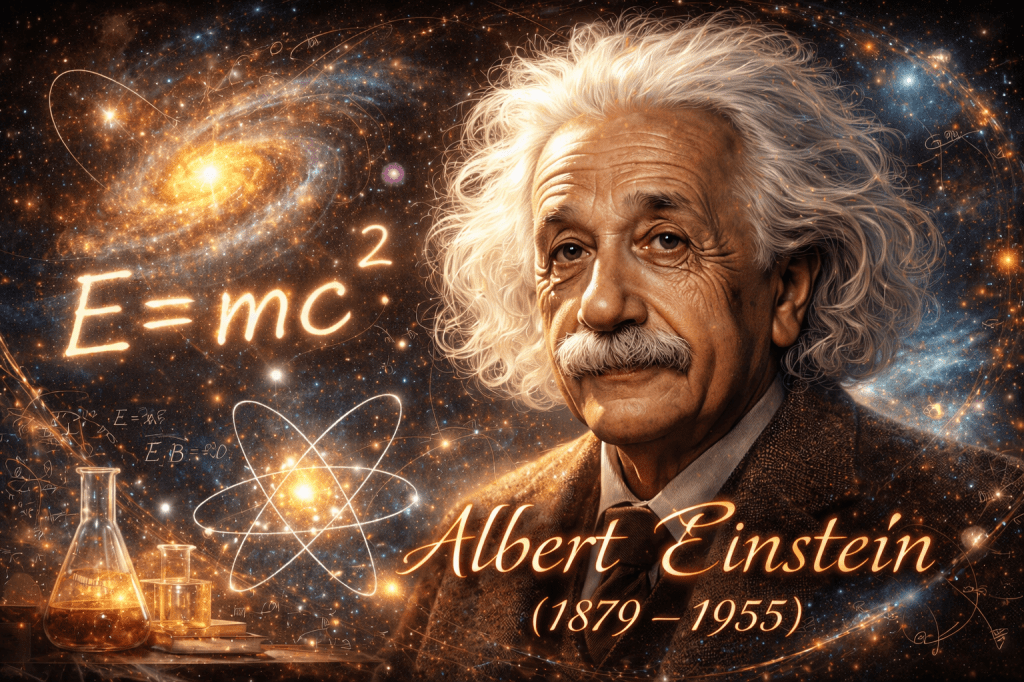
March 14, 1879
When the Vocabulary of Space, Time, and the Universe Changed
Born on March 14, 1879, in Ulm, Albert Einstein became one of the most influential scientific thinkers in history. Through his development of the Theory of Relativity, Einstein fundamentally reshaped how scientists understand space, time, energy, and gravity. Although originally writing in German, his work quickly entered the global scientific community through English translations, profoundly influencing the vocabulary, explanatory style, and conceptual language used in modern physics writing.
1. Introducing Foundational Terminology into English Physics
Einstein’s theories brought with them a set of concepts that required new technical language. As his work spread through English-language journals and textbooks, many of these expressions became standard terminology in modern physics.
Important terms associated with Einstein’s work include:
- relativity
- spacetime
- relativistic effects
- mass–energy equivalence
- time dilation and length contraction
- curvature of spacetime
These expressions became essential to the way physicists describe the structure and behavior of the universe.
2. The Global Spread of the Equation E = mc²
Perhaps the most famous scientific expression ever written is Einstein’s equation E = mc², which states that energy and mass are interchangeable forms of the same physical quantity.
Its influence extends far beyond academic physics.
The equation helped introduce and popularize concepts such as:
- mass–energy equivalence
- the enormous energy potential within matter
- scientific discussion surrounding nuclear energy
- simplified symbolic expressions used to explain complex physical laws
Today, the formula is one of the most recognizable pieces of scientific language in the world.
3. Influencing the Style of Modern Scientific Explanation
Einstein’s writing and lectures also influenced how scientific ideas are explained in English-language scholarship and popular science. His work encouraged physicists to combine mathematical precision with conceptual clarity.
Characteristics of Einstein-influenced scientific prose include:
- careful distinction between classical physics and relativistic physics
- conceptual explanations accompanying mathematical formulas
- thought experiments designed to clarify abstract ideas
- clear terminology describing physical relationships
One famous example is Einstein’s use of thought experiments—imaginative scenarios that allow readers to visualize complex principles such as relativity.
4. A Central Figure in English-Language Scientific Culture
Although born in Germany and later working in several countries, Einstein became one of the most frequently cited scientists in English-language academic literature. His influence extends across physics, cosmology, philosophy of science, and popular science writing.
His legacy in English scientific discourse includes:
- shaping modern discussions of cosmology and gravity
- influencing the vocabulary used to describe black holes, gravitational waves, and spacetime geometry
- inspiring generations of physicists writing and publishing in English
- becoming a cultural symbol of scientific genius
Through these influences, Einstein became one of the most recognizable intellectual figures in modern global culture.
Final Thoughts
Albert Einstein’s birth in 1879 marks the arrival of a thinker who transformed both science and the language used to describe it. Through the theory of relativity and concepts such as spacetime and mass–energy equivalence, Einstein helped establish the vocabulary that modern physics continues to rely upon.
Today, his ideas—and even his equations—remain among the most widely recognized elements of scientific language in English.
One mind didn’t just change physics—
it changed the words we use to describe the universe.
 What Happened on This Day?
Leave a comment